Prestashop FB Wall Post Module – User Manual

1.0 Introduction

PrestaShop Fb Wall Post User Manual provides an easy to use and configure feature to the Prestashop store owners to automatically post your products, categories and brands on your official Facebook page. The innovative and easy to understand and configure module helps in boosting the customer engagement on the social media platform in just a few button click.

1.1. Project Objectives

The module can be used by the store owner to achieve following things:

  1. It allows the admin to post product, category and brand automatically on your Facebook store.
  2. The Module even allows the admin to post the new products on the Facebook page of the store
  3. The admin can hide or display the price of the product.
  4. You can even get the Low Stock post with the help of this module.
  5. The admin can even post the discount coupons.

2.0 Installation

Follow the following steps to install the extension:

  1. Unzip the Facebookwallpost.zip file. It would contain files and folders.
  2. Copy all the files and folders of unzipped folder into your store “modules” directory on the path – Root Directory/modules/.
  3. The module is now ready to be installed in your store. You can find it in Store Admin -> Modules and Services.
  4. Click on “Install” button to install the module. It would show a pop-up for your confirmation. Click on “Proceed with the installation” option. This step will install the module and show notification – “Module(s) installed successfully”.

3.0 System Setup

Before proceeding ahead, it is important to know that what is the correct flow of actions to setup this system as there are several things which are dependent on other things and if we do not take care of them then it would become difficult to process smoothly or may be error prone.
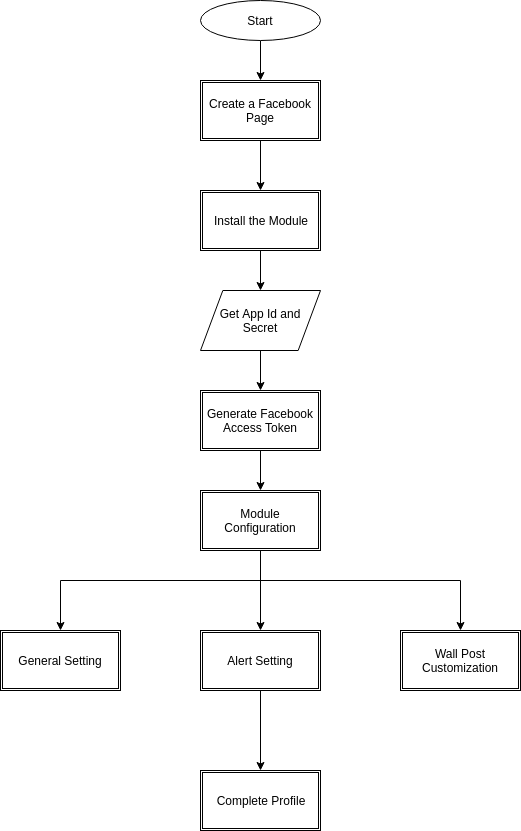
4.0 Admin Interface

The admin interface of the module is completely configurable. Click on the ‘Configure’ next to the module in the admin panel.

4.1 How To Start configuration process?

After clicking the “Configure” button, the admin will be redirected to the Configuration page of the module. It offers the below-listed configuration options:
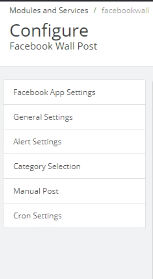
  • Facebook App Setting
  • General Setting
  • Alert Setting
  • Category Setting
  • Manual Post
  • Cron Setting

Let us discuss each options one-by-one.

Facebook App Setting:- The Facebook App Setting includes the process to the sync the Facebook profile of the store owner. Follow the below-mentioned steps:-
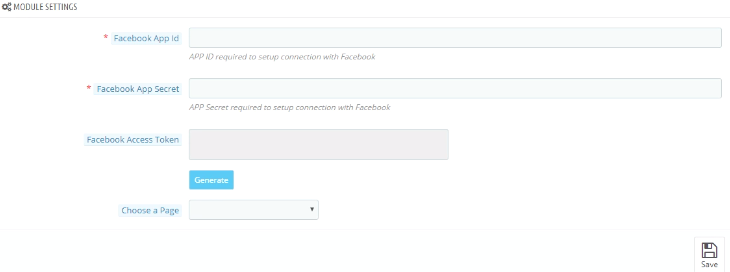
Facebook App Id:- This field is for Facebook App Id created for this module. Enter the Facebook App Id in the first column. In order to find the App id, go to the dashboard of your Facebook App. Copy the app id from the column shown in the image below and paste it in the setup page of the module.
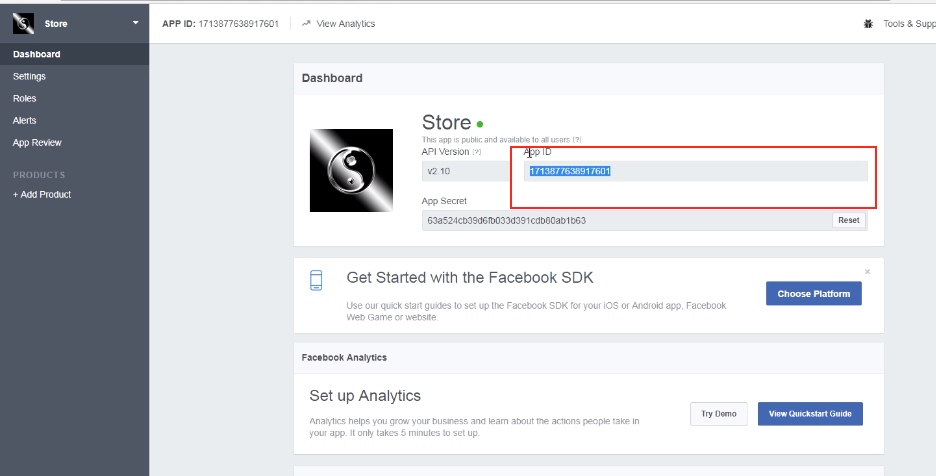
Facebook App Secret:- This field is for Facebook App Secret created for this module. Copy the App Secret from the next column as shown in the image below.
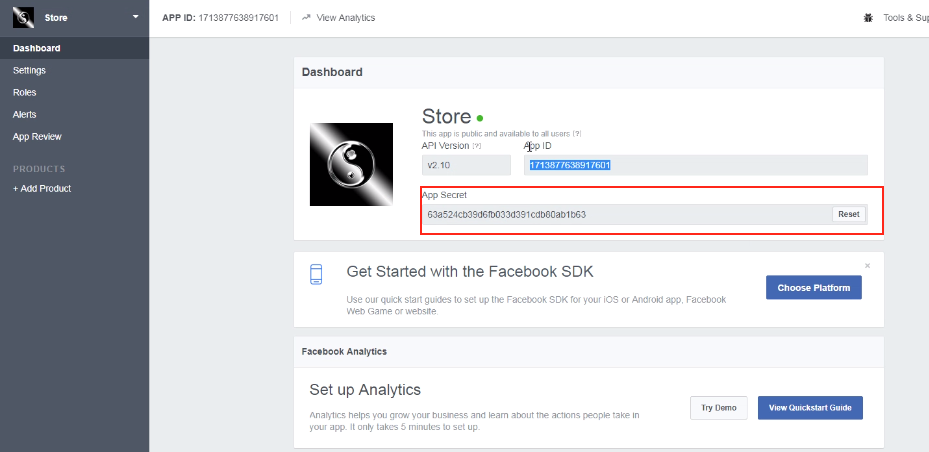
‘Save’ the changes made in the configuration setting.

Facebook Access Token: The next thing you need to do is generate the ‘Facebook Access Token’. Once the changes are saved, click on the ‘Generate’ button. This button will be disabled by default. It will be enabled only when the App Id and App Secret is entered and the changes have been saved.
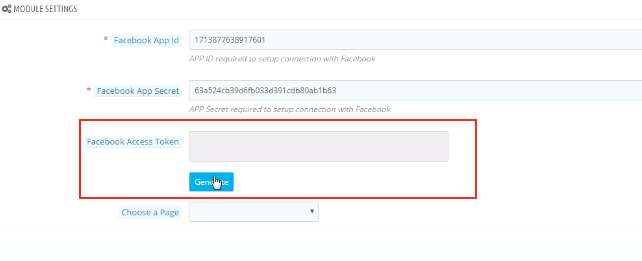
As you click on the button, you will get a pop-up for Facebook Login. Log in your Facebook store and the access token will be generated.
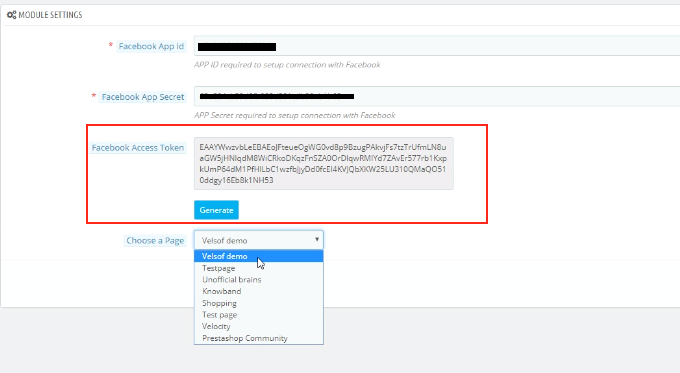
The module is now synced with your Facebook store and is ready for use.

‘Choose the Page’ from the options given in the dropdown list and save the changes. The posts will be displayed on the page selected by you.

4.2 General Settings

The module is now successfully synced with the Facebook Page of the admin.
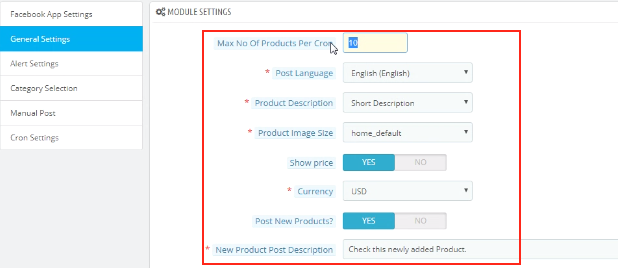
The General Setting allows to make the necessary changes in the look and feel of the FB Wall Post module. Here are some of the options offered.

  1. You can change the ‘Maximum number of Products Per Cron’.
  2. You can select the ‘Post Language’.
  3. The admin can set the ‘Product Description’.
  4. Select the ‘Product Image Size’ from the options offered in the dropdown list.
  5. The ‘Show Price’ option enables you to either display or hide the price of the products.
  6. The admin can select the desired ‘Currency’ from the option available.
  7. ‘Post New Products?’ option asks you if you want to Post New products on the Facebook Wall or not.
  8. In case you are posting the new product, then, you can even set the description for the same in the ‘New Product Post Description’.

Click on the ‘Save’ button in order to save the changes made by you.

4.3 Alert Setting

Here, you can enable/disable the option to send Stock Ending Alert Wall Posts.
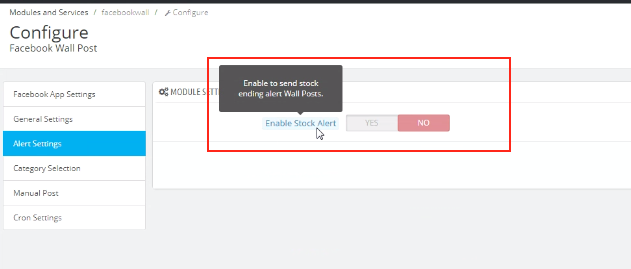
In case, you enable this option, then, you’ll be asked a series of question which includes the following.
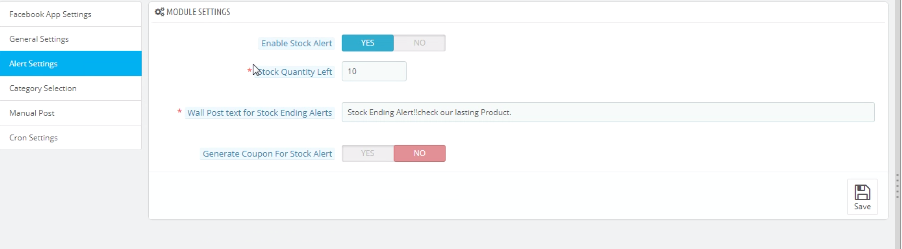
  1. Stock Quantity Left: You can enter the quantity of the stock below which the alert will be send on the wall post.
  2. Wall Post Text for Stock Ending Alert: You can enter the text that you want to be displayed when the inventory falls below a certain limit.
  3. Generate Coupon For Stock Alert: You can enable it if you want to send coupon along with the Alert. In case you enable the coupon code option, the module provides an option to customize the vouchers as well.

  1. Voucher Name: The name of the voucher can be entered in the first column. You can even choose from the different language options available and select the one as per your requirement.
  2. No. Of Vouchers: Allow you to select the number of vouchers you want to send.
  3. Voucher Type: You can select the type of voucher you want to send. It can ‘Absolute’ or ‘Percentage’.
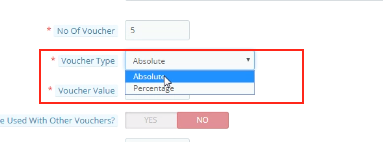
  1. Can be used with Other Vouchers: You can enable this option if the voucher can be send with other vouchers as well.
  2. Voucher Validity: Set the duration for which the voucher is valid is here.

4.4 Category Selection

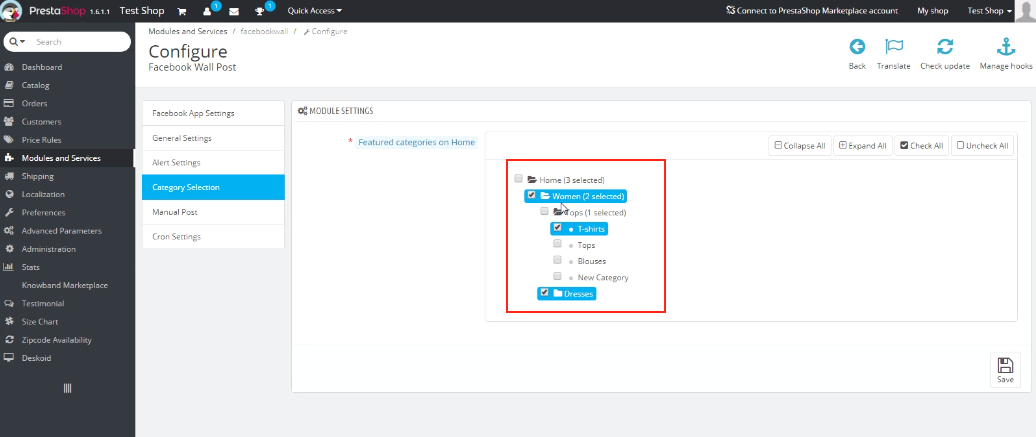
You can select the categories you want to display on the Facebook wall post here. Check the options that you want to display. Only those products whose default category is selected in this section will be posted on the Facebook Wall.
4.5 Manual Post

This option allows you to customize the wall post manually.

  1. Search Product: It will show the dropdown of various product options. You can select the one as per your wish.
  2. Wall Post Text For Products: Set the text that you want to display on the wall post. Click on ‘Post Product Now’ button and the products will be posted.

  1. Search Category: It will show the dropdown of various category options. You can select the one as per your wish.
  2. Wall Post Text For Categories: Set the text that you want to display on the wall post. Click on ‘Post Category Now’ button and the products will be posted.

  1. Search Brand: It will show the dropdown of various brands options. You can select the one as per your wish.
  2. Wall Post Text For Brands: Set the text that you want to display on the wall post. Click on ‘Post Brand Now’ button and the products will be posted.

4.6 Cron Selection

Add the cron configuration to your store in order to sync the products and send Facebook wall posts to your customers automatically according to your setting.

  • ‘Sync Product Manually’ will allow you to sync the products. The products will then get listed below. The admin can even delete the listed products from the table by clicking on the ‘Delete’ icon.

  • On clicking the ‘Send Post Manually’, the products will get posted on the Facebook Wall of the admin.

5.0 Facebook Tab UI

Once you have already configured Prestashop Facebook Wall Post module and synced with the Facebook profile, the changes will be shown in the front end.

5.1 Home Page

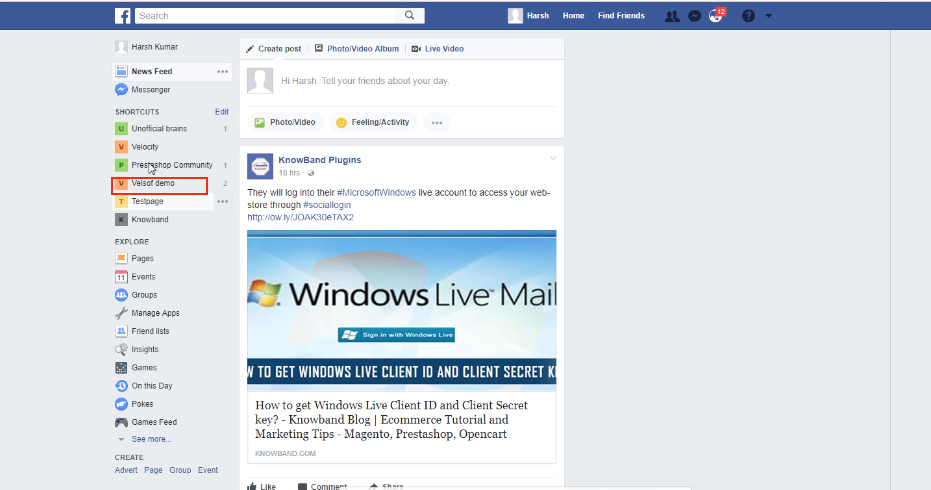
Home page will have the UI similar to mentioned below.
5.2. Selected Page

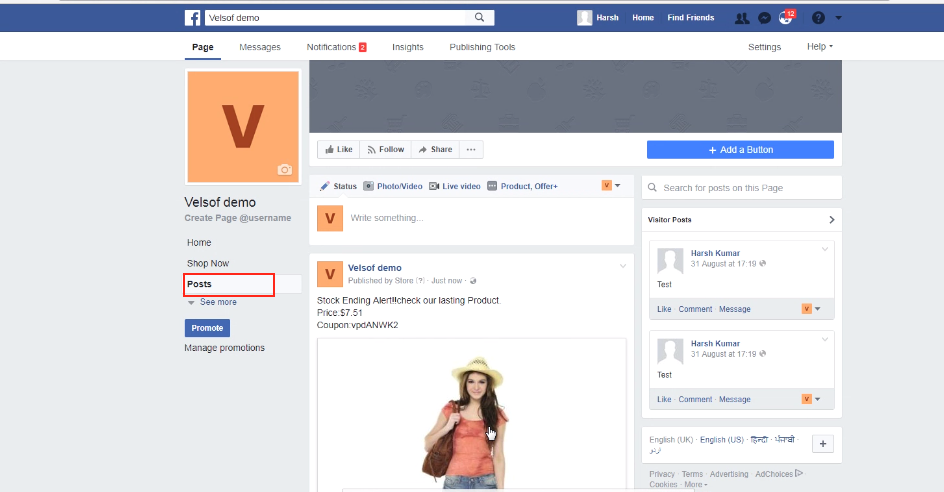
Go to the page which you selected earlier in the admin interface. The products posted will be shown on the wall post of the page.
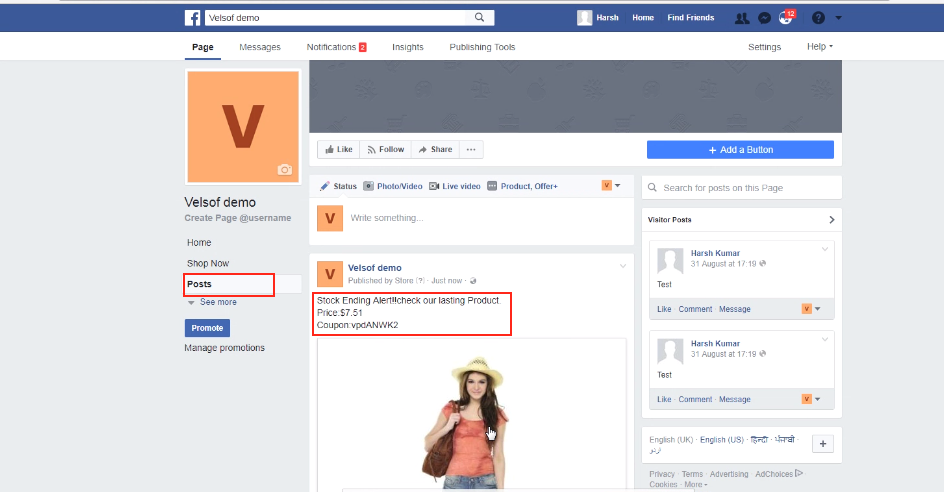
  • As you can see in the image below, the Stock ending alter has been posted on the wall along with the Product Price and the Coupon Code.
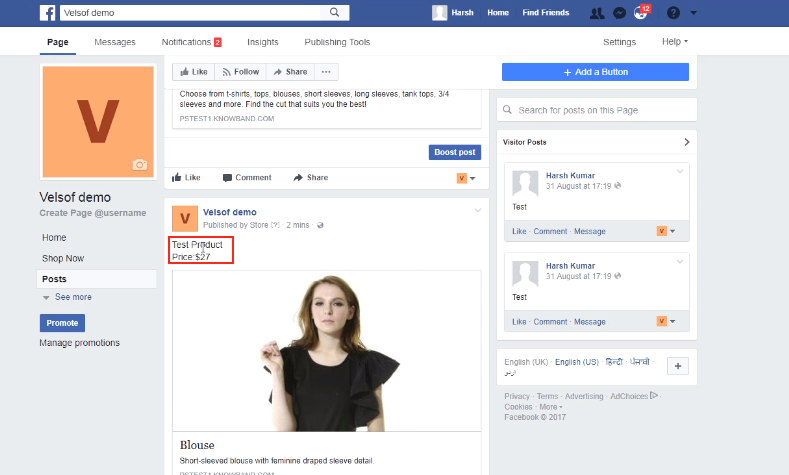
  • The Product along with the price can be seen on the wall of the Facebook.
  • This is how the brand posted on the wall will look like.
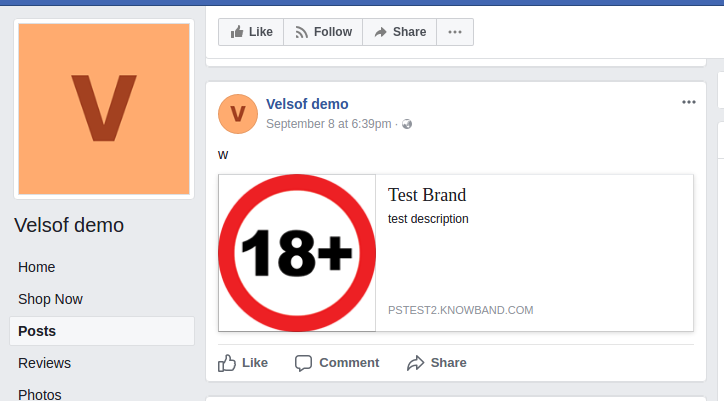
  • The category to be displayed on the Facebook will be seen like this in the front end.


You Might Also Like:

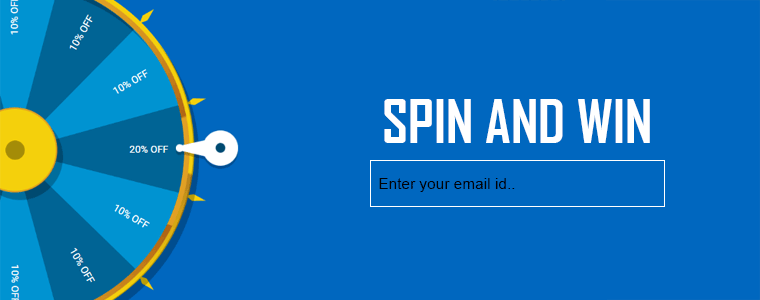
5 Ways Prestashop Spin and Win Popup Module can boost your Conversions

In the competitive eCommerce ecosystem, staying ahead of trends and in sync with the hot and happenings of the industry. Tapping the psychology of the site visitors and selling them the idea instead of the products is the best way to have an edge. The spin and win contest is one of the trends that has reaped results for a lot of players in the industry. Prestashop Spin and Win Module is one such addon that can help boost conversions.

Features of PrestaShop Spin and Win Popup Module

The Spin and Win Module is a 3-in-one PrestaShop addon that you can use as an Entry popup, Exit popup, and email subscription module.

This amazing gamified tool is very helpful in increasing customer engagement in your store. You can offer various discounts to your customers when they spin the wheel to win a reward. This Wheelio like module is made for every eCommerce store that is having customer engagement issues and a higher bounce rate.

  1. Use it as an Entry popup, Exit popup, and email subscription module
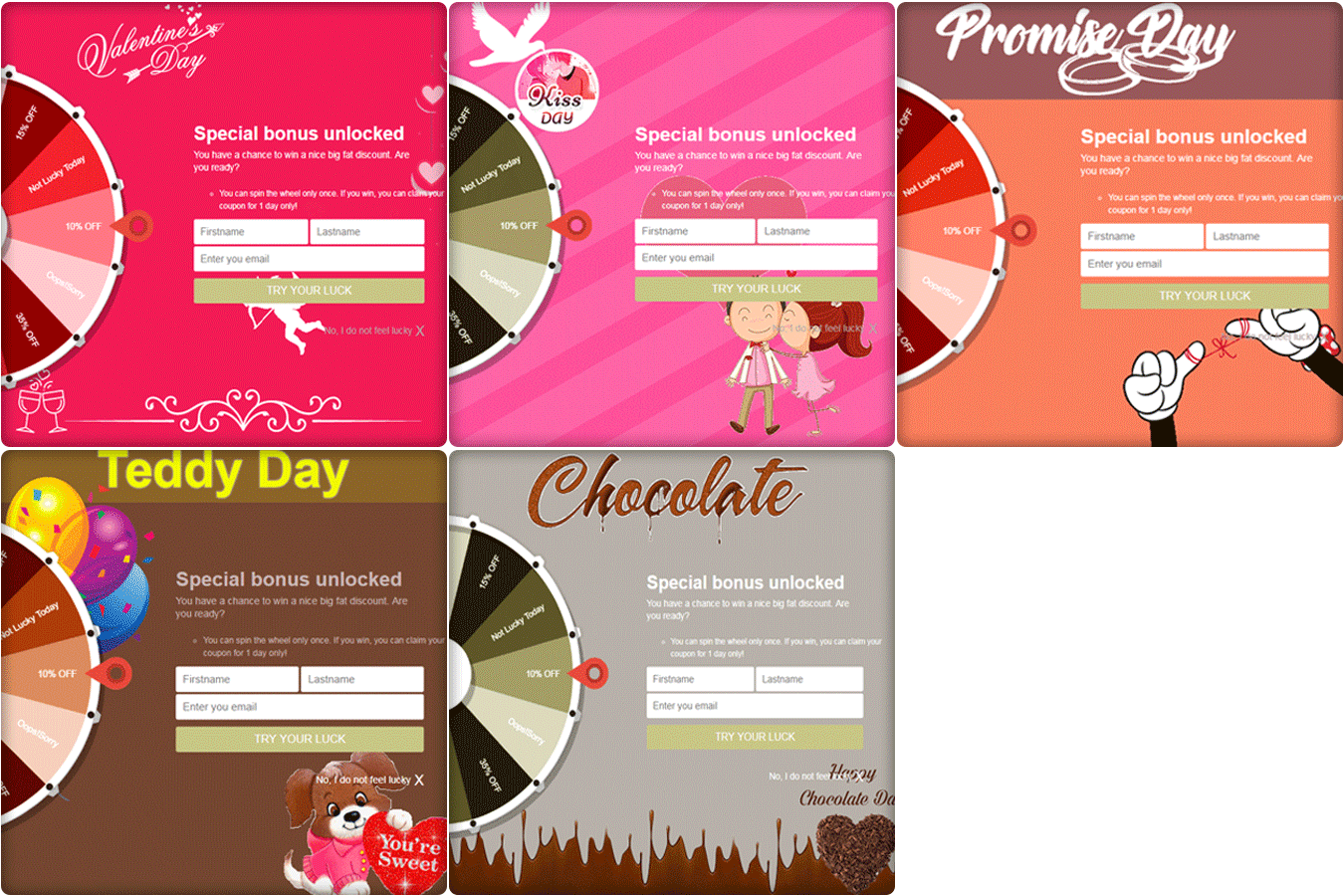
  2. Several themes for every occasion like events, festivals, holiday season, such as for Halloween, Easter, Black Friday, Christmas, New Year, and others, etc.
  3. Gamified Popup tricks the customer’s psychology and keeps them engaged in your store.
  4. You can edit the offers displayed on the slices of the wheel.
  5. The wheel can have different numbers of slices as you want and change the cart rules.
  6.  Control the display frequency, gravity, and position, of the Prestashop Popup module.
  7. You can schedule the module and themes prior to the occasion in case you have a busy schedule.
  8. It effortlessly synchronizes the email IDs with Mailchimp, Klavio, and Sendinblue integrators.
  9. The Spin and Win Popup supports multiple languages and is compatible will all PrestaShop themes.

Wonder how can this spin and win module help increase the conversions. Check out the points about this Spin and Win Popup module mentioned below to know the reasons that make it a revenue booster.

5 Ways Prestashop Spin and Win Popup Module can boost your Conversions

Increases the website traffic

It is a proven fact that a better and attractive UI of the site can lure more customers. Even though there are many other factors that affect the purchase decision of the customers, the look and feel of the site is one aspect that can entice them to stay in the store. Any tedious or monotonous-looking site can put down the browse intention of your target audience. The playful way to give away the offers is something that intrigues the customers to visit your site again and again. Not just this, as per a psychological study, any free coupon is as good as no coupon for online shoppers. Hence, the entire scenario should be structured in such a way that the customer feels as if he/she has stricken a deal or bargain. And what can be better than making them spin the wheel to get the offers?

Better customer engagement

As mentioned above, a better UI is an effortless way to keep the visitors engaged for a longer period of time. While a coupon 10% discount is considered worthless by the shoppers in general, the fun-filled way to get the same offer will make it worthwhile. Another striking factor of the spin and win popup module is that is a better option than the exit pop-ups. Add a spin and win module to your online store and this can effortlessly cripple the exit intent of the visitors. Greater customer engagement is the key to greater conversions. So, the playful spin and win popup wheel option will ultimately aid your conversions.

Aids Email marketing and remarketing

The customers can spin the wheel of the spin and win module only after entering the email ids. Hence, the exit pop-up can even increase the database of the customer is you have. Along with this, the store owners get an additional feature in this spin and win module. The visitor can spin the wheel only with a single id. Hence, one person can’t claim multiple coupons. Moreover, the playful spin and win popup module can get the customers hooked and they even tend to enter multiple email ids. Hence, this facilitates the email marketing campaign of the store owner. The promotional emails can be sent to a greater audience and hence the chances of conversions increases ultimately.

Reduces the bounce rate due to annoying pop-ups

The pop-ups have been used for a very long time to curb the exit intention of the visitors. However, it was even accused of annoying the customers. Prestashop Exit Spin Wheel module is one to stop the visitors from exiting the site without even annoying them. The best thing about this spin and win popup module is that the store owners can even regulate the frequency of the wheel display. Thus, the alluring spin and win module reduce the bounce and exit rates. It is obvious that the more time the customers spend on the site, the more will be the chances of conversions.

Facilitates the purchase decision of the customers

The prizes won by spinning the wheel can be easily used while shopping. The coupon code is generated automatically in this spin and win popup module. The customers can copy the code and paste it in the Voucher Code area of the PrestaShop checkout page. Not just this, the customers are even notified about the coupon code through email. This can facilitate the purchase decision of the visitors and compel them to go to the checkout page.

Final say 

The best way to enhance the conversions and revenue is to keep the customers engaged for a longer duration. While the classic exit pop-ups are considered annoying, Prestashop Spin and Win Module by Knowband are some of the most attractive ways to reduce the exit rate and lure visitors to the checkout page. You can use different themes for various occasions. Voila, This module can keep you ahead of your competitors.

You Might Also Like:

What is Google AMP and how will it impact eCommerce Businesses?

The ever-changing market and consumer behavior have compelled the eCommerce store owners to stay on their toes. With the aim of easing out the pressure of the online business units, Google keeps on updating its policies and schemes from time-to-time. The quest to stand out in the competitive market will be easier if the eCommerce store owners stay abreast of Google’s update. Google AMP or Accelerated Mobile Pages is one of the updates of Google that is expected to take the online market by storm

Google AMP project was launched in the year 2016 but was restricted to a few segments. However, the project now provides an option to the eCommerce companies to build their sites in the AMP format.

What is Accelerated Mobile Pages (AMP)?

Google AMP is an initiative by Google for publishers to make web pages load faster on mobile devices. With M-commerce in trend, AMP proves to be very beneficial to take mobile shopping to the next level.

Around 40 to 50% of the sites are abandoned because of the slow load time, especially in the handheld devices. Catering to this prominent problem of the mobile site owners, this project of Google makes the mobile pages load faster.

The remarkable load time is achieved in two ways. First of all the developers are required to create their pages in accordance with the guidelines prescribed by Google. There is a narrow set of web technology that is required to be used during the web page creation. This technology forbids most of the JavaScript which ultimately reduces the load time of the pages. Secondly, the web pages are served from Google’s server when the page is visited through Google Search.

Effect of AMP on eCommerce business

The whole purpose of Google AMP is to make the web pages load faster, ensure customer retention and boost conversions by simplifying the shopping experience of mobile users. There has been a major shift in online shopping from desktops to mobile devices. Even the famous eCommerce platform like Prestashop offers Prestashop Mobile App Builder modules to help the owners have their own shopping applications. Thus, a project that resolves the problem of slow mobile experience of the customers will definitely give an edge to the businesses.

Impact of Google AMP on online marketing

Having discussed the effect of the Accelerated Mobile Pages on eCommerce, it is inevitable to note that it will have a huge impact on online marketing. Listed below are some of the effects of the same. Take a look.

AMP-enabled web pages will rank higher in SERPs. As per a report shared by Google recently, 9 out of 10 online customers are more likely to shop if they find the mobile experience informative. This is the biggest reason the AMP-enabled article will prove a boon for online marketers. The AMP contents will rank higher in the SERP. Since the number of internet users who seek advice and tips on their mobile phones has increased in the recent past, the articles that are ranking in the first 3 positions of Google’s SERP will reap results for their respective stores.

AMP is open source

Google AMP allows people to incorporate the changes as per their needs. Hence, the marketers can now formulate their content with close reference to the consumer behavior of their niche audience. The contents will get more readers and so the traffic of the mobile sites will increase ultimately.

A boon for SEM

The paid ads with AMP-enabled pages will stand out from your competitors. Ads in AMP use Https and will be more engaging and innovative. Hence, it is likely to have a positive impact on both the organic and inorganic results.

Reduced load time

Loading time is the major factor leading to an increase in the bounce and exit rates. With Google AMP, the quick load speed will have the readers stay longer on your page, hence reducing the bounce rate. In addition to that, a low bounce rate helps to validate the search engines that whether your web page is in accordance with what the visitors are looking for. Along with a number of benefits, it has certain cons for online marketers as well. Some of them are listed below.

  • The AMP contents are currently simple articles. These web pages would not provide any subscription or a form-filling option to the users.
  • Even though ranking the pages on Google SERP will become easier, the budget invested in content marketing will definitely increase.
  • Adding to the troubles, Google will not accept the content in AMP cache unless the content is free of all the errors.

Final Say

While the mobile app can improve your business, Google AMP can take your business to new heights. Google AMP accelerates content marketing, and the Android app builders should gear up for the changes that the search engine is expected to see.

If you have an e-commerce store on PrestaShop or OpenCart platform, you can try out our PrestaShop AMP addon and OpenCart AMP extension.

Liked This? You’ll Like These Too

7 Social Media Trends that may Change the Game of the eCommerce

With over 2.5 billion active social media users worldwide, this platform is one of the greatest rays of hope for the online traders. In addition, this figure is growing 9% every single year. The opportunities are huge and so is the risk. The only way to keep up with the ever-changing market scenario and the cut-throat competition is to stay informed about the market trends. While we are on the doorstep of the third quarter of the year, it is high time for all the marketers to analyze their results and make necessary changes in their marketing strategy.

The social media platform has seen most of the sparks in the recent past and will continue to surprise the marketers in the future. The blog talks about some of the social media trends that will hold the gears of eCommerce in the future. Check them out.

1. Live Streaming

While product videos have always been a USP for the online seller, this aspect is expected to take a leap in the coming year. Taking a shift from the content marketing, the social media platform is expected to see a rise in live video contents. As per a report, approximately 30 – 40% social media marketers have used the interactive video this year. This figure is expected to grow even more in the coming year. One of the statistical reports that give a green flag to this estimation is the fact that live streaming on Facebook reached record-breaking numbers around the globe on this year’s New Year eve. Some of the biggest players in the industry have already pulled up their socks for the huge opportunity, the small and medium enterprises need to gear up for the changing ecosystem.

2. Virtual Reality

Artificial intelligence and virtual reality are undoubtedly the future of eCommerce businesses. This is the talk of the town for over a decade now, but haven’t implementation till the last year. Along with Google and Microsoft, even Facebook is working on this technology for a past few years. This makes inevitable for the eCommerce businesses to make changes in their content marketing strategy. The contents should enable the consumers to compare and visualize the products without getting the touch and feel of the same. This would make it easier for them to take the purchase decision. The introduction of the virtual reality in the social platforms has reduced the dependence of the customer’s decision on the word-of-mouth. So, the online businesses should enhance their social media marketing strategy in order to tap the market while it is still hot and new.

3. Social eCommerce

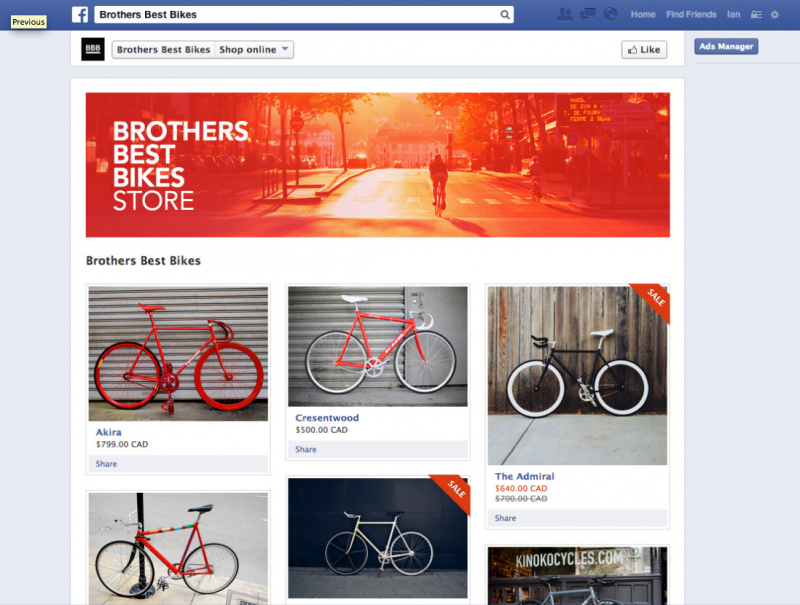
Not just the marketing strategies, the entire face of the online trading has changed from eCommerce to m-commerce and now to social commerce. Trading directly through the social media platforms without driving the traffic to the website is on the rise. According to a survey from Aimia, 56% of consumers said that they follow their brands on social media in order to browse products for sale. Moreover, surprisingly 31% of online shoppers said that they use social media specifically to look for new items to purchase. Not just Pinterest, even Twitter, and Facebook are allowing for purchases. One of the most prominent platforms for tapping the social commerce market is Facebook. Most of the eCommerce stores now offer the option to sync the products of the site on the Facebook store. For instance, Prestashop FB store plugin allows the Prestashop owners to have their own shop on their Facebook pages.

4. Chatting tools

Most of the marketers may consider it a traditional and orthodox method, but SMS has a phenomenal 99% open rate. Most of the brands and the online businesses have made use of the hand held devices to market their brands and have seen exceptional results. The messaging tools, especially, Whatsapp on of the other platforms that will have a marginal effect in the eCommerce ecosystem in 2017 and years to come. It was announced last year that WhatsApp will share user data with Facebook for ad targeting with an option to opt out. Hence, sticking to the classic methods will be one of the ways stay in sync with the growing market.

5. Shift from SnapChat to Instagram

SnapChat have been a trailblazer lately, but this year has seen a change in the trends. A marginal shift in the interest of the online buyers has been observed. Instagram offers a vastly bigger audience than Snapchat. The former has 600 million users while the latter has 150 million users. While Facebook still remains the key to success, the businesses that can quest the market of Instagram will have an egde over the crowd. In fact, many small enterprises have reaped results by advertising their product on Instagram.

6. Mobile advertising

Promotional messages and mobile marketing are two different things. This year, the marketers have made a greater investment in mobile advertising. The ad revenue of Facebook is more than $7 billion out of which 80% came from mobile ads. Even the mobile ad revenue of SnapChat raised the eyebrows of the online marketers, but that of Instagram is something all the online business needs to look out for.

7. Video Storytelling

This is one of the most interesting progressions in the online sphere. Storytelling through video ads has actually succeeded in grabbing the attention of the customers in the competitive marketplace. Amazon.in has made full use of the technique. Their ad for with signature hashtag campaigns and attractive videos is a trend setter. The videos build excitement and nurture customers relationship. Every ad campaign gained millions of views, likes and shares. This has opened up new doors and opportunities for the marketers. Along with this, video testimonials and clips providing quick tips to the customers are other influential ways to stand out among your competitors.

Over to you

The options of social login and Facebook post feed on the eCommerce website are all aimed at increasing the visibility and customer engagement at the social platform. However, eCommerce is changing constantly and so is Social Media. Predicting what’s gonna work and what not is tough, but these staying abreast of these trends will definitely help you go a step ahead in the competitive scenario.

Liked This? You’ll Like These Too

F-Commerce: 6 Steps to Tap the Future of Online Selling

With 600 million users, Facebook poses a huge opportunity to the online traders. While this was a source of entertainment in the past, the face of the social media platforms is changing with time. It is said that nearly 40% of the online customers use social networking sites when shopping. Hence, this is one of the ways that can effortlessly boost your sales. Some of the businesses who have used this medium saw a 20% of their sales coming from Facebook. Not just this, the Facebook transaction is even increasing 10% every month. Moreover, the cart value of the eCommerce store is expected to be 7 – 10% higher.

Despite all the alluring figures, most of the online businesses still hesitate in delving into the technicalities of a Facebook store. The store owners need not worry as there are ways to make it a cinch. just like Prestashop social login and other such modules, there are extensions that are aimed at making your life easier. The Prestashop store owner can take advantage of Prestashop Facebook Store addon that helps to create a shopping store on the social media platform. Once you have created the store, the next important thing is to optimize your business structure. So, for all the store owners out there, this article is a compilation of few steps that can help you find the right customer base and cater them with greater efficiency. Check them out.

1. Focus on high-quality content flow

Content marketing is the need of the hour in the eCommerce ecosystem. Even the online trade through the Facebook store should focus on the content flow. Since the customers don’t get an access to the touch and feel of the products, the content is the only way to get an insight of the same. Hence, the merchandise should come up with innovative ways of showcasing the products. The images and descriptions should not misguide or confuse the end-users. Just the ‘Buy Now’ is not enough to convert the users. The call-to-actions should compel the users to proceed to the checkout pages. The captions and phrases should stand out. One way of doing this is by building the trust through right information and user testimonials.

2. Boost social sharing

While the end goal is to optimize the conversions, the store should be able to reach out to greater masses. One of the ways to touch a wider customer base is by activating social sharing option. This is specifically a must in the fashion industry. A research in the human behavior states that people tend to take a second opinion before placing the order online. The social sharing option will help them share the product with their friends and family. The more shares you get, the bigger will the customer database of the store owners.

3. Optimize the layout and customize the Facebook store

Just like the eCommerce stores, the layout of the Facebook stores plays a big part in enhancing user experience and eliminating hassles. Choosing the right font and color scheme is essential. Set up distinct categories for the products, so that, the consumer can effortlessly reach the product that he is looking for.

4. Target the right audience

The entire concept of social media marketing is all about taping the right customer base. As per a study, Americans spend at least 40 minutes of their day on the Facebook. However, not every visitor is your prospect customers, so you need to come up with a strategy that is directed to the right audience base. Here are few steps to get an insight of the customers.

Keep a track of the recent purchase behavior of the customers. Take a close look at the things that they searched. The Facebook ads should be customised according to the interest of the viewers. Not just the purchasing behavior, even the life-events can help you target the right person. For instance, jewelry and other such gift items is an option for the people whose wedding anniversary is somewhere around the corner. The layer targeting options are one of the most powerful things that Facebook offers. With this social media platform, you have an access to the demographic, geolocation and behavioral data of the users. This is all that is required to create the marketing strategy. These informations can reduce the audience to as little as possible and hand-picking the target customer becomes easier.  Once you have recognized your ideal audience, then, you can reciprocate the features to find the Facebook users with similar characteristics.

5. Lure the customers

Since there is so much that can distract the customers, you need to provide them a reason to like and subscribe your Facebook page. According to a report, 42% of the visitors like the pages for discounts and coupons. Enticing offers and coupons codes is one of the factors that can allure the target base. Along with this as mentioned above, focus on the content flow. Post blogs and articles to engage the customers. Keep the heading and images attractive. These offers should be on the storefront of the Facebook page to get the attention instantly.

6. Sell without actually selling

The sales promotion is the only way to reach out to the prospect audience. However, this is one factor that put off the customer. None of the customers want to hear about buying and selling, especially when they are scrolling through the Facebook. Therefore, the promotion should be subtle. Interesting write-ups, customer testimonials, and videos should convey what you are trying to say. Other than this, creating poll or competition is another way to grab the attention of the target audience. Selling the idea instead of the product is the future of eCommerce structure.

Conclusion

Facebook not just provide you an access to a larger audience, but even your customer has the access to the masses. Thus, you need to have a one-to-one connection with them. Maintain a personal relation and deal with the negativity that comes along with the benefits of social media. Even a single bad rating may prove hazardous to the business. So, deal with it wisely. Use this platform with a bit of care and boost your sales as well as customer engagement effortlessly.

You Might Also Like:
6 Ways to Attract Sellers on your Online Multi vendor Marketplace

The virtual multi-vendor marketplace is one of the most prominent trends in the eCommerce industry. The ease of expanding inventory and product range makes it an inevitable upgrade for the eCommerce sites. While the complexity in making the code changes and marketplace management have been intimidating the store owners for a long, but not anymore. The Multi-vendor Marketplace Extension is a handy solution that converts your single vendor eCommerce store into an online multi-vendor marketplace site.

Are you facing the same problem? Even though this marketplace is an effortless platform to reach out to a wider range of audiences, convincing the seller to indulge in them is still a task. Just like it was difficult to convince the consumers to shop from online stores instead of the shopping malls, convincing the vendors to sell their products in the marketplace is strenuous.

Ways to encourage the sellers to register a shop account at your marketplace

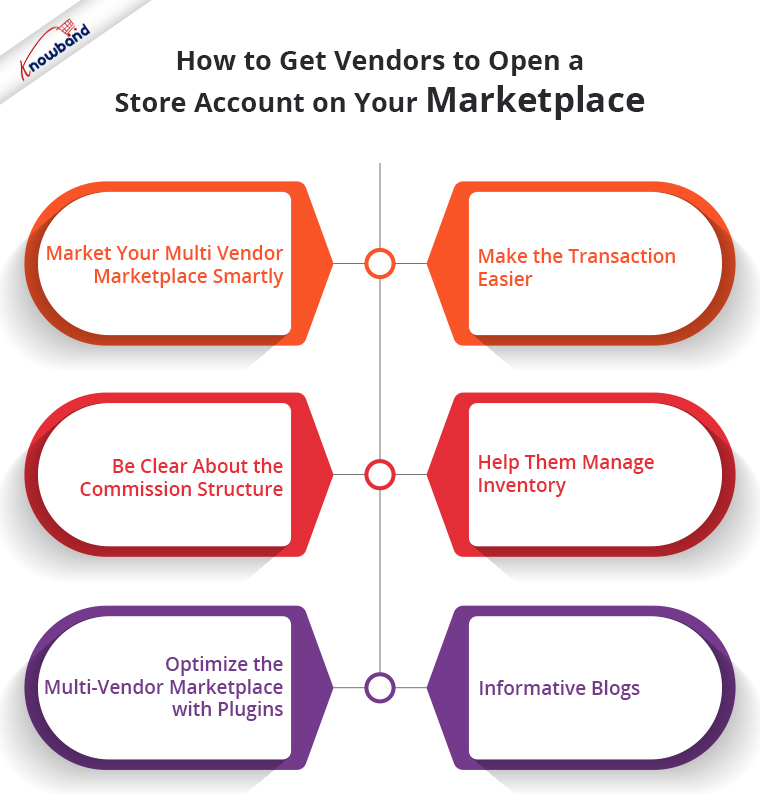
1. Market your multi-vendor marketplace smartly

Marketing is the stepping stone of all business structures. Whether the idea is to attract the end-user or the vendors themselves, nothing but a smart marketing strategy is a foundation for the pillar of the future. Listed below are some of the ways to market your business idea appropriately.

Recommended Blog: How to Launch a Marketplace like Etsy and eBay?

  • Use the Advertising Platform Efficiently

While the internet and social media platforms are a handy way to reach out to a larger audience in one go, offline marketing is a must when it comes to attracting sellers. Along with the hoardings and TV ads, you need to visit the vendors in person. There are a lot of sellers who may not be technically sound but can add a lot of value to your business.

  • Proper Placement

Strategic placement of the ads and banner is a must. The delivery trucks of logistic services are one of the best places to start your campaign. Place the hoardings in wholesale markets, distribute pamphlets in trade fairs and place them where it comes in merchants’ notice.

Recommended Blog: How can a Seller Attract Customers to a Marketplace during Holiday?

  • Target the right audience

Regardless of the target audience, the social media platform is the most effective place to get noticed. Create an account on social networks where you expect to find your target niche. Create an online buzz with affiliate marketing.

  • Use the social media channel

Join groups & communities of merchants across different social media channels. This will help you connect directly with them. Share information on these platforms and keep the merchants updated about the latest progression.

2. Make the transaction easier

  • The lack of technical knowledge is the biggest turn-off for merchants across the market. So, you need to educate the seller about the entire idea of the marketplace and make things simpler for them while attracting a larger customer base.
  • The user modules and training sessions can help them get an idea of how the entire business structure works. The Prestashop marketplace is one such platform that may prove a boon for the vendors.
  • The unlimited features for Marketplace can make the sellers feel like they are using their website. Easy inventory management, payment options, and order management can make the entire business transaction smooth for the sellers.
  • Optimize your marketplace according to the need of the vendors and convincing the vendors will become easier.

Recommended Blog: How to get a Marketplace site: a step-by-step guide?

3. Be clear about the commission structure

The commission and the payment structure are another big concern of the vendors.

  • Whether you structuring the commission as per the category of the product or the quantity. Everything should be explained.
  • Install the modules at your marketplace that automatically break down the cost and ROI. It should be assigned at the payment gateway itself. Any delay in this may leave the vendors in suspicion.
  • The General followed strategy is payment at the end of every week. This keeps the books clean and liquidity maintained at the sellers’ end.

4. Help them manage inventory

Inventory management is the biggest heck for all online merchants. This is another reason that makes them hesitant to delve into the multi-vendor marketplace.

  • Prestashop Marketplace CSV Import/Export Addon is one such module that can help import the products and their combinations via CSV. Thus, it becomes easier for the vendors to enter data and keep track of the products.
  • Other than that the Prestashop store owners can manage the low stock problem with the help of the Prestashop Marketplace Low Stock Alert Addon. It keeps a track of the inventory of the sellers and provides an alert message when the stock is below a certain limit.

Recommended Blog: Best eCommerce platforms for starting a multi-vendor marketplace

5. Optimize the Multi-vendor marketplace with plugins

Even if the marketplace is easy to handle and requires no technical supervision, there are still a lot of factors that may fail to convince the vendors.

  • The language barriers, currency conversions, invoice generations, and customer support are some of these issues. Convince them about the changes that are in the marketplace can bring to their overall business scenario by installing plugins and extensions.
  • Prestashop deal manager, Low stock manager, and other such add-ons can help you optimize and customize your marketplace integration accordingly. Find out the loopholes and the pain points of your vendors and update the marketplace.

6. Informative blogs

Feel free to write about the success stories and reviews of your vendors. An informative blog with some Marketing data will tempt the sellers and bring them close to your store. Moreover, Google indexes blogs quickly thus will help the admin in catching the attention of multiple sellers across the globe in a short time.

Additionally, the multi-vendor marketplace extensions developed by Knowband offer a lot of other features that make it even easier for the store admin delves into the multi-vendor scenario.

Some of the admin features are discussed below:

  • The multi-vendor marketplace extension enables the multi-vendor feature in your eCommerce. The store upgrade is done without actually making any code changes.
  • The automates the entire process of store tracking and management.
  • The admin can approve/disapprove the seller’s profile if they want to from the back-end.
  • The multi-vendor marketplace module for Magento, Prestashop, Magneto 2, and OpenCart even allows the admin to track, add or remove the products/category from the site.
  • The plugin allows the store admin to fix the global/individual and order-wise commissions and manage the dues easily from the back-end interface.
  • The store admin can create various membership plans for the sellers as per their requirements.
  • The admin can even view the performance of the individual sellers and can even track the transaction in the marketplace.
  • The admin can send email notifications to the sellers via a multi-vendor marketplace module.
  • The sellers get a separate dashboard to keep track of their products as well as sales.
  • They can view the orders and manage the same from their dashboard.

Conclusion

The various tips and techniques discussed in this post are just the first step to taking your business model forward. However, the process of convincing the vendors is ongoing and should be improvised according to the needs and requirements. The prominent chicken-and-egg problem of the marketplaces is something that you need to ponder.

Knowband, the eCommerce plugin development company, offers a multi-seller marketplace module for platforms like Magento 2, PrestaShop and OpenCart Module. 3 months of full free assistance will be provided on each module. With the simple installation and configuration process, Knowband offers the smartest way for the store admin to transform their online shop into a fully-functional Marketplace in a few simple clicks. For any query, feel free to contact support@Knowband.com

5 formas de atraer vendedores en su mercado en línea de múltiples proveedores

El mercado virtual de múltiples proveedores es una de las tendencias más destacadas de la industria del comercio electrónico. La facilidad de ampliar el inventario y la gama de productos hace que sea una actualización inevitable para los sitios de comercio electrónico. Si bien la complejidad de hacer cambios en el código y la administración del mercado ha intimidado a los propietarios de la tienda por mucho tiempo, pero ya no. los Extensión de mercado multiproveedor es una solución práctica que convierte su tienda de comercio electrónico en un sitio de mercado de múltiples proveedores en línea. Complemento del mercado de Prestashop, Extensión del mercado de múltiples proveedores de Magento y Complemento del mercado de vendedores múltiples de OpenCart son tales extensiones que pueden convertir fácilmente los sitios en línea de un solo proveedor basados ​​en las respectivas plataformas en un mercado de múltiples proveedores. A pesar de que este mercado es una plataforma sin esfuerzo para llegar a un público más amplio, convencer al vendedor para que se entregue a ellos sigue siendo una tarea. Al igual que fue difícil convencer a los usuarios finales para comprar en las tiendas en línea en lugar de los centros comerciales, convencer a los vendedores para vender sus productos en el mercado es extenuante.

¿Estás enfrentando el mismo problema? Aquí hemos alistado algunas de las formas de alentar a los vendedores a registrar una cuenta de tienda en su mercado. Échales un vistazo.

1. Comercialice su proveedor de múltiples

El marketing es el trampolín de toda la estructura empresarial. Si la idea es atraer al usuario final o a los propios vendedores, nada más que una estrategia de marketing inteligente es la base del pilar para el futuro. A continuación se enumeran algunas de las formas de comercializar su idea de negocio de forma adecuada.

  • Use la plataforma publicitaria de manera eficiente:

Si bien Internet y la plataforma de redes sociales son una forma práctica de llegar a un público más amplio de una sola vez, el marketing fuera de línea es imprescindible cuando se trata de atraer a los vendedores. Junto con las vallas publicitarias y los anuncios de televisión, debe visitar a los vendedores en persona. Hay muchos vendedores que pueden no ser técnicamente correctos, pero pueden agregar mucho valor a su negocio.

  • Colocación correcta:

La ubicación estratégica de los anuncios y el banner es imprescindible. Los camiones de reparto de servicios logísticos son uno de los mejores lugares para comenzar su campaña. Coloque las vallas publicitarias en los mercados mayoristas, distribuya panfletos en las ferias comerciales y ubíquelos en los avisos de los comerciantes.

  • Apunte a la audiencia correcta:

Independientemente del público objetivo, la plataforma de redes sociales es el lugar más efectivo para llamar la atención. Cree una cuenta en las redes sociales donde espera encontrar su nicho de destino. Cree un zumbido en línea con el marketing de afiliación.

  • Use el canal de redes sociales:

Únase a grupos y comunidades de comerciantes en diferentes canales de redes sociales. Esto te ayudará a conectarte directamente con ellos. Comparta información sobre estas plataformas y mantenga a los comerciantes actualizados sobre la última progresión.

2. Haz la transacción más fácil

La falta de conocimiento técnico es el mayor obstáculo para los comerciantes en todo el mercado. Por lo tanto, debe informarles que la idea general del mercado es simplificar las cosas a la vez que atraen a una mayor base de clientes. Los módulos de usuario y las sesiones de capacitación pueden ayudarlos a tener una idea de cómo funciona toda la estructura empresarial. El mercado de Prestashop es una de esas plataformas que puede ser beneficioso para los proveedores. Las funciones ilimitadas para Marketplace pueden hacer que los vendedores sientan que están usando su propio sitio web. La administración sencilla del inventario, las opciones de pago y la administración de pedidos pueden hacer que toda la transacción comercial sea más fácil para los vendedores. Optimice su mercado de acuerdo con la necesidad de los proveedores y convencer a los proveedores será más fácil.

3. Sea claro acerca de la estructura de la comisión

La comisión y la estructura de pago es otra gran preocupación de los proveedores. Haga las comisiones que los vendedores serán asignados. Ya sea que esté estructurando la comisión según la categoría o el producto o la cantidad. Todo debe ser explicado. Instale los módulos en su mercado que descomponen automáticamente el costo y el ROI. Debería asignarse en la propia puerta de pago. Cualquier retraso en esto puede dejar a los vendedores en sospecha. La estrategia general seguida es el pago al final de cada semana. Esto mantiene los libros limpios y la liquidez se mantiene al final de los vendedores.

4. Ayúdelos a administrar el inventario

La gestión de inventario es la mayor diablos para todos los comerciantes en línea. Esta es otra razón que los hace dudar en profundizar en el mercado de múltiples proveedores. Prestashop Marketplace CSV Import / Export Addon es uno de esos módulos que puede ayudar a importar los productos y sus combinaciones a través de CSV. Por lo tanto, es más fácil para los proveedores ingresar datos y realizar un seguimiento de los productos. Aparte de eso, los propietarios de las tiendas Prestashop pueden gestionar el bajo problema de stock con la ayuda de Prestashop Marketplace Low Stock Alert Complemento. Mantiene un registro del inventario de los vendedores y proporciona un mensaje de alerta cuando el stock está por debajo de cierto límite.

5. Optimizar el mercado con complementos

Incluso si el mercado es fácil de manejar y no requiere supervisión técnica, aún existen muchos factores que pueden no convencer a los proveedores. Las barreras de idioma, las conversiones de moneda, las generaciones de facturas y la atención al cliente son algunos de estos problemas. Convencerlos acerca de los cambios que el estar en el mercado puede traer a su escenario empresarial general mediante la instalación de complementos y extensiones. El administrador de acuerdos de Prestashop, el administrador de valores bajos y otros complementos de este tipo pueden ayudarlo a optimizar y personalizar su integración en el mercado en consecuencia. Descubra las lagunas y los puntos débiles de sus proveedores y actualice el mercado.

Además, el proveedor de itulti

  • La extensión del mercado de múltiples proveedores habilita la característica de múltiples proveedores en su eCommerce. La actualización de la tienda se realiza sin realizar ningún cambio de código.
  • Automatiza todo el proceso de seguimiento y administración de la tienda.
  • El administrador puede aprobar / desaprobar el perfil del vendedor si lo desea desde el back-end.
  • El módulo del mercado de múltiples proveedores para Magento, Prestashop y OpenCart incluso permite que el administrador rastree, agregue o elimine los productos / categorías del sitio.
  • El complemento permite al administrador de la tienda corregir las comisiones globales o de orden y gestionar las cuotas fácilmente desde la interfaz de fondo.
  • El administrador incluso puede ver el rendimiento de los vendedores individuales e incluso puede rastrear la transacción del mercado.
  • El administrador puede enviar notificaciones por correo electrónico a los vendedores a través de
  • Los vendedores obtienen un tablero separado para mantener un registro de sus productos y ventas.
  • Pueden ver los pedidos y administrarlos desde su tablero.

Conclusión

Los diversos consejos y técnicas que se analizan en esta publicación son solo el primer paso para llevar adelante su modelo comercial. Sin embargo, el proceso de convencer a los vendedores es un proceso continuo y debe improvisarse según las necesidades y los requisitos. El prominente problema del huevo y la gallina de los mercados es algo que debes considerar. Por lo tanto, cree estrategias de marketing bien investigadas que involucren tanto a los clientes como a los

Historias relacionadas:

5 vous permet d'attirer des vendeurs sur votre marché multi-fournisseurs en ligne

Le marché virtuel multi-fournisseurs est l’une des tendances les plus marquantes de l’industrie du commerce électronique. La facilité d’augmentation des stocks et de la gamme de produits en fait une mise à niveau inévitable pour les sites de commerce électronique. Bien que la complexité de la modification du code et de la gestion du marché ait longtemps intimidé les propriétaires de magasins, mais plus maintenant. le Extension de marché multi-vendeurs est une solution pratique qui convertit votre magasin de commerce électronique en un site de vente en ligne multi-fournisseurs. Ajout du marché Prestashop, Extension de marché multi-fournisseurs Magento et OpenCart plugin de marché multi-vendeurs sont de telles extensions qui peuvent facilement convertir les sites à fournisseur unique en ligne basés sur les plates-formes respectives en un marché à plusieurs fournisseurs. Même si cette place de marché est une plate-forme sans effort pour toucher un public plus large, convaincre le vendeur de s’y livrer reste une tâche difficile. Tout comme il était difficile de convaincre les utilisateurs finaux de faire leurs achats dans les magasins en ligne plutôt que dans les centres commerciaux, il est difficile de convaincre les fournisseurs de vendre leurs produits sur le marché.

Êtes-vous confronté au même problème? Ici, nous avons recruté certains des moyens d'encourager les vendeurs à enregistrer un compte de magasin sur votre marché. Vérifie-les.

1. Market yourmulti vendeur

Le marketing est la pierre angulaire de toute la structure de l'entreprise. Que l'idée soit d'attirer l'utilisateur final ou les fournisseurs eux-mêmes, rien d'autre qu'une stratégie marketing intelligente ne constitue la base du pilier de l'avenir. Vous trouverez ci-dessous quelques-unes des façons de commercialiser votre idée d’entreprise de manière appropriée.

  • Utilisez efficacement la plate-forme publicitaire:

Alors qu'Internet et la plate-forme de médias sociaux sont un moyen pratique de toucher un public plus large en une fois, le marketing hors ligne est indispensable pour attirer les vendeurs. En plus des panneaux publicitaires et des publicités télévisées, vous devez rendre visite aux fournisseurs en personne. Il y a beaucoup de vendeurs qui peuvent ne pas être techniquement sains, mais peuvent ajouter beaucoup de valeur à votre entreprise.

  • Placement correct:

Le placement stratégique des annonces et de la bannière est indispensable. Les camions de livraison des services logistiques sont l'un des meilleurs endroits pour démarrer votre campagne. Placez les panneaux dans les marchés de gros, distribuez des brochures dans les foires commerciales et placez-les à la connaissance des commerçants.

  • Cibler le bon public:

Indépendamment du public cible, la plate-forme de médias sociaux est l'endroit le plus efficace pour se faire remarquer. Créez un compte sur les réseaux sociaux où vous vous attendez à trouver votre créneau cible. Créez un buzz en ligne avec le marketing d'affiliation.

  • Utilisez le canal des médias sociaux:

Rejoignez des groupes et des communautés de commerçants sur différents canaux de médias sociaux. Cela vous aidera à vous connecter directement avec eux. Partager des informations sur ces plates-formes et tenir les commerçants au courant de la dernière progression.

2. Faciliter la transaction

Le manque de connaissances techniques est la plus grande difficulté pour les commerçants du marché. Vous devez donc leur apprendre que l’idée du marché est de simplifier les choses tout en attirant une clientèle plus large. Les modules utilisateur et les sessions de formation peuvent les aider à se faire une idée du fonctionnement de l’ensemble de la structure métier. Le marché Prestashop est l’une de ces plates-formes qui peut se révéler bénéfique pour les fournisseurs. Les fonctionnalités illimitées de Marketplace peuvent inciter les vendeurs à utiliser leur propre site Web. La gestion facile des stocks, les options de paiement et la gestion des commandes peuvent faciliter la transaction commerciale pour les vendeurs. Optimiser votre marché en fonction des besoins des fournisseurs et convaincre les fournisseurs deviendra plus facile.

3. Soyez clair sur la structure de la commission

La commission et la structure de paiement sont une autre grande préoccupation des vendeurs. Faites les commissions qui seront attribuées aux vendeurs. Que vous structuriez la commission selon la catégorie ou le produit ou la quantité. Tout devrait être expliqué. Installez les modules sur votre marché qui décomposent automatiquement les coûts et le retour sur investissement. Il doit être affecté à la passerelle de paiement elle-même. Tout retard dans ce processus peut laisser les vendeurs en suspens. La stratégie générale suivie est le paiement à la fin de chaque semaine. Cela permet de garder les livres propres et la liquidité maintenue chez les vendeurs.

4. Aidez-les à gérer l'inventaire

La gestion des stocks est le plus important pour tous les marchands en ligne. C’est une autre raison qui les pousse à plonger dans le marché des fournisseurs multiples. Ajout / exportation CSV Prestashop Marketplace CSV est un de ces modules qui peut aider à importer les produits et leurs combinaisons via CSV. Ainsi, il devient plus facile pour les fournisseurs de saisir des données et de suivre les produits. En dehors de cela, les propriétaires de magasins Prestashop peuvent gérer le problème des stocks bas avec l’aide de Ajout d'alerte de stock faible sur le marché Prestashop. Il garde une trace de l'inventaire des vendeurs et fournit un message d'alerte lorsque le stock est en dessous d'une certaine limite.

5. Optimiser le marché avec des plugins

Même si le marché est facile à gérer et ne nécessite aucune supervision technique, de nombreux facteurs risquent de ne pas convaincre les fournisseurs. Les barrières linguistiques, les conversions de devises, les générations de factures et le support client sont quelques-uns de ces problèmes. Convainquez-les des changements que la présence sur le marché peut apporter à leur scénario d’entreprise en installant des plugins et des extensions. Le gestionnaire d’affaires Prestashop, le gestionnaire de stock faible et d’autres outils de ce type peuvent vous aider à optimiser et à personnaliser en conséquence l’intégration de votre marché. Découvrez les failles et les difficultés de vos fournisseurs et mettez à jour le marché.

En outre, themulti vendor

  • L'extension de marché multi-fournisseurs permet la fonctionnalité multi-fournisseurs dans votre commerce électronique. La mise à niveau du magasin est effectuée sans effectuer aucun changement de code.
  • Le système automatise l'ensemble du processus de suivi et de gestion du magasin.
  • L'administrateur peut approuver / désapprouver le profil du vendeur s'il le souhaite.
  • Le module marketplace multi-fournisseurs pour Magento, Prestashop et OpenCart permet même à l'administrateur de suivre, d'ajouter ou de supprimer les produits / catégories du site.
  • Le plug-in permet à l'administrateur du magasin de réparer les commissions globales ou par ordre et de gérer les cotisations facilement depuis l'interface principale.
  • L'administrateur peut même voir la performance des vendeurs individuels et peut même suivre la transaction du marché.
  • L'administrateur peut envoyer des notifications par courrier électronique aux vendeurs via
  • Les vendeurs disposent d'un tableau de bord distinct pour suivre leurs produits et leurs ventes.
  • Ils peuvent voir les commandes et gérer les mêmes depuis leur tableau de bord.

Conclusion

Les différentes astuces et techniques présentées dans cet article ne sont que la première étape pour faire avancer votre modèle d’entreprise. Cependant, le processus de convaincre les fournisseurs est un processus continu et doit être improvisé en fonction des besoins et des exigences. Le proéminent problème de la poule et de l'oeuf des marchés est quelque chose que vous devez réfléchir. Par conséquent, créez des stratégies marketing bien documentées qui impliquent à la fois les clients et les

Histoires connexes:

5 Wege, um Verkäufer auf Ihrem Online-Marktplatz mit mehreren Anbietern anzuziehen

Der virtuelle Multi-Vendor-Marktplatz ist einer der wichtigsten Trends der eCommerce-Branche. Die einfache Erweiterung des Inventars und der Produktpalette macht es zu einem unvermeidlichen Upgrade für die eCommerce-Sites. Die Komplexität der Code-Änderungen und das Management des Marktplatzes haben die Ladenbesitzer schon lange eingeschüchtert, aber nicht mehr. Das Multi-Vendor-Marktplatz-Erweiterung ist eine praktische Lösung, die Ihren eCommerce-Shop in eine Online-Marktplatzplattform für mehrere Anbieter verwandelt. Prestashop Marktplatz Addon, Magento Multi-Vendor-Marktplatz-Erweiterung und OpenCart Multi-Seller Marktplatz-Plugin sind solche Erweiterungen, die die Online-Einzelhändler-Websites, die auf den jeweiligen Plattformen basieren, leicht in einen Multivendor-Marktplatz umwandeln können. Obwohl dieser Marktplatz eine mühelose Plattform ist, um die breitere Zielgruppe zu erreichen, ist es immer noch eine Aufgabe, den Verkäufer davon zu überzeugen, sich ihnen hinzugeben. So wie es schwierig war, die Endverbraucher davon zu überzeugen, in den Online-Shops statt in den Einkaufszentren zu shoppen, ist es überzeugend, die Anbieter davon zu überzeugen, ihre Produkte auf dem Marktplatz zu verkaufen.

Stehen Sie vor dem gleichen Problem? Hier haben wir einige Wege gefunden, die Verkäufer zu ermutigen, ein Shop-Konto auf Ihrem Marktplatz zu registrieren. Schau sie dir an.

1. Vermarkten Sie Ihren Multi-Vendor

Marketing ist das Sprungbrett für die gesamte Geschäftsstruktur. Ob es darum geht, den Endanwender oder die Anbieter selbst zu gewinnen, nichts als eine kluge Marketingstrategie ist die Grundlage für die Säule der Zukunft. Im Folgenden finden Sie einige Möglichkeiten, Ihre Geschäftsidee angemessen zu vermarkten.

  • Nutzen Sie die Werbeplattform effizient:

Während das Internet und die Social-Media-Plattform ein praktischer Weg ist, um ein größeres Publikum auf einmal zu erreichen, ist Offline-Marketing ein Muss, wenn es darum geht, die Verkäufer anzuziehen. Zusammen mit den Horten und TV-Spots müssen Sie die Verkäufer persönlich besuchen. Es gibt viele Verkäufer, die technisch vielleicht nicht so gut sind, aber Ihrem Geschäft viel Wert hinzufügen können.

  • Richtige Platzierung:

Strategische Platzierung der Anzeigen und Banner ist ein Muss. Die Lieferwagen von Logistikdienstleistungen sind einer der besten Orte, um Ihre Kampagne zu starten. Platzieren Sie die Tafeln in den Großmärkten, verteilen Sie Flugblätter auf Messen und platzieren Sie sie dort, wo sie auf Sie aufmerksam werden.

  • Richten Sie die richtige Zielgruppe aus:

Unabhängig von der Zielgruppe ist die Social-Media-Plattform der effektivste Ort, um wahrgenommen zu werden. Erstellen Sie ein Konto in sozialen Netzwerken, wo Sie Ihre Zielnische erwarten. Erstellen Sie Online-Buzz mit Affiliate-Marketing.

  • Nutze den Social-Media-Kanal:

Treten Sie Gruppen und Communities von Händlern über verschiedene Social-Media-Kanäle bei. Dies wird Ihnen helfen, direkt mit ihnen zu verbinden. Teilen Sie Informationen auf diesen Plattformen und halten Sie die Händler über den neuesten Fortschritt auf dem Laufenden.

2. Erleichtern Sie die Transaktion

Der Mangel an technischem Wissen ist die größte Abkehr für Händler auf dem Markt. Sie müssen ihnen also beibringen, dass die gesamte Idee des Marktplatzes darin besteht, die Dinge für sie einfacher zu machen und gleichzeitig einen größeren Kundenkreis zu gewinnen. Die Benutzermodule und Trainingseinheiten können ihnen helfen, eine Vorstellung davon zu bekommen, wie die gesamte Unternehmensstruktur funktioniert. Der Prestashop-Marktplatz ist eine solche Plattform, die für die Anbieter von Vorteil sein kann. Die unbegrenzten Funktionen für den Marktplatz können den Verkäufern das Gefühl geben, dass sie ihre eigene Website verwenden. Einfache Bestandsverwaltung, Zahlungsoptionen und Auftragsverwaltung können den gesamten Geschäftsvorgang für die Verkäufer reibungslos abwickeln. Optimieren Sie Ihren Marktplatz entsprechend dem Bedarf der Anbieter und überzeugen Sie die Anbieter werden einfacher.

3. Machen Sie sich mit der Kommissionsstruktur vertraut

Die Kommission und die Zahlungsstruktur ist ein weiteres großes Anliegen der Anbieter. Machen Sie die Provisionen, die den Verkäufern zugewiesen werden. Ob Sie die Provision nach der Kategorie oder dem Produkt oder der Menge strukturieren. Alles sollte erklärt werden. Installieren Sie die Module in Ihrem Marktplatz, die automatisch die Kosten und den ROI senken. Es sollte am Zahlungsgateway selbst zugewiesen werden. Jede Verzögerung kann die Verkäufer in Verdacht setzen. Allgemeine verfolgte Strategie ist die Zahlung am Ende jeder Woche. Dies hält die Bücher sauber und die Liquidität wird von den Verkäufern aufrechterhalten.

4. Helfen Sie ihnen, das Inventar zu verwalten

Die größte Herausforderung für alle Online-Händler ist die Bestandsverwaltung. Dies ist ein weiterer Grund, der sie zögern lässt, in den Multi-Vendor-Markt einzusteigen. Prestashop Marktplatz CSV Import / Export Addon ist ein solches Modul, mit dem Sie die Produkte und ihre Kombinationen über CSV importieren können. Dadurch wird es für die Anbieter einfacher, Daten einzugeben und die Produkte im Auge zu behalten. Darüber hinaus können die Besitzer des Prestashop-Ladens das Niedrigbestandproblem mit Hilfe von Prestashop Marketplace Warnsignal Addon. Sie verfolgt den Bestand der Verkäufer und gibt eine Warnmeldung aus, wenn der Bestand unter einem bestimmten Limit liegt.

5. Optimiere den Marktplatz mit Plugins

Auch wenn der Markt einfach zu bedienen ist und keine technische Überwachung erfordert, gibt es immer noch viele Faktoren, die die Anbieter nicht überzeugen können. Die Sprachbarrieren, Währungsumrechnungen, Rechnungsgenerationen und Kundendienst sind einige dieser Probleme. Überzeugen Sie sie von den Veränderungen, die das Marktgeschehen durch die Installation von Plugins und Extensions für das gesamte Geschäftsszenario bringen kann. Prestashop-Deal-Manager, Low-Stock-Manager und andere solche Addons können Ihnen helfen, Ihre Marktplatz-Integration entsprechend zu optimieren und anzupassen. Finden Sie die Schlupflöcher und Schwachstellen Ihrer Anbieter heraus und aktualisieren Sie den Marktplatz.

Zusätzlich, der Multi-Vendor

  • Die Multi-Vendor-Marktplatz-Erweiterung ermöglicht die Multi-Vendor-Funktion in Ihrem eCommerce. Das Store-Upgrade wird durchgeführt, ohne Codeänderungen vorzunehmen.
  • Sie automatisiert den gesamten Prozess der Filialverfolgung und -verwaltung.
  • Der Administrator kann das Profil des Verkäufers genehmigen / ablehnen, wenn er vom Back-End möchte.
  • Das Multi-Vendor-Marktplatz-Modul für Magento, Prestashop und OpenCart ermöglicht es dem Administrator sogar, die Produkte / Kategorie von der Site zu verfolgen, hinzuzufügen oder zu entfernen.
  • Das Plugin ermöglicht dem Filialleiter, die globalen oder auftragsbezogenen Provisionen zu fixieren und die Gebühren einfach über die Backend-Oberfläche zu verwalten.
  • Der Administrator kann sogar die Leistung der einzelnen Verkäufer einsehen und sogar die Transaktion des Marktplatzes verfolgen.
  • Der Administrator kann per E-Mail Benachrichtigungen an die Verkäufer senden
  • Die Verkäufer erhalten ein separates Dashboard, um den Überblick über ihre Produkte und Verkäufe zu behalten.
  • Sie können die Bestellungen einsehen und über ihr Dashboard verwalten.

Fazit

Die verschiedenen Tipps und Techniken, die in diesem Beitrag besprochen werden, sind nur der erste Schritt, um Ihr Geschäftsmodell voranzubringen. Der Prozess, die Anbieter zu überzeugen, ist jedoch ein fortlaufender Prozess und sollte entsprechend den Bedürfnissen und Anforderungen improvisiert werden. Der Prominente Henne-Ei-Problem der Marktplätze ist etwas, über das du nachdenken musst. Also, erstellen Sie gut recherchierte Marketing-Strategien, die sowohl die Kunden als auch die

Ähnliche Beiträge:

5 Modi per attirare i venditori sul tuo Marketplace multi-vendor online

Il mercato dei venditori virtuali multipli è una delle tendenze più importanti del settore dell'e-commerce. La facilità di espansione dell'inventario e della gamma di prodotti lo rende un aggiornamento inevitabile per i siti di e-commerce. Mentre la complessità nel far cambiare il codice e la gestione del mercato hanno intimidito i proprietari dei negozi per molto tempo, ma non più. Il Estensione del Marketplace multi-vendor è una soluzione a portata di mano che converte il tuo negozio eCommerce in un sito di marketplace online multi-vendor. Addon del market di Prestashop, Ampliamento del marketplace multi-fornitore Magento e OpenCart multi marketplace plugin per venditori sono tali estensioni che possono facilmente convertire i siti single-vendor online basati sulle rispettive piattaforme in un mercato multivendor. Anche se questo mercato è una piattaforma senza sforzo per raggiungere la più ampia gamma di pubblico, convincere il venditore a dedicarsi a loro è ancora un compito. Proprio come è stato difficile convincere gli utenti finali a fare acquisti dai negozi online invece che dai centri commerciali, convincere i venditori a vendere i loro prodotti sul mercato è faticoso.

Stai affrontando lo stesso problema? Qui abbiamo elencato alcuni dei modi per incoraggiare i venditori a registrare un account di negozio sul tuo mercato. Dategli un'occhiata

1. Mercato tuo multiplo venditore

Il marketing è il trampolino di lancio di tutta la struttura aziendale. Se l'idea è di attirare l'utente finale o i venditori stessi, nient'altro che una strategia di marketing intelligente è la base del pilastro per il futuro. Di seguito sono elencati alcuni dei modi per commercializzare la tua idea di business in modo appropriato.

  • Usa la piattaforma pubblicitaria in modo efficiente:

Mentre Internet e la piattaforma di social media sono un modo pratico per raggiungere un pubblico più ampio in una volta sola, il marketing offline è un must quando si tratta di attrarre i venditori. Insieme ai cartelloni pubblicitari e agli annunci TV, devi visitare i venditori di persona. Ci sono molti venditori che potrebbero non essere tecnicamente validi, ma possono aggiungere molto valore alla tua attività.

  • Posizionamento corretto:

Il posizionamento strategico degli annunci e del banner è un must. I camion di consegna dei servizi logistici sono uno dei posti migliori per iniziare la tua campagna. Posiziona i cartelli nei mercati all'ingrosso, distribuisci opuscoli nelle fiere e posizionali dove si trovano nelle notifiche dei commercianti.

  • Indirizza il pubblico giusto:

Indipendentemente dal target di riferimento, la piattaforma di social media è il luogo più efficace per farsi notare. Crea un account sui social network dove ti aspetti di trovare la tua nicchia di destinazione. Crea un ronzio online con il marketing affiliato.

  • Usa il canale dei social media:

Unisciti a gruppi e community di commercianti attraverso diversi canali di social media. Questo ti aiuterà a connetterti direttamente con loro. Condividi le informazioni su queste piattaforme e mantieni aggiornati i commercianti sull'ultima progressione.

2. Semplifica la transazione

La mancanza di conoscenza tecnica è il più grande spunto per i commercianti sul mercato. Quindi, è necessario istruirli sul fatto che l'intera idea del mercato è quella di rendere le cose più semplici per loro mentre attira una clientela più ampia. I moduli utente e le sessioni di formazione possono aiutarli a farsi un'idea di come funziona l'intera struttura aziendale. Il mercato di Prestashop è una di queste piattaforme che potrebbe rivelarsi vantaggiosa per i venditori. Le funzionalità illimitate per Marketplace possono far sentire i venditori come se stessero utilizzando il proprio sito web. La facile gestione dell'inventario, le opzioni di pagamento e la gestione degli ordini possono semplificare l'intera transazione commerciale per i venditori. Ottimizza il tuo mercato in base alle necessità dei venditori e convincere i venditori a diventare più semplice.

3. Sii chiaro sulla struttura della commissione

La commissione e la struttura di pagamento sono un'altra grande preoccupazione dei venditori. Fai le commissioni che i venditori saranno assegnati. Sia che si strutturi la commissione secondo la categoria o il prodotto o la quantità. Tutto dovrebbe essere spiegato. Installa i moduli nel tuo marketplace che analizzano automaticamente il costo e il ROI. Dovrebbe essere assegnato al gateway di pagamento stesso. Qualsiasi ritardo in questo può lasciare sospetti i venditori. La strategia generale seguita è il pagamento alla fine di ogni settimana. Ciò mantiene i libri puliti e la liquidità mantenuta alla fine dei venditori.

4. Aiutali a gestire l'inventario

La gestione dell'inventario è il più grande diavolo per tutti i commercianti online. Questo è un altro motivo che li rende titubanti nell'affrontare il mercato multi-vendor. Addon di importazione / esportazione CSV di Prestashop Marketplace è uno di questi moduli che può aiutare a importare i prodotti e le relative combinazioni tramite CSV. Pertanto, diventa più facile per i venditori inserire dati e tenere traccia dei prodotti. Oltre a questo i proprietari dei negozi Prestashop possono gestire il problema del basso stock con l'aiuto di Addon di avviso stock basso di Prestashop Marketplace. Mantiene una traccia dell'inventario dei venditori e fornisce un messaggio di avviso quando lo stock è inferiore a un certo limite.

5. Ottimizza il mercato con i plugin

Anche se il mercato è facile da gestire e non richiede alcuna supervisione tecnica, ci sono ancora molti fattori che potrebbero non convincere i venditori. Le barriere linguistiche, le conversioni valutarie, le generazioni di fatture e il supporto clienti sono alcuni di questi problemi. Convinci che i cambiamenti che si trovano sul mercato possono portare al loro scenario aziendale generale installando plugin ed estensioni. Prestashop deal manager, Low stock manager e altri addons possono aiutarti a ottimizzare e personalizzare l'integrazione del tuo marketplace di conseguenza. Scopri le lacune e i punti deboli dei tuoi fornitori e aggiorna il mercato.

Inoltre, fornitore di themulti

  • L'estensione multi-vendor marketplace abilita la funzionalità multi-vendor nel tuo eCommerce. L'aggiornamento del negozio viene eseguito senza apportare effettivamente modifiche al codice.
  • L'automatizza l'intero processo di tracciamento e gestione del negozio.
  • L'amministratore può approvare / disapprovare il profilo del venditore se lo desidera dal back-end.
  • Il modulo multi-market marketplace per Magento, Prestashop e OpenCart consente anche all'amministratore di tracciare, aggiungere o rimuovere prodotti / categorie dal sito.
  • Il plug-in consente all'amministratore del negozio di correggere le commissioni globali o ordinate e di gestire facilmente le quote dall'interfaccia di back-end.
  • L'amministratore può persino visualizzare le prestazioni dei singoli venditori e persino monitorare la transazione del mercato.
  • L'amministratore può inviare notifiche via email ai venditori tramite
  • I venditori ricevono una dashboard separata per tenere traccia dei loro prodotti e delle vendite.
  • Possono visualizzare gli ordini e gestirli dalla loro dashboard.

Conclusione

I vari consigli e le tecniche discusse in questo post sono solo il primo passo per portare avanti il ​​tuo modello di business. Tuttavia, il processo di convincere i venditori è un processo continuo e dovrebbe essere improvvisato in base alle esigenze e ai requisiti. Il prominente problema di pollo e uova dei mercati è qualcosa su cui devi riflettere. Quindi, creare strategie di marketing ben studiate che coinvolgono sia i clienti che i

Storie correlate: