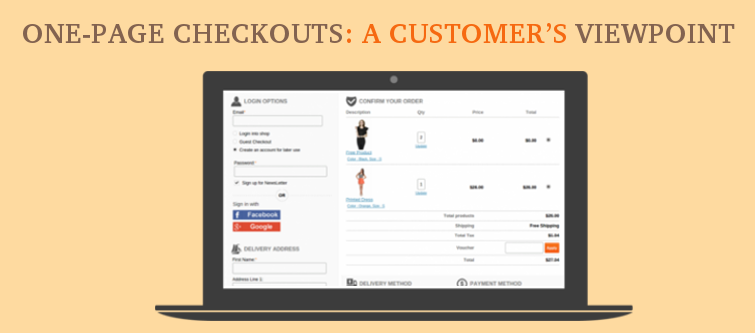
One-page checkouts: A customer’s viewpoint

One-page checkouts have become the trend since they entered the eCommerce market on a trial basis. They entered the web world as a variation to enhance the usability of the website and gathered the attention of the digital shopping world. There efficacy and efficiency is what that has made them a must add feature on your website. The analysis of customer behavior before and after the inception of one-page checkout has revealed that the feature is an effective tool against checkout abandonment. It has reduced the cart abandonment rate drastically and has acted as a tool for propelling conversions.

Customer’s viewpoint on one-page checkout
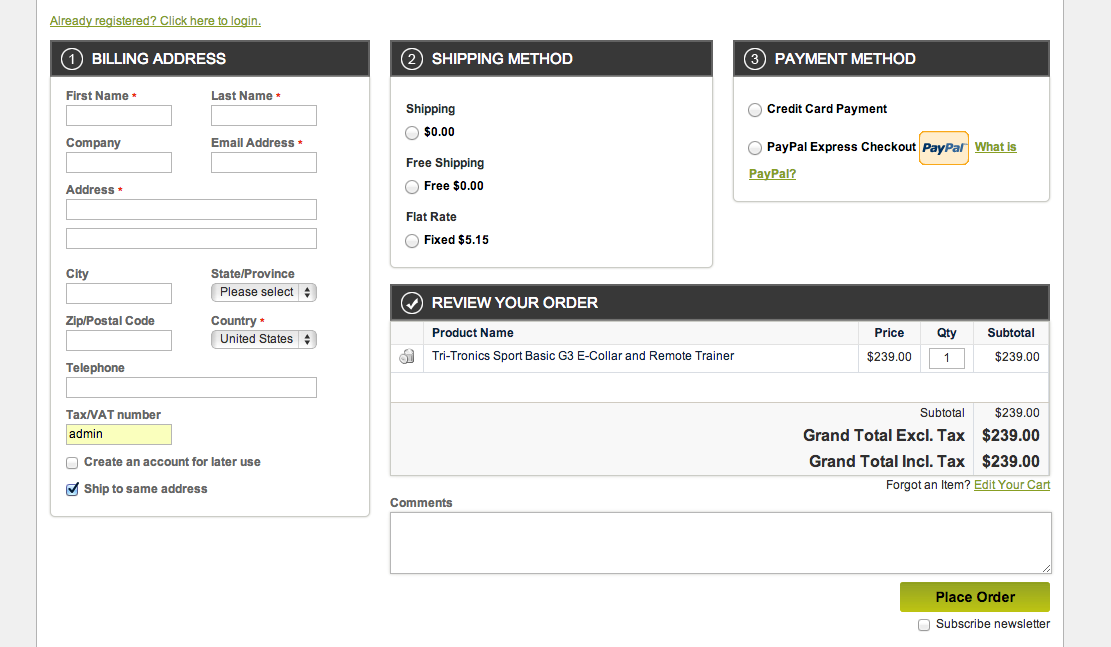
Magento one-page checkout extension is effective in nature.

Now, we will take a look at what the customer feel about one-page checkout.

1. Ease of operation:

Most of the customers found it easy and smooth to operate through the one-page checkout process rather than indulging in a lengthy page-by-page checkout. This one thing has contributed significantly on the conversion front.

2. Smooth navigation:

Another thing which customers pointed out was the smooth navigational aspect of the one-page checkout. Most of the customer found it easy to navigate through the login, credentials and transaction parts due to the single page arrangement. The column based arrangement and clear description helped them in sailing through the process.

3. Ease of correction:

This is one thing which has helped the customer to cut the hassle of re-initiation of transaction again and again. Most of the time customer found themselves frustrated due to re-filling of information in case they make a petty mistake in filling details. One-page checkout makes this task easy by allowing you the freedom of correcting that specific mistake without refilling the correct ones.

4. Mobile friendly:

Since a lot of traffic is driven by mobiles and tablets these days catering to the needs of mobile audience is very important. A one-page checkout fits in this process and saves the mobile audience from non-compatibility of their device (sometimes) to multi-page long loading checkouts. Also, it is often found that most of the multi-page checkouts are not responsive in nature, thus, causing a jolt to conversions.

5. Frequent page re-loading was a burden:

In generic multi-page checkout structure, the checkout process used to break as soon as a customer decides to update something in the cart. The updates could be anything from adding a new product, removing a product from the cart to increasing or decreasing a product quantity. With the introduction of one page checkouts, the frequent page re-loading has been curbed by the use of Ajax coding. Now a customer can perform all these tasks without reloading a page each time. So, a major burden has been removed from the customers and it has curbed the customer frustration up to a major extent.

Final say

Considering the positive feedback of customers in regards to one-page checkout this is a must-have for every website, in order to, excel their conversions. Various online modules like Magento one-page checkout extension are available in the market that can enrich your website with the feature. Magento one-page checkout extension is suitable for Magento based website and you should look for an extension that is suitable for your website platform.

Related Stories:
Why is shopping cart a must-add for your website?

The shopping cart has been one such feature that is making a buzz in the eCommerce arena. The feature has become a driving force for pulling conversions. Many eCommerce websites have already adopted it and those who have not are considering it. Having a shopping cart feature has become an unequivocal necessity, especially in the wake of cut-throat competition. In a scenario where cart abandonment is already acting as a huge revenue killer, loss of revenue due to some petty avoidance can be really drastic. Here, we will talk about the need for having a shopping cart feature on your website.

Advantages of a shopping cart

Now, we will take a look at those advantages which a shopping cart feature brings in.

  1. One-stop-shop: It acts as a one-stop-shop for data management. The customer can easily manage all those products and services that he/she wants to avail through a particular website. Apart from this, a shopping cart also contains data like customer name, card details, processing details, etc., thus making the transaction smoother.
  2. Stats and analysis: A shopping cart feature helps in maintaining the data and stats related to successful ( as well as dropped) transactions. This will help you to manage multiple requests from a single customer, which otherwise would be difficult to maintain.
  3. Discounts and coupons: An effective shopping cart feature allows you the freedom to integrate coupons and discounts into the transaction process. Other features like inventory tracking, customer review, etc., may also be channelized by the shopping cart feature. It acts as a profit-generating medium between payment processors and website.
  4. Customer and SEO friendly: By providing the customer with ease of transaction and instant access to product details as well as comparison, a shopping cart feature proves it worth in creating a customer-friendly environment. Apart from that, a good shopping cart ensures maximum traffic flow to your website by generating keyword rich URL for products and services, thus acting as an SEO booster.

Tools for shopping cart

To have a shopping cart feature on your website, all you need to do is to install an add-on compatible with the platform of your website. Prestashop Ajax cart module is one such tool for Prestashop-based eCommerce websites. You can choose from the variety of add-ons available in the market.

Last thoughts

Keeping in mind the target of conversion optimization, the addition of a shopping cart feature on your website will surely be a game-changer. To latch on to the revenue ladder you must ponder about the same.

Related Stories:

Boosting customer engagement and sales by encouraging reviews and opinions

Online shoppers have a habit of checking out reviews and opinions of other users before investing in anything. Even when you go to purchase a nail clipper from Amazon, you would see the bulk of customers reviews and opinions. If in case the reviews are all so good, then it takes no time to boost the product’s monetary value. Take the example of this nail clipper being sold on Amazon.

Good product reviews can have direct effect on the pricing of the products.

The above example explains how a bulk of positive product reviews can determine the pricing of a product. This example is aimed to explain the importance of positive product reviews. Instead it has been given to explain how product reviews are important and how people them very seriously.

Product reviews have become a habit

For every online customer, online product review is not just a piece of information on an eCommerce site, but it a valuable asset that maintains the credibility of decision making without even touching a product from hand. Product reviews have become an integral prat of any eCommerce purchase. It is one of the best ways to gather information about a product, plus one of the best ways to site owners to build trust and credibility among the customers.

It has become a habit of customers to check reviews before any online purchase. And, it is a good habit for sure.

Showing product reviews- using it as a tool for CRO-

With the growing competition in the eCommerce market, every website owner is looking for new ways to engage their customers. In most of the CRO campaigns, a proper focus on online product reviews is an inseparable part. No wise e-store owner would commit the mistake of ignoring product reviews and their role in customers’ decision-making process. Product reviews have always played a great role in Influencing the customer’s decision making and they will continue to do so forever.

Product reviews are not just about products, but other metrics are also analyzed using them. For example, a customer review might not just include his experience with the product, but it might also explain how the shipping services were and in what condition did he get the product. So, a single product review can guide your customers not just about the products but also about your efficacy in providing the shipping services.

How to adopt a better product review system on your eCommerce store?

If you own an OpenCart or a PrestaShop store then you get an effective product review system by default from the first installation itself. In PrestaShop, you might have to install an additional “Product comment” module which is a free module from official PrestaShop itself.

However, having a product review system alone is not enough. You have to encourage your shoppers to write review on your site about their experience with your products. These encouragements can be provided by using the OpenCart Review Incentive extension and PrestaShop Review Booster module. These modules are competent to encourage the customers to write reviews by providing them offers and discounts on their next purchase. You can use these modules for your review boosting campaign if you are planning to latch on reviews for better conversion rates on your eCommerce stores.

Liked This? You’ll Like These Too

Methods by which you can minimize cart abandonment on your store

Cart abandonment is a big issue that haunts most of the eCommerce website. As a matter of fact the average cart abandonment rate is well above 50% for most of the website. The issue is same but the way you tackle it makes the difference. An effective card abandonment strategy is what that can change the game for you. Here we will take a look at those strategies and will analyze how they work in reducing the percentage of your cart abandonment.

Tips to reduce shopping cart abandonment:-

Now, we will look at the various strategies that can be adopted to tackle the problem of cart abandonment.

The revenue at stake on abandon cart is huge, which cannot be neglected.

1. Provide multiple payment methods: Restricting the customer to a specific payment mode has been the most significant reason behind cart abandonment. Allowing the customer to avail the benefits from various payment methods like Paypal, Google wallet, Paytm, Mobikwik etc. has a good chance of turning an abandonment cart into a potential sale.

2. Be clear about your policy: Clearly, spell out your return and shipment policy in the content part of your website. This will enrich the customer’s confidence and will drive him to purchase the product as, he/she will clearly know what to do in case of return or delivery problem.

3. Avoid shipping charges: Try to keep out shipping charges as far as possible. The Customer really doesn’t like charges to be paid for delivery of their products. If unavoidable then try to lure the customer by providing some equivalent discounts or cash backs.

4. Provide social login registration: Allow the customer to enter and purchase from your website by channelizing his/her social login credentials. Restricting the customers for a specific registration process act as big turn off. Social login allows the users to purchase from a new website without necessarily creating an account there. The user can use their social accounts to sign up on-the-go in few clicks.

5. Provide some analysis: Provide some fact, analysis, data and reviews with regards to every product. This will allow the customer to get a holistic picture and make an informed decision. The more you inform your customers, the more they will trust your brand.

6. Utilize the power of mailing: Use effective innovations to retain the customer by customizing your abandonment card mails. An effective and attractive abandonment cart mail can be created using some good tools based on your CMS platform. Magento’s abandon cart extension is one such tool for Magento based website.

Conclusion

Cart abandonment is an issue that most of the eCommerce website are facing. The revenue at stake on abandon carts is huge and nobody wants to miss this big piece of cake. However the winner is one who adopts to effective strategies to counter this problem. Keeping in mind the level of competition in eCommerce arena, the adoption of the above-mentioned technique can prove to be handy for your website.

Liked This? You’ll Like These Too

Is marketplace model the new shift in eCommerce?

The government’s announcement in march regarding the allowance of 100% FDI in marketplace model set the bell ringing in e-commerce market. As most of the big e-commerce websites are adopting the marketplace model, we need to understand that what exactly is all about and how it can be the new shift in the market.

What it is ?

A marketplace model refers to an arrangement in which the e-commerce websites allow the small vendors and entrepreneur to use their digital platform so as to connect with large base of buyers. In lieu of their usage of the platform, the vendors pay a certain percentage of profit they gained through each transaction made online. It marks a shift from the traditional inventory based model where the e-commerce websites used to keep the stock in their warehouses. They had to update it regularly in accordance with the market’s demand.

How it can mark a shift ?

With most of the e-commerce business in developed countries going the marketplace way, the developing countries are also adopting the same. The reason for this can be sited from the fact that, the nature and structure of the marketplace model is such that it caters the demand of all the stakeholders involved. The customers get a wide range of product to choose form, while the sellers get an access to larger consumer base. The e-commerce website on the other hand enjoys certain benefits in terms of cost cuts, customer satisfaction, conversion rate, and commission from the sellers.

Another reason why the marketplace model holds a key is its inclusive nature. The offline shop owners who were left ignored after the advent of e-commerce era now get a chance to evolve themselves and reap the benefits of the digital market.

While providing such benefits, the one thing which marketplace model does silently is its contribution to the economy. By bringing in the small and medium vendors and start up in the picture, it widens the base of economy. Especially in developing countries where a large portion of market is captured by SMEs and start ups.

Transparency and seamless delivery are other such aspects which favors the marketplace model. With similar guidelines for all the sellers it promotes healthy competition. At the same time, it promotes transparency as the customers clearly know with whom they are transacting.

How you can adopt it ?

In order to shift your e-commerce website to the marketplace model you need to install the marketplace module of the CMS platform you are using for your website. For example, various marketplace module like Knowband’s Magneto’s marketplace extension, PrestaShop’s marketplace module etc. are available online. These modules are user friendly and easy to adopt, and allow you to get an overview through the free trial facility provided.

Conclusion

With the wind sailing in direction of the marketplace model, we need to wait and watch as how long it will take for the marketplace model to capture the market. Nevertheless with its add advantages, it presents a strong case against the traditional inventory based model.

Liked This? You’ll Like These Too

Why is content marketing effective for your marketplace website?

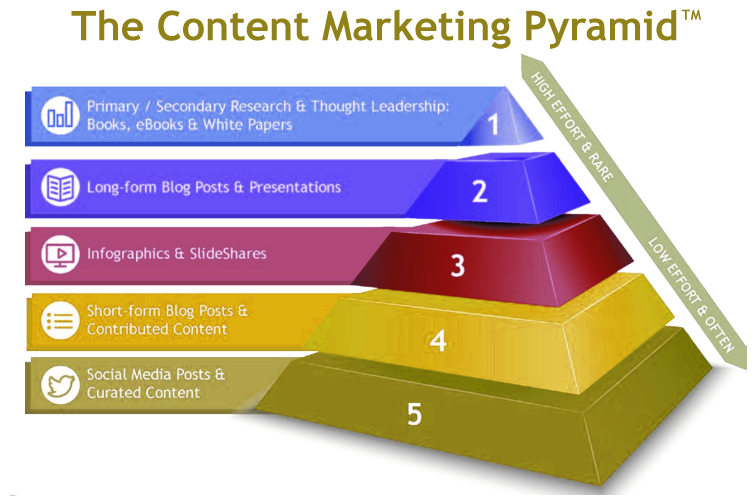
Marketing strategy plays a crucial role in deciding the fate of your business enterprise. A marketing strategy has the potential to either make or break the situation for your enterprise. Content marketing is one aspect of your marketing strategy that can do wonders to your business if properly utilized. Content marketing generally refers to the act of delivering the content that is relevant and interesting to your target audience. Even though it sounds general, it has been the area which is less pondered during your business discussions. We will here take a look at the reasons which make content marketing an effective part of your marketplace enterprise.

What does content marketing brings to your marketplace?

Content marketing involves a detailed structurization of your marketing strategy.

Marketplace model provides a good scope for content marketing, as there is always a chance of mixing up of irrelevant content due to the presence of a large number of sellers and a huge range of products. Now we will look at the aspects which make content marketing a necessity for your marketplace.

1. Ads doesn’t create value: The content that you put on your ads doesn’t arouse much of desire from the visitors. Though the branding aspects of these ads is high in a marketplace set up, but they often act as a disturbance to the actual content reading. You can structure your ads to provide a little more sneak into the product like price, brand, discount etc. This will act as the crux for the entire content and will make it a bit interesting for the visitors.

2. Makes customer realize the utility of the product: An ordinary display of content highlights only the seller’s aspect in its description. While a content marketing approach molds it into a description that describes its utility from the customer’s perspective. For instance, a normal safety shoe Ad will describe the product in length, but in content marketing approach can provide a detailed information of the same to the target audience.

3. Helps you in realizing the power of visuals: A content marketing guides you to make your marketplace more visitor friendly and customer-centric. It is always difficult to cramp through a detailed content for a range of products in marketplace set up. The content marketing approach helps you realize that its not the usual textual description that works all the time. Videos are an important part of your content set up. They not only help in making the website more engaging, but also provides a better insight and remembrance for the visitors. So, videos can also act as an important content on your product pages that works for both – product description and content marketing.

4. Helps in website SEO : Visitor’s land on your website either when they are looking for the product and services delivered by you or when they are searching generally for product and services that fall under your functional area. In this case, a market-oriented content will attract the maximum traffic through higher SERPs as it will be showcasing those keywords that the customer usually targets. Thus, marketing of content becomes essential, especially when you are dealing with a range of products.

Final say

The importance of adopting a customer-centric and user-friendly approach for your website is the need of the hour for all the websites. However, o run through text charges and they worked, orders were created.

Suggested Post:-

How to grow your business with multi-vendor marketplace model?

The multi-vendor marketplace model has created a sensation since it arrived in the e-commerce arena. The growth and expansion opportunity that it brings along are seen as the driving factors behind its success. The adoption of the model has bought some effective results for those who have adopted it thus, substantiating its success.

Initially, the developed countries were latching on to the model but now after the effect, it has created, developing countries are not far behind. You might be wondering how a shift in a model can bring such a difference to your business growth. To make your job easy we will here discuss on how a multi-vendor marketplace model helps in expanding your business growth.

Multi-vendor marketplace vs business growth

After taking a look at the general trends of the marketplace model, we will now shift our focus towards its positive effects on your business.

  1. Base expansion: By allowing the integration of various vendors on to your platform, a marketplace module expands the base of the products and services offered by you. More the number of choices you offer, more are the chances that the visitor will turn into a customer. Thus, a direct boost to your conversion rate.
  2. Deeper market penetration: As the multi-vendor model involves the integration of sellers from various regions, it becomes easier to cater to the early shipment needs of the customers. This allows you to reach the customers even at the remotest corner, thus increasing your market penetration.
  3. Cost-cutting: The shift to multi-vendor model takes away the responsibility of product update, inventory management, and SKU up-gradation. This, in turn, cuts the cost involved in managing these expenses without even disturbing the flow of your business. You can utilize these resources in some other aspects of your business like the enhancement of your product shipment through integration with different shipping solutions.
  4. Efficiency: With multiple vendors involved, the process of procurement, packaging, and shipment take place in a more speedy and efficient way. Unlike the traditional model, where all these responsibilities rest with a single unit that too for the entire range of customers, this division of labor makes the task smooth and simple.
  5. Customer satisfaction: By enriching your business with the above-mentioned features, the last thing which you can expect from the model is ensuring customer satisfaction. The aim of any business is to satisfy the customer with their product and services and to cater to this need you need to devise methods that cater to this effect.

Final say

Expansion and growth are what any business love to witness. To achieve these aims for your business, you need to ensure that your business is leaving up to the extent of its full potential. Multi-vendor marketplace model is one such tool you can rely on expand your business reach.

Liked This? You’ll Like These Too

E-commerce platform that you can opt for your multi-vendor marketplace

The e-commerce world has started shifting its base towards the multi-vendor model in the past few years. The traditional inventory model which used to be the king some while ago is now becoming a choice of lesser importance. The reason for which it is cited in the nature and scope of the multi-vendor model which fits in with the aspirations of the e-commerce world. Being mutually beneficial and inclusive in nature, it not only caters to the demand of sellers, but also brings delight to the customers by providing a wide range to choose from. The importance of having a multi-vendor platform for an e-commerce website is what that cannot be bogged down. But, what are those platforms that offer you a chance to build such a platform for your website? To ease your task a bit, we will discuss some of the trending multi-vendor that you can choose from.

WordPress

WordPress is a reliable name in the market.

With a market share of over 23%, the reliable support for the website, WordPress, needs no introduction when it comes to discussing the e-commerce platforms. Being a reputed name in the market, WordPress offers a smooth transformation for your business into a multi-vendor setup. The various customization and management features offered allows you to cut the hassle which comes in with the management of a multi-vendor marketplace.

Magento

Magento is another open source platform for your website.

Magento is another such name in the market which entirely focuses upon enriching your e-commerce experience. With a dedicated support for your e-commerce website, Magento is a name you can rely upon. Through Magento marketplace extension, it allows you to adopt the multi-vendor mode for your website. By providing an option for separate seller profile with specific login, it provides freedom of managing and updating the products to the vendors. Thus, providing them with the experience of a personal e-commerce set-up for their business.

Always being the first choice of any large scale online business setups, a Magento store can always be converted into a marketplace site using any of the better Magento multi vendor marketplace extensions.

PrestaShop

PrestaShop has been there for a while.

Being there in the market for a decade or so PrestaShop has tightened its grip with its service quality and features. With over 1,00,000 sites availing its services, PrestaShop stands as a strong contender to be chosen for your marketplace website. The features offered include easy integration of multi-payment options, simple registration, and profiling of vendors, easy customization and effective product and service management. All these contributes in the transformation of your business into a multi-vendor mode for a smooth ride.

PrestaShop has always been a first choice of most of the business startups. With the availability of effective marketplace modules like Knowband-PrestaShop marketplace module, it has become so easy to convert your PrestaShop store in to PrestaShop marketplace site.

OpenCart

OpenCart provides you a seamless experience.

OpenCart is one such platform which stands among the top in the business. With e-commerce specific features and valuable modules, OpenCart has always ensured a seamless business transaction for its users. Features like e-mail payment notification for vendor and personalized store management makes OpenCart a good choice to opt. Moreover, OpenCart is one of the easiest eCommerce platforms to learn to work upon. With high affinity to extendable feature using OpenCart Modules, it possess a major flexibility to get converted in to a marketplace site using any of the efficient OpenCart marketplace addons.

Final say

The above-mentioned e-commerce platforms are some of the tops in their section. Their user base and market credibility are ever increasing. In order to, make a smooth transaction for your multi-vendor set-up, you can rely on any one of them.

Liked This? You’ll Like These Too

What are the components of a Multi-vendor marketplace model?

Multi-vendor marketplace model has been making the buzz ever since it was introduced in the e-commerce industry. The mutual benefit sharing and inclusive nature of the model brings a win-win situation for all the stakeholders involved. However, The key component that culminate to make a successful model is a topic of discussion for many. Here we will discuss those essential components that a marketplace model of e-commerce is composed of.

Component of Multi-vendor marketplace model

Blind adoption of anything can be dangerous. Hence, go true with the Multi-vendor marketplace model.

Now we will take a look at those components of marketplace model which make it a success.

  1. Easy inclusion of vendors: An effective Multi-vendor model allows easy registration and listing of products by a vendor. Vendors require an easy procedure for listing their products. Also, many vendors ask for an own profile page to effectively extend the reach of their product. This profile provides the vendors with an interface like their own website. The vendors can upload and manage their products using this interface.
  2. Feedback and reviews: As a large number of sellers are involved in a Multi-vendor model, customers generally do not prefer to contact the sellers directly. In this case, they look for an alternative such as an online review or feedback from the established customer about a particular vendor. A good Multi-vendor caters to this need by providing the customers an option to give a review or decimate feedback using their account or email id.
  3. Smooth search feature: An effective marketplace model allows you to easily search for a desired product or vendor in a sea of vendors and from around a range of products. With the ease the customer is able to locate the product on your website, the higher are the chances that he will convert it into a purchaser. Thus, your conversion optimization is at stake when we talk about this component. Any effective marketplace module that follow the standards, will provide this functionality for sure.
  4. Price management: Due to the involvement of a large number of sellers, there is always a chance of price variability for a particular product. Thus, an effective Multi-vendor platform must cater to this need and shall assist you in maintaining the price of the products in accordance with its features. Moreover, as you are involved in the process, you will be generating an effective amount of money in the form of commission. So, management of your profit margin shall also be assisted here.

Final Words

Catering to its popularity in the market and the role it plays in your conversion optimization, a Multi-vendor model becomes an indispensable addition for your e-commerce website. You can easily adapt to this model by installing a Multi-vendor module in accordance with your eCommerce platform. Magento multi-vendor extension is one such software for Magento based e-commerce website.

Liked This? You’ll Like These Too

Why they abandon the cart? A customer’s perspective on cart abandonment

Abandoned cart is the biggest revenue killer for all those e-commerce websites that are operating out there. With an average cart abandonment rate of over 50% for almost all e-commerce websites, the question arises, what is the reason behind it? To get a deeper look at the problem, we need to look upon the issue from the perspective of a customer to understand it better. Here, we will discuss those points which annoy the customer to abandon the cart.

Why customer abandons a cart?

  1. Lack of details: Most of the customers point out that due to lack of certain information like return and shipment policy, they are forced to abandon the cart. This information is crucial as they contribute in promoting transparency and builds a customer connect instantly, as the customer knows what to expect from your side.
  2. Website crash/slow loading: This is another major reason which customers find very annoying. Since the whole meaning of e-commerce is quick, easy and seamless transaction for the customer, unnecessary delay in loading and unwanted crashes of your website would give a huge blow to this seamless experience. Thus, you must ensure that your website is bug-free, responsive and up to date so as to cater the needs of the customers. You need to work on your website loading speed immediately if it is having any such speed issue.
  3. Lack of payment options: Limited payment options during checkouts act as final nail on your conversion rates coffin. Nowadays, customers want to avail the benefits offered by various payment modes so as to avail the discount on their purchase. Restricting the customer to a particular payment mode not only results in cart abandonment but also restricts your customer base. Because, some customers may not want to use that payment method or they do not have an access to the payment mode which you are offering.
  4. Lengthy checkout process: Long checkout process with lots of unnecessary details to be filled often forces the customer to opt out. Nobody likes to wait for loading of 5-10 pages to fill a detail information when his/her motive is a fast and easy transaction. In this regard, you need to update your e-commerce website with any of the One page checkout modules based on your CMS platform. PrestaShop One page checkout is one such addon which you can opt for your e-commerce website.
  5. Shipping charges: Asking for shipping charges act as a great diverge for your conversions. Most of the customer that transact online prefer to purchase from a website that offers free shipping or a minimum charge for shipment. Customers generally don’t like to pay charges over and above the product price and when certain shipment charges are added they make the product costly from the customers perspective. Moreover, customers can easily find an alternative to your site which might offer free shipping on the same kind of purchase.

Conclusion

Looking at the problems from the customer’s perspective has an optimum chance to deliver you with certain positive solutions. Cart abandonment is one such problem which requires itself to be analyzed from the customer’s perspective. The points discussed above would certainly help you in getting a deeper insight into the problem.

Liked This? You’ll Like These Too