Vishakha can be found writing, crafting or digging Earth. Her love for writing made her switch her profession from a Geologist to a Writer. Additionally, she likes keeping herself engaged in crafting and redecorating spaces. You might found her posting 3 am poetry on her Instagram story. Her proclivity for writing is never-ending.
AI is the fastest-growing tech industry and recently, Mailchimp added some striking features and updates to make the customer journey smarter with some smart solutions. They quoted this press release with the tagline, ‘If you’ve got big goals, we’ve got big updates’. There are millions of businesses registered and customer data of billions are available on Mailchimp.
To build the smart solution Mailchimp used all the available data. The new update of Mailchimp AI Integration is incorporated with Stripe, a redesigned App, creative assistant which is entirely focused on personalization to enhance the customer journey. Let’s dig deep into it and find out what and how this newly updated Mailchimp can help the e-commerce industry.
App redesign:
Mailchimp development team have redesigned the application with all new developer experience with native client libraries and mobile SDKs. The Mailchimp APIs can manage audience data, send campaigns, activate event-based messages, and more. The global infrastructure of Mailchimp can be utilised to send fast, personalised transactional emails, high deliverability rates, and scalable analytics through API or SMTP.
Creative assistant:
Mailchimp used AI to give the best personalization experience to the customers. It creates assets for design automatically with pre-existing designs and alters them as per the command. Consider an image with a caption you have designed earlier and now you want to use that same content for other applications having different layout. With Mailchimp, you can make a new design in just a few clicks.
Visual automation builder:
The main focus of building this smart solution was to improvise the customer journey. It helps users with the next best advice for action by giving recommendations for improving campaign performance. It can grow business and uplift sales with personalizing product recommendations.
Users can send emails at any time with auto-trigger functionality. Mailchimp sends targeted campaigns to future leads. The new version suggests some catchy taglines and subject lines for email marketing. It includes real-time input on word count, count of characters, punctuation, and use of emoticons.
Building your online presence:
With Mailchimp, small businesses can make their online presence. Since the pandemic hit the economy, many queries were raised and this forced Mailchimp to create features with an AI-driven approach. They have incorporated domain purchase options for adding it to email marketing. Another tool that will be launched soon is a website builder tool that will not require any coding at all, mentioned in the Mailchimp latest release. Users can incorporate buy buttons and much more to bring their brick and mortar to the online platform.
New tools for personalizing marketing for e-commerce:
Mailchimp and e-commerce: Mailchimp have data of all the possible customers so they have built the solution which can be used for a growing audience if you connect your eCommerce store to Mailchimp. It can predict purchase probability, by using previous purchase details in which customers are likely to be the most loyal and valued clients.
Mobile landing pages– Mobile app integration is another key tool that has been added to the Mailchimp AI update. Now users can add more new contacts or upload new from the address book.
Run Surveys with Popup forms- It has eye-catching survey popup forms to attract more visitors for gathering information that can be used for improving customer experience with personalized marketing.
Grow an audience with e-commerce integration- G-Suite Add-On with Google’s business software and technical email addresses.
Author’s Opinion
Mailchimp is the most powerful marketing platform founded back in 2001. It’s been two decades and it is still flourishing. These new solutions, software upgrades will allow many small businesses to work smart. E-commerce can take advantage of creative intelligence-backed tools, a visual automation builder with a redesigned app built to help companies expand alongside their ambitions. Let’s see what magic Mailchimp AI integration expel on e-commerce in upcoming years.
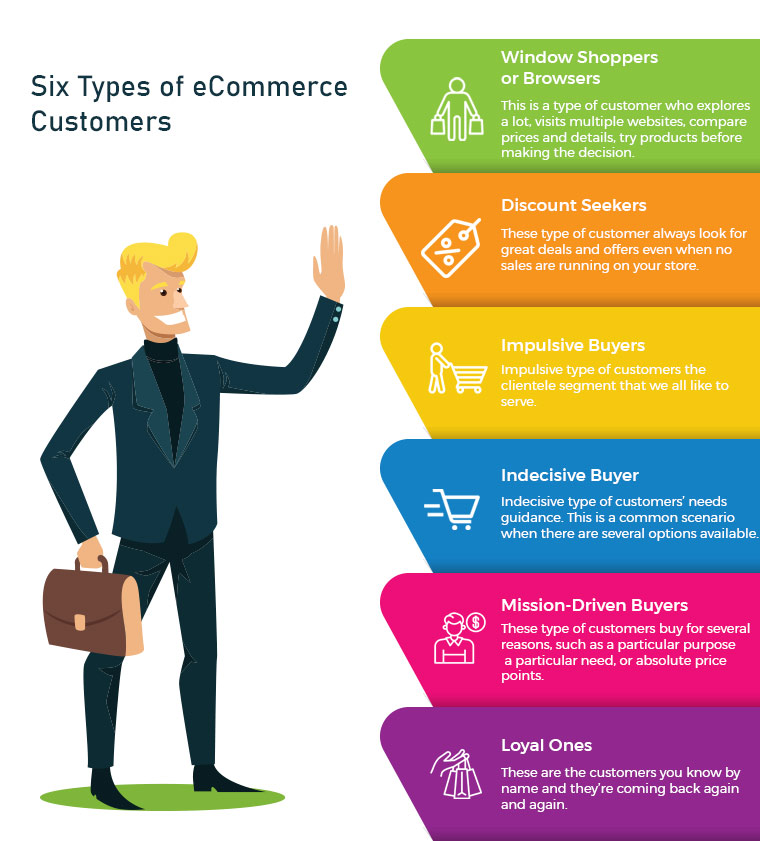
Online shopping is increasing, and customers who are enamoured with eCommerce sites spend countless hours researching the goods they want. There are some very popular quotes which make shopping, therapy, cardio or a hobby. It makes evident just how fixated people can be. There are many different types of eCommerce customers, therefore business owners need to keep each one not just entertained but also motivated to make purchases.
Some eCommerce customers like exploring before buying and some have a focused approach with a to-buy list which makes them good customers. But, being a retailer or eCommerce store owner, you cannot rely on one type of customer. Every shopper is different and they follow a certain pattern of buying with different priorities. Being a retailer, you must have gone to a lot of stores or manufacturers before choosing the item for sale. You also have a pattern which makes you a type of customer. I’m going to talk about some distinct categories of consumers that store owners frequently deal with and offer some expert advice on how to handle various types of eCommerce customers in your business to increase conversions.
1. Window Shoppers or Browsers
The number one on the list is servers or browsers. This is a type of customer who explores a lot, visits multiple websites, compares prices and details, try products before making a decision. They add products to their cart but never intended to shop from them. Yes, there are many such buyers and you may call them a pain. Can you do something about it? Yes, I guess. There can be ways to attract such visitors and encourage them to buy products from your store.
Greet them well:
If you are a retailer, you must remember to greet them well. Even if they are not asking for any assistance you can provide them one. eCommerce store owners can add any entry or exit popup such as Better Thank you Page module to their store for greeting these types of customers.
Entry or Exit Popup:
Some of the easiest ways to engage your consumers are by the use of innovative methods. The customer’s attention must be drawn to the digital interface and manner of presentation. The gamified interface of Spin and Win Pop-up attracts shoppers to your store. This is a 3-in-one pop-up which is used as an entry pop-up, exit pop up or an email subscription pop-up.
Don’t ignore the browsers, they can become your loyal eCommerce customers if treated right.
2. Discount Seekers
These types of eCommerce Customers respond well to pushy sale tactics. They always look for great deals and offers even when no sales are running in your store. For attracting such buyers you should focus on highlighting what they will save on that particular deal.
Host Clearance or Flash Sales:
These discount seekers can give you huge sales if provided with flat discounts. Clearance sales can be a good option. The products that have been stocked in your store for months can be sold out, and customers looking for discounts will benefit from it.These sales can be a key contributor to your cash flow which will make room for the new products by removing the older ones.
Scratch Card:
You can provide your customers with Scratch Cards while having a purchase. Customers will be attracted to the alluring coupons which can save their deal a lot.
Free Shipping:
Free shipping encourages customers to buy more from your store. A fixed amount of purchase is to be made by the shopper to get free delivery.
Impulsive types of customers are the clientele segment that we all like to serve. Nothing is more exciting than helping the impulse shopper to respond favourably to your recommendations. Impulse shoppers, also known as emotional shoppers, make unplanned purchases based on items that are currently appealing to them. Online shopping is a popular example of pulse or emotional buying. They look for products which attract them and you can do that by showing related products or by offering personalisation.
Show Related Products:
If you are dealing with an impulse buyer then make this chance an opportunity. Because they shop when they like it without giving a second thought. Show them what’s new in the store and let them feel, that they will be out of the race if they don’t own it. This can be done with modules like related products.
4. Indecisive Buyer
This is a common scenario when there are several options available. For instance, search for a floral top and the results will blow your mind. hundreds of products will start appearing in various stores. Deciding one will be difficult. Indecisive type of customers needs guidance. Ask them questions and give honest advice. A flexible return policy can also help them with their shopping.
Ask Questions:
Shop owners can help them decide what they want. Provide them with chat support or in-store assistance for choosing the right product. This effort can turn them into loyal eCommerce Customers.
Product Custom Field:
You can add a product custom field with the product description. You can add a field with related questions which can help you understand the need of the buyer. Advance Product Feld extension can be a good fit to improve UX.
Return Manager:
An indecisive customer will be encouraged if he/she knows that the product can be returned if they don’t like it. The Return Manager is a good module to add to your eCommerce store.
5. Mission-Driven Buyers
These can be called researchers or need-based customers. These customers buy for several reasons, such as a particular purpose, a particular need, or absolute price points. As difficult as it can be to please these individuals, they may still become regular customers if they are well taken care of. Provided with a good customer experience which is not available online or on other retailers stores can turn them into loyal customers.
Offer buy-online, Pick Up In-Store:
These types of buyers do not have much time to spend in window shopping or i-store shopping. They can make the purchase online and pick up the product from the store. Implement this new pick-up and drop option in your store to attract mission-driven buyers.
Cross-Selling:
Retailers can help the need-based customer with cross-selling techniques. You can place bread in related products while they are buying milk or a mobile cover if they are purchasing a mobile. The Automatic Related Product module can help you show relevant products on various pages such as the product page, the home page, the shopping cart page, etc.
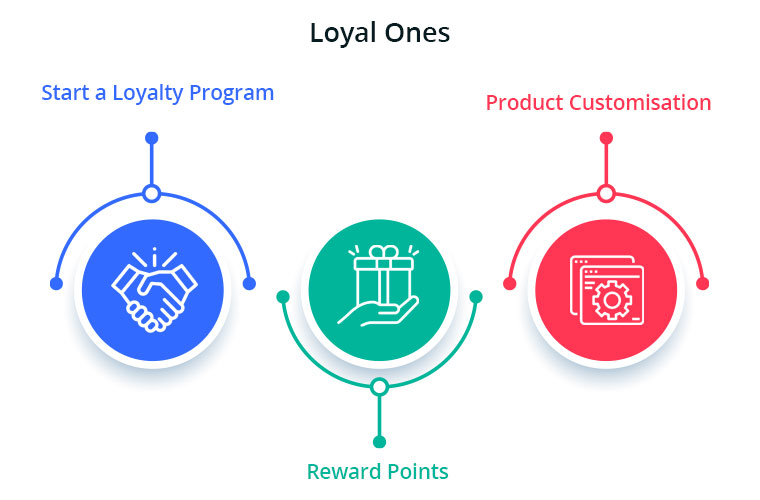
These are the customers you know by name and they’re coming back again and again. Loyal eCommerce Customers already know and enjoy your shop, so now you need to keep them happy. Offer customisation and personalised experience and never lose them to others. The best ones are difficult to find and it is your responsibility to give them your best services. You can give them reward points or loyalty points on every purchase. These types of customers are the best marketers for your store as the more they shop, the more will be the word of mouth communication.
Start a Loyalty Program:
Choose a module or plugin for your eCommerce Store to give loyalty points to your loyal ones. This will motivate these types of buyers to shop again and again from your store. During checkout, the loyalty points can be redeemed for a discount.
Reward points:
You can also give them reward points on various purchases like first purchase, on a fixed amount order, on particular products etc. The reward points encourage the buyer to make more purchases. It helps the admin boost customer engagement and creates loyal customers.
Product Customisation:
Product customisation and personalisation can turn your sales to the next level. this is one of the most accepted trends. Help them get a personalised product of their taste. The best module for giving a customisation experience is Product Designer/Customization which can provide several choices to you and shoppers.
Using this understanding to help turn deals, desires, needs-based and even casual customers into loyal ones will help the business expand. At the same time, ensuring that your loyal customers have a good experience every time they visit your store would only boost your bottom-line income.
Thanks to the idea of hyperlocal business models which are redefining the economy with on-demand delivery models. The idea of home delivery is gaining ground and businesses are cashing in on it. BigBasket a famous brand have established their hyperlocal marketplace in the year 2016 and the change in the pattern has provided a wide range of product availability to the customers with super-fast delivery.
With hyperlocal delivery model, BigBasket established an online marketplace for local vendors and sellers and they have integrated a network of all the possible bakeries and popular vendors. This move opened up the doors for many small businesses to grow with the help of a marketplace.
There are multiple types of online marketplaces categorised based on industry, focus and target audience. We will be discussing them one by one and how the Multi Vendor Marketplace Module can help you build your own marketplace is explained.online
Online Marketplace based on Core-Focus:
There are two types of online marketplaces based on focus segments: There are marketplaces that provide either one type of service or sell one category of products and the others are a hub for multiple services with a variety of niche.
Vertical Marketplace
A marketplace providing a single type of service and not diving into the pool full of fishes. Let us consider an example of Etsy, what started out as a simple place for people to sell crafts has become a behemoth.
Horizontal Marketplace
A marketplace where you will find many services or different types of products on one online platform. For example, a mall where you will find all the brands and products under one roof. An online eCommerce marketplace like Amazon is a horizontal marketplace.
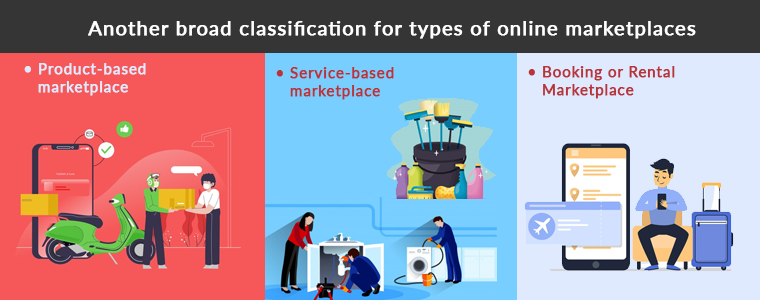
Another broad classification for types of online marketplaces
A major feasible classification for the online marketplace occurs on the verticals they are offering:
· Product-based online marketplace
This type of online marketplace deals with selling products. Like Amazon and Flipkart are product based marketplaces. Commission and subscription are the two ways product based marketplaces earn money. They can even charge for delivery fees.
· Service-based online marketplace
An online marketplace where service providers can list and provide services like personal care, cleaning, plumbing, appliance repair, pest control, graphic designing, etc.
Popular service-based online marketplaces are the Urban Company, Fiverr, Upwork who are providing multiple services with hundreds of categories.
· Booking or rental online marketplace
No chance you haven’t heard about a booking or rental service providing an online marketplace. Ola, Uber, booking.com, MakeMyTrip are the most popular websites for booking or rental Marketplace.
A platform or an online marketplace for the purchase or sale of goods and services through wireless handheld devices or mobile phone
eCommerce
A two-party site, e.g. seller – shopper, company owner – investor, etc.
The crowdfunding-the website enables people to post their projects and raise funds through fundraising efforts for their execution.
Marketplaces on the basis of Customer Type:
B2B – an online marketplace for the exchange of goods or services between companies or two business merchants
B2C – an online marketplace for the transaction from the merchant to customer for goods or services
C2C– an online platform for the transaction between customers for goods or services
How to start a Hyperlocal Marketplace with Multi Vendor Marketplace?
An online marketplace should have a seller and customer-driven features covering all possible requirements of the admin, seller, and the consumer. A multi-vendor marketplace extension is a module that can serve you well for setting up a B2B or B2C marketplace.
You can customize the settings as an admin. With Multi Vendor Marketplace module the seller who registers on your marketplace can easily manage the functionality for providing the service or selling a product to the customers.
Benefits of Multi Vendor Marketplace
Protection and guarantee for users
Authentic sellers and customers
Customizable settings and easy to configure from admin and sellers end
Track product details and orders for operating intermediate transactions
Marketplace handles the complete process
Multi vendor Marketplace provides superior customer experience
How to generate revenue with an Online Marketplace using Multi Vendor marketplace addon?
Based on Commission Model
How does the commission model work for Multi Vendor Marketplace? A commission is a percentage or amount of money a person gets when the product or service is being provided to the customer. With the aid of Marketplace Module, the store admin can set up a global commission for the sellers.
Using Multi Vendor Marketplace, commission for the individual sellers can be set. It provides the marketplace owner with the functionality of the category level commission. Marketplace admin can charge different commission rates on various marketplace product categories.
By offering a Membership Plan
Membership plans allow the store administrator to launch a subscription-based program. If the store administrator allows membership plans to work, then all new sellers and current sellers will have to purchase a marketplace membership to list their goods in the Multi Vendor Marketplace.
The marketplace owner can allow a free membership plan in which sellers can list only restricted products. Store admin can also send custom notifications to those sellers whose membership plans are about to expire. By giving a free subscription for a limited period will grab you more sellers in your market place.
Conclusion:
Some vendors and small businesses think it is easier to sell their goods in an online marketplace than to build a website and look for technological tools that handle several e-commerce sites. A marketplace is easy to manage with multi vendor marketplace addon.
If you’re willing to have an omnichannel approach with several online marketplaces, research all the industries and niche and think about which one suits you best and looks more lucrative, to begin with. Then we’ll help you keep your product details in order, safely, conveniently for all your marketplaces and networks.
Online reviews and ratings are a medium for customers to share their feedback with the seller and the world. In Magento 2, the product rating is an inbuilt feature but reviews play a pivotal role in increasing sales and decreasing product return rates. How about offering incentives for a review? For collecting more reviews you can offer incentives as a reward to the customer with Magento 2 Product Review and Rating Extension. Genuine reviews build trust through transparency and Google SEO prioritises the company or products which includes product rating and reviews.
In this article, we will show you how to attract more visitors to give product ratings in your Magento 2 store in exchange for the incentives. A survey says 92% of the consumers now read online reviews. There is a possibility that the product is getting less than 3 stars or poor reviews which drives customers away. This is a chance for the seller to accept the flaw and work on the product issues based on genuine reviews.
It is important to have a review section on the product page as 88% of online shoppers take the purchase decision based on star ratings and reviews.
Magento 2 Product Review Reminder and Incentives Extension collects and displays valuable reviews which encourage other customers to buy the same product. Offer Incentive to collect Product Review and Rating with Magento 2 extension.
Offer Incentives for a review
With Magento 2 Product Review and Rating Incentives Extension you can offer some amount as an incentive to the visitors or the existing customer for dropping a review for the product. Store admin can approve or disapprove the review. After the approval by the admin, that person will get an incentive as a reward.
Email Notification informing if you are lucky to get the incentive
An email notification will be sent to the reviewer if admin approves the review and accepts it for incentive reward. The Magento 2 product review and rating extension have some pre-crafted email templates for:
A notification mail to admin will be sent if someone writes a new review
When a review is accepted and incentives are included
A template when admin accepts the review and exclude incentive
An apology mail template when admin disapproves the review
Entice the customers with an incentive-plan reminder email
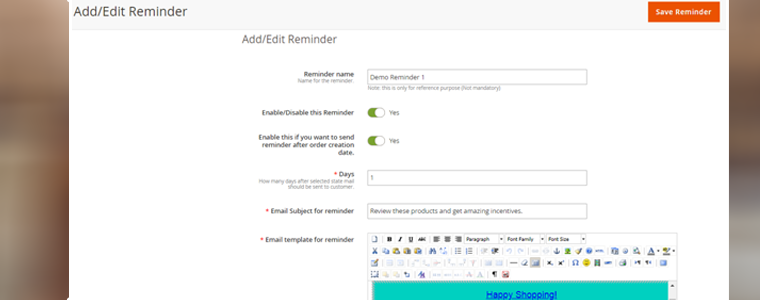
A custom email setting for the reminding about the incentive plan against a review is an alluring feature of Magento 2 product review and rating extension. Admin can set a time and shoot a follow-up mail to the customers reminding them about the review incentive plan.
Exclude product from review booster and incentive system
If Magento 2 store wants to exclude some of the products from review booster and incentive system then he can. The review and rating system for Magento 2 allows admin to configure the exclude settings by adding products or categories for which he/she doesn’t want to offer an incentive amount.
Keep the record
There is no harm in analysing the reports and keeping the track of product reviews reports and customer’s reports. With Magento 2 product review and rating incentive system, the owner can see the review reports, product review reports and customer review reports with the incentive details.
Why Review Reminder and Incentives Extension matter?
Reviews can be negative or positive and before buying a product people choose to read both. Try approving mixed reviews otherwise, the customer finds it suspicious.
There are some advantages of having a review system in your eCommerce store:
Transparency and trust: It builds trust through transparency and customers prefer buying products with good reviews.
Reward with Incentive: Allows customers to earn incentives by giving feedback
Google might show you on top– Google improves your SEO ranking in search results if your website has a rating and review system.
Lower returns: Customers rely on feedback for purchase and it has been observed that the return rates decrease for a reviewed and rated product.
Genuine feedback: You can improve the quality of your product by observing the reviews because genuine feedback allows you to analyse the faults and issues of the product.
Final Thought:
As I mentioned earlier that a review can be positive or negative and I prefer reading negative reviews over positive ones. Not because I rejoice or derive pleasure from the misfortunes of others but to find out if the product is worth buying or not. Magento 2 Product Review Reminder and Incentives plugin is a good option if you believe in close-review system because the owner can approve the reviews before displaying them.
If you are looking for a product review extension for Magento 2 store then increase your sales and conversions with this perfectly designed module. The Product Review Reminder and Incentives module is also available for PrestaShop and Magento platform!
If you have any queries or suggestions then feel free to drop one in the reply section. Or if you need any assistance, you can contact us at support@knowband.com
Affiliate marketing is the passive income source and many are taking the advantage.
Affiliate marketing is one of the ways to make money with promoting and branding other people’s product through the affiliate network and getting some commission over the sell. Marketing is like asking someone out on a date and branding is the reason they say yes. Presenting the content in a way that they click over the provided link and convinced to buy the product is the key strategy for affiliate marketing.
People often search for Affiliate Marketing on Amazon. Amazon affiliate is the largest affiliate program globally. Content creators, publishers and bloggers can monetize their traffic with Amazon Associate program. There are different ways one can earn with affiliate marketing.
How Does Affiliate Marketing Works?
There are 4 parties involved in affiliate marketing. Before that, it is necessary to understand how it works. There are two major components which are involved in the process. One is the creator and seller of the product while the Second is the affiliate marketer. The process starts with the seller or the merchant, affiliate networks are the mediators who promote the product which is to be purchased by the consumer.
The Merchants:
The seller or the manufacturer of the product who intends to sell the product and earns a direct profit. A merchant is a party who creates the product.
A merchant party can a big shot company or a small business owner who is manufacturing a product.
The Affiliate:
Affiliates are the one who promotes the product. They can be an individual or a company who is dedicatedly generating revenue through affiliate marketing.
Affiliates do their job with social networking sites, by creating SEO content or through captivating videos. They can give product reviews or write appealing content which will convince the consumer the buy a product.
The Affiliate Network:
Not everyone considers the affiliate network an important part of the chain. In my opinion, the affiliate network plays a vital role in affiliate marketing.
Affiliate networks are intermediaries that connect bloggers and entrepreneurs (“publishers”) or the affiliates to businesses (“merchants”) that offer affiliate programme opportunities for their products or services.
The Consumer:
It is the last and most important party involved in affiliate marketing. All of the efforts will go in vain if the affiliate or affiliate network fails to attract and convince the potential customer.
The content should be convincing so that the consumer ends up buying the product. A review blog can be an excellent way to start with.
Is affiliate marketing easy?
I am afraid that I won’t say what you want to hear. Affiliate marketing isn’t easy but with more traffic, more clicks and conversions, you can generate revenue.
If you are a newbie and want to get started with affiliate marketing you should start finding the problems people face while buying a product. The information helps the user solve a problem. Offer them a perfect, presentable solution for the issue, and there you have your first customer.
Choose a category or a niche for the blog or video, and expand it eventually. The affiliates or affiliate networks earn hundreds to tons of dollars with affiliate marketing programs.
How to become an affiliate marketer?
To become a merchant you have to come up with a new innovative idea for creating a product. To become an affiliate marketer you need to choose a niche, collect some customer information, present it well and finally get paid.
Register yourself with a merchant or a company as an affiliate marketer. Every company pays a variable amount for every product. It is generally percentage-based and they provide you with a link which you need to use while promoting the product.
Every sell with that link will add some money in your pocket.
Begin with reviewing the product through a blog or a YouTube video. More the visitors or subscribers more are the chances to earn.
Next, you can collect details like the email of the visitors for the follow-up. It is good to do email marketing and follow your leads.
Third, you can invite leads to live webinars and do a live product review. You can promote your webinars on social media platforms. Many sources are available for conducting live sessions.
Lastly, you can promote your products through referral marketing. Refer and Earn plays the trick.
How a merchant can take advantage of affiliate marketing?
Affiliate marketing and referral marketing program can be beneficial for the merchants, manufacturers, sellers and vendors. They can generate more revenue by offering some commissions over the products an affiliate sells.
There are affiliate marketing tools available for PrestaShop and Magento stores on Knowband. In my previous blog, I have discussed how you can acquire new customers with referral and affiliate marketing tool for PrestaShop store. A merchant can boost conversions and increase brand awareness with affiliate marketing.
The Affiliate and Referral Program- PrestaShop module helps you in many ways. You can refer to the blog post or the user manual for its features and benefits. The extension for affiliate marketing is also available for Magento and Magento 2 platforms.
Wrap-up
The affiliate marketing or passive income sources will not make you a billionaire overnight. With extra efforts, meaningful content and a strategic approach you can at least make decent money in some time. With reinvesting the money in blogs or website you will increase the chances of earning more with the expansion of your audience.
If you are looking for something which can help you earn money even in your sleep then affiliate marketing can be something you should start with.
Do you own an OpenCart store and willing to start a marketplace business? OpenCart Multi-Vendor Marketplace extension by Knowband is an exemplary plugin available for your OpenCart Marketplace business.
You must be coming up with a lot of questions for the same. First, what makes a multi-vendor marketplace an appealing business model for a peer-to-peer, B2B, or B2C business? The thing is: you want to make sure that you are working on the most profitable possible business. And that is just what a marketplace is. You can choose an industry to start your business with.
How does the OpenCart Multi-Vendor Marketplace Extension work?
If you are looking for a well-developed option for managing admin and seller interface then OpenCart Multi Vendor Marketplace extension is the solution. The extension has a separate admin interface and seller interface along with the front-end.
The registered seller is provided with a seller dashboard to manage all his orders, product inventory, delivery, and payment gateways and what not! The seller can easily register for selling his products on OpenCart Marketplace and access the dashboard. This is what a marketplace owner wants.
OpenCart Multi-Seller Marketplace plugin has a flawless admin interface that allows admin to manage all the sellers easily. It makes the seller commission management effortless. Proving multiple product choices in different categories is now handy with the OpenCart Marketplace extension.
How Admin of OpenCart Marketplace is Benefited?
Setting up a marketplace itself is an optimum business idea. This can make you plenty of money if done thoughtfully and strategically. All you need is a plan and a management system. The OpenCart Multi Vendor Marketplace extension is fully functional which can be incorporated into your existing single-vendor eCommerce site and converts it into a marketplace.
Easy Commission Management: A Source of Passive Income
The marketplace business is a source of passive income. If you are an owner of the marketplace then you will be earning some commission over every sell completed over your marketplace. The Multi Vendor Marketplace Plugin designed for OpenCart allows the admin to charge the sellers the global as well as the category-based commission.
Prudent management of sellers, products, and categories
It is simple to accept the seller’s profile from the admin panel of the OpenCart Marketplace plugin. The store owner can easily track the profile of the vendor and the items that are posted on sale. The admin can also assign sellers the categories. Besides, the vendors can submit an admin category request that is handled at the back end of the OpenCart Multi Vendor Marketplace plugin.
Offer Several Shipping Choices
OpenCart Marketplace Multi-vendor plugin provides custom delivery options to the customers. A seller is allowed to offer different shipping options for their products.
Track the Orders and Payments
Keeping the track of the sales, orders, and payments is an essential part of the business. The OpenCart Marketplace Extension provides efficient monitoring of the site’s sales report and the pay-outs.
Opencart Multi-Vendor Marketplace plugin offers admin to configure the payment settings for PayPal from the store’s backend. Admin needs to fill in the store’s backend with the Client ID, Client Secret Key, Paypal Email subject, and Paypal Currency.
Attract More Sellers to your Marketplace
Easy Seller Registration
If you want more vendors to sell on your OpenCart Marketplace then install the OpenCart Multi-vendor Marketplace extension because it allows third-party vendor registration in few clicks by simply filling out a form.
Sell Everything
The OpenCart Multseller marketplace extension allows sellers to sell ‘N’ number of products added in different categories. They can easily list the products and manage the inventory. OpenCart Marketplace allows the seller to request for the approval of product categories.
Lucrative Product Page
Sellers can incorporate banners, shop logo, and metadata from the dashboard to make the product page more appealing. An SEO friendly URL can be added by the seller.
Sellers can keep the Track
The sellers can track the Dashboard’s overall transactions and sales report with ease. It makes management simpler and quicker.
Shipping Choices and easy Payouts
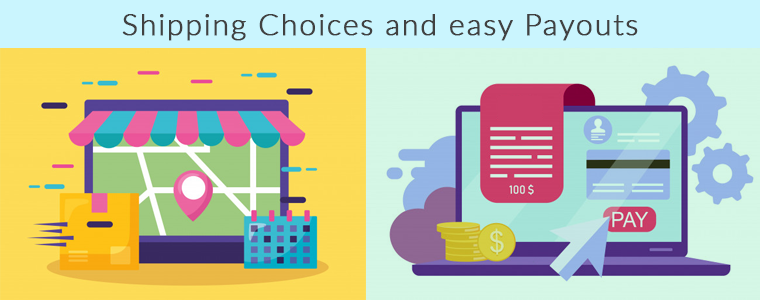
If allowed from the OpenCart Multi seller Marketplace module admin panel, the sellers can add their own shipping methods. This will give customers a lot more choices.
Sellers can request the payment from time to time. This is very simple and easy.
Provide Notifications and Alerts through Email
This has a powerful email notification system that is capable of providing timely updates and feedback to the marketplace community concerned. Provide all the information about activities taking place within the online marketplace to customers, sellers, and store managers for taking the appropriate action at the earnest level. This will help us make the right business decision with no hiccups.
Customers are the Most Benefited Entity
Wonderful services at the most competent price: A customer will be happy to buy a product from your store if he can see what others are saying about the product they are willing to buy. It has been observed that a product that is highly reviewed receives more engagement.
Visitors of the OpenCart Marketplace store can now select the ideal products from a wider range of product choices. Let you the customer decide if the product and the seller are good enough by asking for feedback and reviews. From the seller’s account page, customers can easily contact the product sellers and raise a ticket for their queries and problems.
Final Words
Handling a business is not easy and a small task. Not every business owner can set up their own marketplace and earn money but giving them an opportunity will make the difference. Also, you need a strong and easy-to-use marketplace platform to create a successful marketplace. And to help you find the best platform, we have developed a Multi-Vendor Marketplace Extension for you, to see the demo you can click here.
Hyperlocal delivery is a new style of shopping. Everyone is looking for a home delivery option for the required things to avoid going out. Moving out of the walls for shopping isn’t safe and buying stuff from a supermarket or a grocery store can put you into risk.
Practicing social distancing, taking extra care, and maintain hygiene is the new normal. We are now habitual of the work from home and not willing to leave the comfort zone. Every coin has two sides. With the dark side of the pandemic, On-demand, near-me, hyperlocal delivery services are the new business opportunities that came into existence.
Hyperlocal delivery businesses work in a small region by providing different types of services. The process can be monitored in real-time. To start a hyperlocal business you need to decide the service you want to provide or you are good with, find the target audience, decide the geography and make it happen in the given time.
Hyperlocal delivery business overcomes the biggest constrain of renting or owning a physical space. Instead, you only need space on the cloud and an app or a website, to begin with.
I will be discussing the top 10 low investment hyperlocal business ideas for 2020. It is important to understand the concept, how it works and for that, you can refer to our blogs on Hyperlocal Marketplace. The hyperlocal business basically revolves around on-time home delivery.
1. Fresh Edibles
Getting your morning bread and fresh milk delivered on your doorstep that too from the store you purchase from can be a great relief.
The fresh edibles delivery business is the niche you won’t fail on. It hardly requires any investment. The main focus of hyperlocal business is to cater to the needs of people living in a certain geography. The store owner can decide the region or the distance where they would like to serve.
All you need to give express delivery for fresh fruits and vegetables, bakery products, and dairy items. Managing an inventory and keeping the tracks of the demand will help you expand.
2. Groceries
Next in the category is the Grocery home delivery business. A hyperlocal marketplace for a grocery business can give you a kick start. No individual can live without food grains, cereals, millets, or pulses. You can start delivering these day-to-day essentials on the doorstep.
An e-grocery has observed tremendous growth in the last three years. Now after the pandemic, it is the most demanded and successful businesses in the economy.
3. Health and Hygiene
I have put health and hygiene in a single category because the two works together. The hyperlocal business idea does not just stick to delivery services but giving on-demand services is an important aspect. In the last couple of years, e-pharmacies has been a popular concept in India. Now the need is higher than ever before.
COVID-19 outbreak increased the demand for home assistance, nurse facility, medicine delivery, doctors’ home visit, and many more on the line. You can connect with some of the doctors in your area and ask them to join your hyperlocal marketplace on-demand service platform.
Provide Baby care facility, old age caregiving services, home delivery of pharmaceutical products and medicines in your neighborhood. If you live in a small town then it is a great idea for starting a new hyperlocal business.
4. Personal Care
Traveling kilometers for personal care in heavy traffic will waste your weekend. Why not bring the salon to your home? Oh! Yes, I have quoted the line from an advertisement but this can become a reality with the hyperlocal business idea of personal care.
Personal care home services have received a good response in urban cities in the past few years. Urban Company is one of the popular personal care company providing on-demand services. You can start with beauty salon services, Spa and Massage, or hairdressing.
Also, you can make the home delivery of personal care products like soaps, shampoo, floor cleaners, detergents, mops, etc. You will have to make some research before starting this business. For that, you can ask people to fill up a form asking all the personal care requirements for a week.
A good plan can bring success and this won’t need much of an investment. Hyperlocal on-demand services in personal care can be a good option to start with.
5. Expert Hospitality Services
Make a list of all the handyman services a person needs. You can gather all the experts in a place for providing services like plumbing, carpenter, welding, stone works, etc. for your new hyperlocal business. A craftsman or an expert in any of the fields can work with you on a commission basis.
You can take advantage of the current situation and ask people in your neighborhood for the requirements. It would be more suitable for a retailer or an artist to work with you in this crisis.
Handyman implies a person who can do minor repairs and tasks but who does not have the qualifications and experience or credentials for more than minor repair jobs. If the work does not need expertise or mastery then you will easily find many people looking for work.
Start giving work to people and make money for you too. This can be at the top of the list as not many people are into this business.
6. Cleaning Services
Providing cleaning services can be a perfect way to start doing what you love — soon, with a low barrier to entry. Start with your neighborhood and see the response to this. You can hire people on your behalf and provide cleaning services like vehicle cleaning, carpet, cleaning, sofa cleaning services, or garden maintenance services.
Word of mouth can work for this hyperlocal business. Share ads in your neighborhood, and get more bang for your buck by gaining some local businesses as customers. Usually for a comparable amount of work they would pull in a higher paycheck.
7. Pet watching
Do you love pets? Consider turning into a pet sitter. Or even if you don’t then you might find people who do and in the need for work. Start a hyperlocal business with pet watching services or with pet suppliers.
Pet suppliers are equally as important as food or medicine. A business idea needs some strategic planning and if you see many people with pets around you then this can be a good option for starting a hyperlocal business. You will be able to provide the required items on time which gets delayed with existing eCommerce stores.
Join in to start a pet sitting service like Rover or Care.com.
8. Fitness equipment
In my opinion, fitness gyms are the most unhygienic place out there. Many people use the same machinery and equipment which needs sanitization every now and then. You can start a hyperlocal home delivery service by providing fitness equipment or renting them for a few days.
People are more conscious about health in urban areas and this can be a one in a million idea for a newbie with a little investment.
To get the word out, give in-home seminars, customized diet and fitness regimens, and online group boot camps. Don’t forget to load an Instagram feed with motivational quotes, free workout videos, and even nutritious snack ideas — it’s a great way for fitness gurus to create their brands.
9. Logistics
This can be put a bit above in the list but all the mentioned hyperlocal business ideas are equally important. A document delivery, on-demand pick up and drop services, Stationary delivery application can be a great help during this work from home time.
We are well aware of the fact that people are going careless with social distancing. Why not start a business providing delivery services like existing courier companies? Here, the only difference will be the addition of the location factor.
Hyperlocal delivery services will operate in a smaller region with safety and hygiene. You can pick a parcel from one place and deliver it to another in minimum time.
10.Tow-truck
Tow-truck business can be a good choice when we talk about hyperlocal business. With a tow-truck, you can provide services like movers and packers, tie-up with delivery service providers, become a partner with local auto repair shops, motor clubs, auto auction companies, and property owners.
This might need some investment if you do not own a truck or a suitable vehicle but can make a lot of money if planned well.
A tow truck company makes money by charging fees for a tow. A standard charge will include a flat tow charge, a mileage fee, and a storage fee. Hyperlocal tow truck business can be profitable and if done with safety and hygiene, people won’t mind paying a little extra.
Pro tips from the author:
A hyperlocal business has two constraints, time and geo-location. Firstly, identify your small business idea and determine if your business idea works well from home. If you are a beginner, then start as a side business or hobby. Research well before starting up and reach your target audience. You can take the help of a website developer or a mobile application for creating a market place. Make a strategic business plan. Get to work!
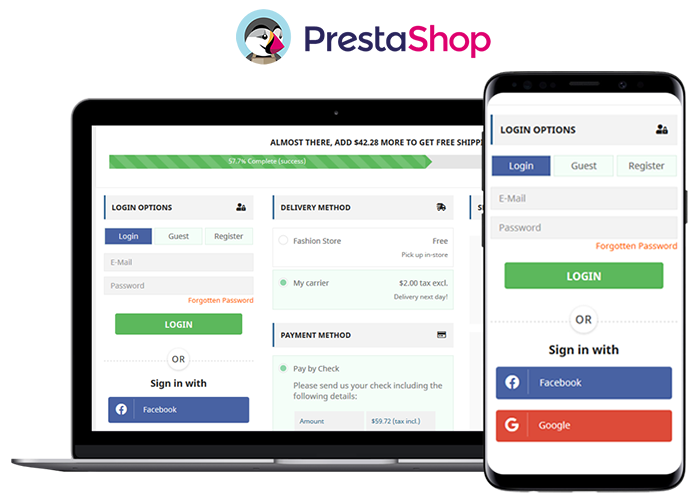
Prestashop One Page Checkout Module is the solution to all your conversion issues. If you are facing a lot of cart abandonment on your PrestaShop store it can be because of the lengthy and boring checkout page. Prestashop One Page Checkout v7.0.1, the new version is offering some time-saving features which will reduce checkout time and enhance the customer experience.
The upcoming holiday season can help you overcome the losses you have faced during the COVID-19 outbreak. You can raise your sales with various modules available on the PrestaShop store. The most important of all is the PrestaShop Quick Checkout Page module. It is necessary to replace the conventional multi-page checkout with PrestaShop One Page Checkout. An optimized checkout page for your PrestaShop store will reduce the bounce rate and helps to boost conversions.
What is new in Knowband’s PrestaShop One Page Checkout
We keep updating our best seller PrestaShop One Page Checkout module. It helps sellers boosting conversion and reducing abandoned carts during the holiday season sale.
If you want to know how this checkout module works, give this blog a read. PrestaShop One Page checkout is incorporated with new features:
(New) Customers can Choose Profile type:
This is a new feature added in the PrestaShop One Page Checkout module. Now it allows customers to select a profile type as an individual, or business. This helps the owner in running personalized marketing campaigns. It also lets the owner decide what fields are mandatory for each profile type. In addition, the owner can display the mandatory or some of the fields on the invoice too.
(New) Redirect the Customer to Checkout Page Instead of Cart
With the previous version of PrestaShop One Page Checkout, when a customer hits the call-to-action button on the product page it redirects them to the cart. But with a new feature added, PrestaShop store admin can allow the consumer to jump to the checkout page directly. It will save them from taking extra effort.
(New) Use Payment Address Name for Registration
Prestashop store admin can allow customers to Use Payment Address Name for Registration. Earlier the delivery address was the only option that was used as default registration details. But from now on, if the admin wants he can enable the setting on PrestaShop One Page checkout to use the payment address name for registration.
Checkout features you must not forget about when deciding on your marketing campaigns during holidays
The user interface of One Page Checkout can cast spells on your customers and will do magic to stop them from leaving the website. The PrestaShop Quick One Page Checkout gives you appealing layout options, various login choices like guest checkout, social login with Facebook and Google+, multiple Payment and delivery choices, and what not!
Offer Free Shipping and increase average cart value:
Asking them to shop more with a popup not always works. Besides, you can offer free shipping over a definite amount and they will grab the chance without giving a second thought. Free shipping is the most compelling thing out there.
The store owner can add a free shipping bar on the top of the One Page Checkout Page.
Improve engagement with its simple and sleek UI:
The simple and riveting user interface of the checkout page increases conversions. It helps to convert your visitors into customers with features like guest checkout and social login. All the required fields appear on a single page. No more waiting or jumping pages! Prestashop One Page Checkout is mobile responsive.
Ship-to-pay:
The responsive One Page Checkout has functionality for your PrestaShop store which lets the store owner set the payment mode for available delivery choices. If you don’t want to accept bank checks for fashion store delivery mode then you can disable the service.
Highly Recommended Modules with One Page Checkout
There are many PrestaShop modules available in the market which can fit well into your store. I am going to recommend you two super engrossing modules which are compatible with One Page Supercheckout on your PrestaShop store.
Store Locator and Pick up
The hyperlocal marketplace is the new trend in eCommerce. Prestashop Store Locator and Pickup Module incorporate website delivery features in-store and displays positions in physical stores using Google Maps.
Cash On Delivery with Fee
Offer Cash on Delivery with Fee to your customers on PrestaShop Store. Integrating Cash on Delivery with Fee module along with PrestaShop One Page Checkout can gain the trust and loyalty of a customer. Remove the barrier of secured payment which is a major concern for many. Click here to know more about Cash On Delivery with Fee module for the PrestaShop store.
We have produces a listicle on compatible modules with PrestaShop One Page Checkout, click here to explore.
To wrap up
I have always said that the checkout page is most important when it comes to conversion rates. Replace the existing checkout page with PrestaShop One Page Checkout and you can observe the change by yourself. Prestashop One Page Checkout with these new features can help you grow your business and earn loyal customers. What are you waiting for?
You can visit the Knowband store and check on the modules available for boosting holiday season sales.
If you are considering turning your online business into a marketplace then this is the best time for you. A hyperlocal marketplace business is in-demand and shaping the market trend. Hyperlocal Marketplace needs to be adopted to evolve your business.
What is a marketplace and how it works for an online business? What is the concept of hyperlocal and why one should go for it? You definitely want answers to these questions. In my previous blog post, I have discussed Why Hyperlocal is a new trend after COVID 19 outbreak? There are many challenges faced by the business merchants in the transition process but there is a solution to every problem. The previous blog answers everything about hyperlocal.
In this blog post I will be focussing on hyperlocal marketplace business and why is it flourishing nowadays?
Definition
A marketplace that caters to the needs of a limited geographical area is the hyperlocal marketplace. To build up a marketplace one has to find a vital space. Setting up a marketplace is an erupting business idea.
Different business owners can register on a website or application and sell their products to the consumer in a limited geographical area. Hence, an eCommerce hyperlocal marketplace has been established. If you take a walk around your local market, you will find all the necessary and essentials available. The local marketplace will fulfill all your demands.
The concept of establishing a hyperlocal marketplace sounds fuzzy and it is gaining popularity day by day. In 2020, going hyperlocal is the last thing you will say no to. The near-me hyperlocal business sounds affordable and convenient. You can make a business model and plan it accordingly.
Some of the important factors hyperlocal marketplace is thriving are the Geo-location facility, on-time delivery, safety, and convenience.
These can be considered the key factors for the hyperlocal marketplace because these businesses primarily depend upon the less delivery time and precise location. In other words, delivering a product at a location within time is the only goal for a hyperlocal marketplace business.
Major domains involved in Hyperlocal Marketplace
5 major Industries are dominating the On-demand near me hyperlocal marketplace business. The business of the marketplace is spreading and different industries are taking advantage of the hyperlocal marketplace.
Home Delivery of Consumer Goods:
Fast-moving consumer goods, also known as consumer packaged goods are the products that are always in demand and get sold quickly. Grocery, packaged goods, dairy products, medicines etc.are categorized in top hyperlocal marketplace businesses.
Amazon Grocery is one popular example of grocery delivery in India. It is gaining attention and people in urban areas are opting for it. BigBasket and Grofers are leading the grocery market in India.
Post COVID-19, the delivery apps have become very popular and in order to avoid crowds, people are willing to take advantage of food and grocery home delivery services. Now is the golden chance for local vendors to shine in the dark.
Pre-Book the slot or make the reservations:
The transport market is driving the on-demand industry. Cab services like Ola andUberare the dominators. They are offering food delivery, rideshare, and what not!
Other Hyperlocal Marketplace booking businesses are booking dinners, movie ticket bookings, BookMyShow– movie ticket bookings, Dine Out– Restaurant table booking, Dine Out even offers discounts and deals to the consumer. MakeMyTrip is another popular website for hotel bookings, to book flight tickets or plan a trip and many such exemplary startups are in the market which is on bloom.
Hospitality services:
On-demand services provided by local business owners are looking forward to establishing a hyperlocal marketplace. Housekeeping, beauty salons, Spa and Massage, dog care services are popular these days. Urban Clap is an example of hyperlocal marketplace on-demand services.
Appliances Repair, Electricians, Mobile Services, Technicians, Carpenters, House Cleaning or Pest Control, Packers and Movers, Plumbers are other businesses for the hyperlocal marketplace.UrbanHopperzis another app popular for on-demand delivery services.
Health Care Services:
After the pandemic, the health care industry is gaining a lot more attention than before. The health care services, nurses, baby care, Old age health care are all needed to be taken care of after COVID-19. Considering the availability of space in hospitals, the demand for home health care services is increasing.
Developing countries are unable to provide the needful facilities in hospitals so, a home caretaker or nurse is the best option one can go for. The health care industry has a huge scope in hyperlocal marketplace businesses.
Logistics:
People tend to move on to the hospitality sector. Hyperlocal on-demand near-me services are still evolving. It includes logistics or concierge, which is growing in urban areas. People are taking the help of such services for sending documents or lunch boxes.
Some of the popular startups offering on-demand concierge are Dunzo, a mobile-based concierge services provider in India, Fetchr is popular in Dubai for booking delivery services, Alfred Club is US based and it provides an ‘Alfred’ to households to take care of their weekly errands and many are there. Pidge is a startup in Delhi NCR, they are offering 60 min Pick-up and immediate delivery facility.
If you want to try your hands into on-demand delivery services, this is the right time.
Why Hyperlocal Marketplace is blooming in 2020?
We are aware of the scenario and going through a tough time because of the COVID-19 outbreak. Eventually, life is getting on track, and demand for home delivery is increasing. Hyperlocal marketplace businesses offer home delivery services in the nearby region or zones in a matter of time.
It is in trend because it connects customers with the sellers who are closer to him. It plays with the customer’s psychology for being well served. They get their product or service ordered within a couple of hours.
Satisfaction comes with hardly any effort and cost. The merchants, on the other hand, find it super easy to cater and deliver a customer who is close in geography. The merchants know their customers’ aesthetics, and can therefore play accordingly with their business models. Costs drop appreciably for both aggregator and merchants at the end, and therefore a win-win tactic for both.
How to configure this?
These days a lot of business in the Hyperlocal Marketplace is growing aggressively. Now If you are willing to start an on-demand delivery business and interested in setting up a hyperlocal marketplace business, you can take the following steps:
Select the Industry which you want to provide your services
Choose your Niche: For example, if you want to go for logistics then for the starter, you can deliver medicines.
Develop a Responsive website where your leads will land
The marketing strategy should be based on Target Audience.
Smart Phone is the key: Develop a Mobile App.
Build Partnerships with courier services or other hyperlocal service providers and make a hyperlocal marketplace
Note: In between COVID-19 outbreak, you must take care of security, hygiene, and safety.
If this doesn’t work for you than many tools are available which can help you with hyperlocal marketplace business idea or you can take help from the experts. But this isn’t a difficult task, with little efforts and a good plan you can allow users to take advantage of your offerings and services through Online Store Website and Mobile applications.
Final words:
The hyperlocal marketplace needs robust underlying realtime software architecture that ensures the fastest delivery possible from nearby or local sellers in the targeted regions or zones. Consumers or end-users demand for fresh and consumable products to be delivered by the earliest. The hyperlocal marketplace business can help you grow your business explicitly.
It is often observed that customers want to return or cancel their orders. Managing orders and fulfilling customer’s demands isn’t an easy task. Considering consumer rights in the EU, every eCommerce platform needs an easy return manager to maintain the records and meeting customer’s needs. EU has a policy that a consumer can request a return or refund for a faulty product within 14 days after purchase. As an eCommerce owner, it may sound tedious and time taking.
Don’t worry! PrestaShop Return Manager Addon takes care of all the functions required to cancel or order returns. With additional features described below, this new version gives a user-friendly experience to eCommerce store owners and customers.
What’s New in PrestaShop Return Manager Addon?
Customer retention is a merchant’s need and this can be achieved with customer satisfaction. PrestaShop Return Manager module comes with an easy cancel request format with multiple return and cancellation methods for a customer.
1. Decide when to start calculating Policy time
Imagine a situation when the product is delivered after the expiry of the return date. What impression this will create on your customer? Sometimes the return date expires if the product delivery is delayed, to resolve this issue, the addon now provides a drop-down menu for selecting a product status after which the return policy time will be calculated.
2. Quick Access of Return Listing from Dashboard
You don’t have to find the module from a long list of installed modules in the admin panel, instead, you can configure the PrestaShop Return Manager Addon from the left menu of the admin panel.
Additionally, a new option to access all the return listing counts has been added on top of the admin panel. All the return listings like order returns, canceled orders, etc can be seen in one place.
3. Custom features for email templates
In the updated version of Return Manager, the admin is provided with an option in the admin panel to add a custom text for each Return Status and created a placeholder that can be used in the Return Status Email templates. The updated version provides an option in the admin panel to ‘send a Test Email’.
4. Search and Filter all the Listing Tabs
With the latest version, the store manager can easily sort and filter the listing tabs on the basis of date, customer ID, Return ID, Customer Name, etc. This makes the task easier for the admin.
Features that enhance admin’s power
5. Allows Partial or complete order replacement
The online store administrator can now allow online customers to pick items from their orders for replacement. Online customers can even request for returning the whole order if they want to do so. They can now choose all the products from the list. This increases the usability rate.
6. Admin can add Custom Field
This updated version of PrestaShop Return Manager Addon allows an online merchant to create custom fields. Online store owners can build several custom fields from the PrestaShop Refund Order Addon admin interface. The store owner may set custom field block names, apply validations, and also set default values (if required). Admin can make any field as required. Admin can set a default value and validation type.
Why choose PrestaShop RMA over other Order Return Module?
The RMA plays a vital role in the eCommerce store. The Customer sometimes raises the request for the product return, refund, and replacement. To improve customer retention and usability the online merchant needs a flawless RMA interface. Other eCommerce like the Magento Return Manager plugin does not come with these new features. This rejuvenated tool provides both a user-friendly experience and customer satisfaction.
1. Increased Customer Conversion Rate
Easy refund and return policy builds trust and makes the customer believe in the merchant. This eventually increases the word-of-mouth publicity of the website and brings more traffic to the site. From this, you can expect a good conversion rate. This one small change will catapult your conversion rate and this way you can keep the complaints zero.
2. Customer Satisfaction
The front-end easy ‘return’ option lets them believe if they are not completely satisfied with their purchase, they may return it or replace it. This assurance lets your visitor believe in your product policy and allows them to shop more. The easy email template functionality sends an email to both parties which enhances your business relationship. A happy customer always comes back to you without any pause.
Benefits of PrestaShop Return Manager for the merchants:
PrestaShop Order Return Manager Addon makes it easy to handle the returns of customers.
The possibility of receiving “Store Credits” for a faulty product helps to improve consumer retention.
The product issues can be fixed by knowing the return reasons.
With the aid of the PrestaShop Consumer Return Manager, you will find out the exact problem in the product by providing customers with the option of uploading the picture of the faulty product.
Email template makes you craft a mail for your customer at every return stage.
With RMA quick return addon, by adding custom fields you can collect more information from the customer.
Benefits of PrestaShop RMA return module for the customers:
A ‘Return’ button allows the existing customer or guest customer to return or cancel the placed order completely or partially.
PrestaShop Order Return Manager provides an easy cancel request format with credit, refund, and replacement options
Customers can upload an image of a faulty product highlighting the defect.
An email with custom text will be sent to the customer at every stage for their order cancellation or return request.
PrestaShop Order Return Manager allows customers to select a nearby store address for shipping the damaged product.
Customers can return partial or whole orders by easy select option.
Customers will have the option to cancel the order for a short period. The customers need to go to the My Account >> Return Manager section to cancel the order.
Other useful features of order return or cancellation addon
Easy Return Request Option
There are some other features that make this addon more convenient and user-oriented. It helps you identify the return reasons for customers and lets you raise a return request on behalf of your customer. Thanks to a quick and effective cancellation method, customers are more likely to go back to your platform.
Crafted Email-Templates
Well-designed email Templates emerged as an attractive feature. This pre-formatted email template option gives the admin a hassle-free experience at the backend and directly sends an email to both the parties as soon as the query is raised and updates the customer at every stage of their request. There are 14 different email templates as per the requirements. It is a timesaver for both merchants and customers.
Managing Return Requests at one place
Managing an eCommerce store with fewer efforts is like a cherry on the cake and this amazing addon does that. It helps you manage all the return requests in one place. You can find pending return lists, active return lists, and canceled return lists on the admin panel as well as on the dashboard. This information is also available to export in .csv format in case you want the compiled data.
Compatible with GDPR Module
PrestaShop Return Manager is compliant with GDPR. When you are using the Knowband GDPR module, both the customer and the administrator will be able to access the information of the return request. Besides, the Customer can request the admin to remove personal data from their shop.
Final Words
PrestaShop Return Manager addon is an interesting and helpful tool for the eCommerce store owner to manage the return and cancel the request at the backend. A hassle-free return policy attracts buyers and gains the customer’s trust.
For more information or to shop the PrestaShop Return Manager for your PrestaShop store, you can visit Knowband store or reach out to us at support@knowband.com. Return Manager Extension is also available for Magento and Magento 2 stores.