A great customer support system can reinforce the teams working to achieve respective goals in a company. To fulfill the demands of the customer and improve customer experience, strategic planning, support tools, and a fully dedicated team play a significant role.
The information collected from the user can be implemented to improve customer service by making reasonable policies that can help the company grow and flourish your PrestaShop customer support.
Customer support is an indicator of customer repurchase and loyalty. Customer satisfaction assures you that the customer will be willing to purchase from you in the future.
In a marketplace where companies are competing to grab more customers, a customer support system can back you up. A company with versed customer services can sustain longer and can provide outstanding customer experience.
There are some amazing modules that have been developed by the Knowband team to help you with customer support management and in improvising customer experience on your PrestaShop store.
1. RMA to manage returns and canceled orders
I am putting Return Manager Addon first on the list because sellers find it hectic and fail to manage the return or canceled orders. Prestashop RMA will help you manage the returns easily as it is fully configured and you can track the return orders from the backend of the module.
Store admin can see various choices for reacting to the return if the customer claims that the item arrived damaged or does not fit the listing description. Also, the customer can upload the image of the faulty product with a reason or add one if it does not match the listed description. This will hopefully reduce your tension of order return management.
2. Deskoid Helpdesk system for customer service
The Deskoid Helpdesk system provides a unified customer experience which makes it easier for the customers to shop from your Prestashop online store. The Prestashop Deskoid Helpdesk add-on combines the store with a helpdesk ticket system.
The admin will provide an interface with the aid where clients will contact the support team for any query or problem and it shows the message thread inside the message block hence they can also see old tickets.
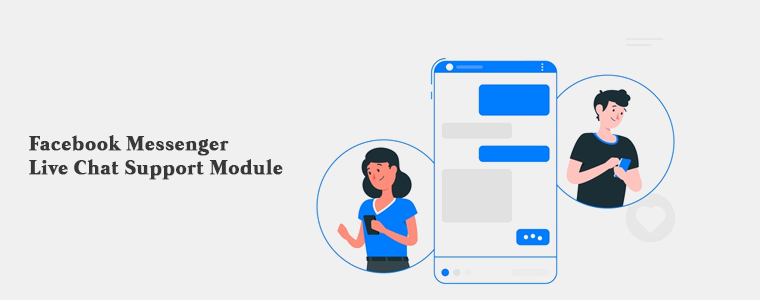
3. Facebook Messenger – Live Chat Support Module
Half of the world’s population is using mobile phones and most of them are on social media platforms. The Social Messenger module can be used by PrestaShop store admin for live chat support to enhance the customer experience. It helps customers to connect using their personal Facebook messenger account with the store owners.
The administrator will set the look and feel settings for the icon and window of the social messenger. Live chat support can boost the conversion rate and customer acquisition.
Final Thought:
Customer services are a considerable stream to spend your time and money if you own an eCommerce company. To provide better customer services you should have a live desktop chat support, easy return policy and management system, contact forums or you can provide customer care calling services.
Customer satisfaction and UX plays an essential role in an eCommerce for business growth and productivity. With 24×7 customer support channels show your customer that you care.
Online shopping is increasing, and customers who are enamoured with eCommerce sites spend countless hours researching the goods they want. There are some very popular quotes which make shopping, therapy, cardio or a hobby. It makes evident just how fixated people can be. There are many different types of eCommerce customers, therefore business owners need to keep each one not just entertained but also motivated to make purchases.
Some eCommerce customers like exploring before buying and some have a focused approach with a to-buy list which makes them good customers. But, being a retailer or eCommerce store owner, you cannot rely on one type of customer. Every shopper is different and they follow a certain pattern of buying with different priorities. Being a retailer, you must have gone to a lot of stores or manufacturers before choosing the item for sale. You also have a pattern which makes you a type of customer. I’m going to talk about some distinct categories of consumers that store owners frequently deal with and offer some expert advice on how to handle various types of eCommerce customers in your business to increase conversions.
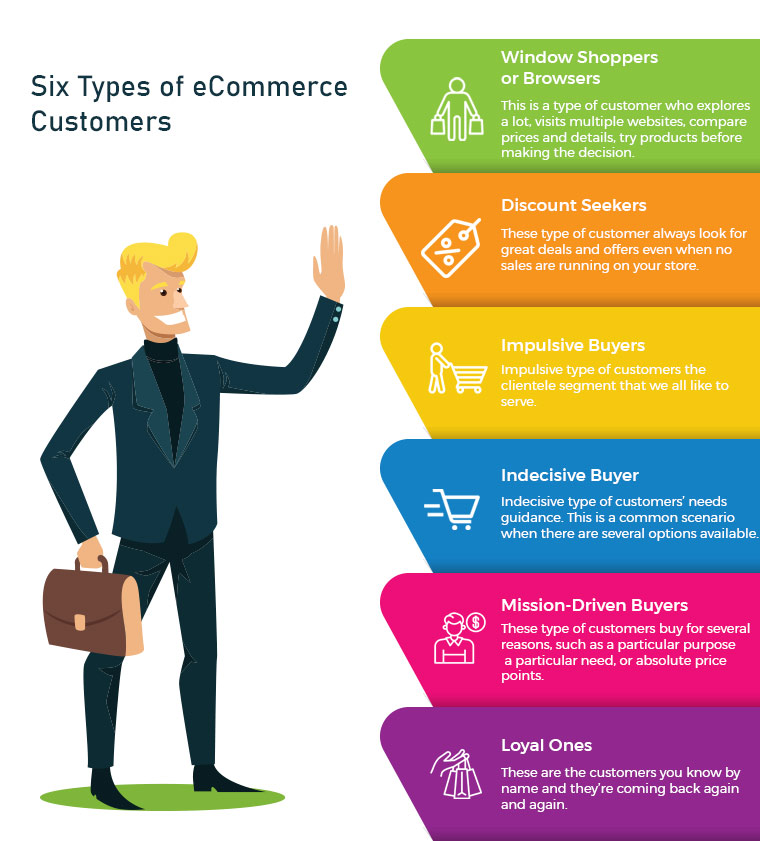
1. Window Shoppers or Browsers
The number one on the list is servers or browsers. This is a type of customer who explores a lot, visits multiple websites, compares prices and details, try products before making a decision. They add products to their cart but never intended to shop from them. Yes, there are many such buyers and you may call them a pain. Can you do something about it? Yes, I guess. There can be ways to attract such visitors and encourage them to buy products from your store.
Greet them well:
If you are a retailer, you must remember to greet them well. Even if they are not asking for any assistance you can provide them one. eCommerce store owners can add any entry or exit popup such as Better Thank you Page module to their store for greeting these types of customers.
Entry or Exit Popup:
Some of the easiest ways to engage your consumers are by the use of innovative methods. The customer’s attention must be drawn to the digital interface and manner of presentation. The gamified interface of Spin and Win Pop-up attracts shoppers to your store. This is a 3-in-one pop-up which is used as an entry pop-up, exit pop up or an email subscription pop-up.
Don’t ignore the browsers, they can become your loyal eCommerce customers if treated right.
2. Discount Seekers
These types of eCommerce Customers respond well to pushy sale tactics. They always look for great deals and offers even when no sales are running in your store. For attracting such buyers you should focus on highlighting what they will save on that particular deal.
Host Clearance or Flash Sales:
These discount seekers can give you huge sales if provided with flat discounts. Clearance sales can be a good option. The products that have been stocked in your store for months can be sold out, and customers looking for discounts will benefit from it.These sales can be a key contributor to your cash flow which will make room for the new products by removing the older ones.
Scratch Card:
You can provide your customers with Scratch Cards while having a purchase. Customers will be attracted to the alluring coupons which can save their deal a lot.
Free Shipping:
Free shipping encourages customers to buy more from your store. A fixed amount of purchase is to be made by the shopper to get free delivery.
Impulsive types of customers are the clientele segment that we all like to serve. Nothing is more exciting than helping the impulse shopper to respond favourably to your recommendations. Impulse shoppers, also known as emotional shoppers, make unplanned purchases based on items that are currently appealing to them. Online shopping is a popular example of pulse or emotional buying. They look for products which attract them and you can do that by showing related products or by offering personalisation.
Show Related Products:
If you are dealing with an impulse buyer then make this chance an opportunity. Because they shop when they like it without giving a second thought. Show them what’s new in the store and let them feel, that they will be out of the race if they don’t own it. This can be done with modules like related products.
4. Indecisive Buyer
This is a common scenario when there are several options available. For instance, search for a floral top and the results will blow your mind. hundreds of products will start appearing in various stores. Deciding one will be difficult. Indecisive type of customers needs guidance. Ask them questions and give honest advice. A flexible return policy can also help them with their shopping.
Ask Questions:
Shop owners can help them decide what they want. Provide them with chat support or in-store assistance for choosing the right product. This effort can turn them into loyal eCommerce Customers.
Product Custom Field:
You can add a product custom field with the product description. You can add a field with related questions which can help you understand the need of the buyer. Advance Product Feld extension can be a good fit to improve UX.
Return Manager:
An indecisive customer will be encouraged if he/she knows that the product can be returned if they don’t like it. The Return Manager is a good module to add to your eCommerce store.
5. Mission-Driven Buyers
These can be called researchers or need-based customers. These customers buy for several reasons, such as a particular purpose, a particular need, or absolute price points. As difficult as it can be to please these individuals, they may still become regular customers if they are well taken care of. Provided with a good customer experience which is not available online or on other retailers stores can turn them into loyal customers.
Offer buy-online, Pick Up In-Store:
These types of buyers do not have much time to spend in window shopping or i-store shopping. They can make the purchase online and pick up the product from the store. Implement this new pick-up and drop option in your store to attract mission-driven buyers.
Cross-Selling:
Retailers can help the need-based customer with cross-selling techniques. You can place bread in related products while they are buying milk or a mobile cover if they are purchasing a mobile. The Automatic Related Product module can help you show relevant products on various pages such as the product page, the home page, the shopping cart page, etc.
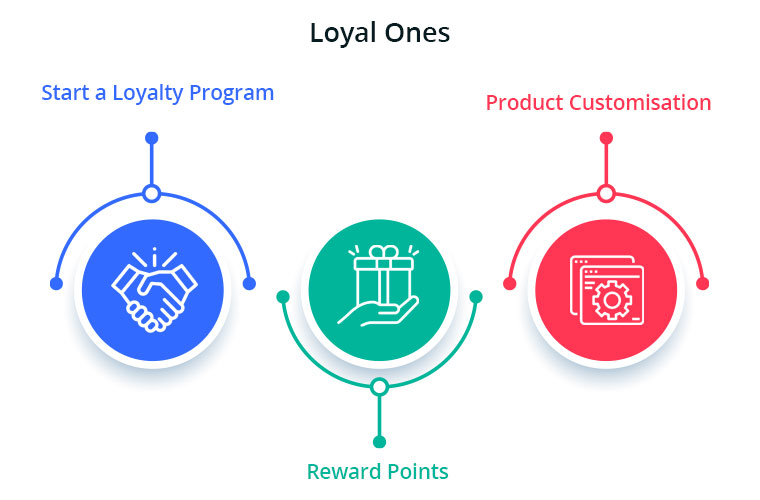
These are the customers you know by name and they’re coming back again and again. Loyal eCommerce Customers already know and enjoy your shop, so now you need to keep them happy. Offer customisation and personalised experience and never lose them to others. The best ones are difficult to find and it is your responsibility to give them your best services. You can give them reward points or loyalty points on every purchase. These types of customers are the best marketers for your store as the more they shop, the more will be the word of mouth communication.
Start a Loyalty Program:
Choose a module or plugin for your eCommerce Store to give loyalty points to your loyal ones. This will motivate these types of buyers to shop again and again from your store. During checkout, the loyalty points can be redeemed for a discount.
Reward points:
You can also give them reward points on various purchases like first purchase, on a fixed amount order, on particular products etc. The reward points encourage the buyer to make more purchases. It helps the admin boost customer engagement and creates loyal customers.
Product Customisation:
Product customisation and personalisation can turn your sales to the next level. this is one of the most accepted trends. Help them get a personalised product of their taste. The best module for giving a customisation experience is Product Designer/Customization which can provide several choices to you and shoppers.
Using this understanding to help turn deals, desires, needs-based and even casual customers into loyal ones will help the business expand. At the same time, ensuring that your loyal customers have a good experience every time they visit your store would only boost your bottom-line income.
Thanks to the idea of hyperlocal business models which are redefining the economy with on-demand delivery models. The idea of home delivery is gaining ground and businesses are cashing in on it. BigBasket a famous brand have established their hyperlocal marketplace in the year 2016 and the change in the pattern has provided a wide range of product availability to the customers with super-fast delivery.
With hyperlocal delivery model, BigBasket established an online marketplace for local vendors and sellers and they have integrated a network of all the possible bakeries and popular vendors. This move opened up the doors for many small businesses to grow with the help of a marketplace.
There are multiple types of online marketplaces categorised based on industry, focus and target audience. We will be discussing them one by one and how the Multi Vendor Marketplace Module can help you build your own marketplace is explained.online
Online Marketplace based on Core-Focus:
There are two types of online marketplaces based on focus segments: There are marketplaces that provide either one type of service or sell one category of products and the others are a hub for multiple services with a variety of niche.
Vertical Marketplace
A marketplace providing a single type of service and not diving into the pool full of fishes. Let us consider an example of Etsy, what started out as a simple place for people to sell crafts has become a behemoth.
Horizontal Marketplace
A marketplace where you will find many services or different types of products on one online platform. For example, a mall where you will find all the brands and products under one roof. An online eCommerce marketplace like Amazon is a horizontal marketplace.
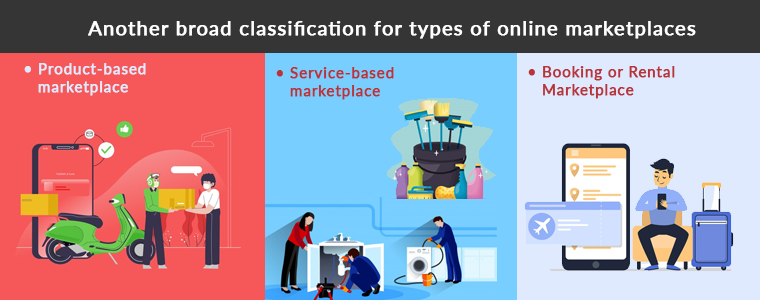
Another broad classification for types of online marketplaces
A major feasible classification for the online marketplace occurs on the verticals they are offering:
· Product-based online marketplace
This type of online marketplace deals with selling products. Like Amazon and Flipkart are product based marketplaces. Commission and subscription are the two ways product based marketplaces earn money. They can even charge for delivery fees.
· Service-based online marketplace
An online marketplace where service providers can list and provide services like personal care, cleaning, plumbing, appliance repair, pest control, graphic designing, etc.
Popular service-based online marketplaces are the Urban Company, Fiverr, Upwork who are providing multiple services with hundreds of categories.
· Booking or rental online marketplace
No chance you haven’t heard about a booking or rental service providing an online marketplace. Ola, Uber, booking.com, MakeMyTrip are the most popular websites for booking or rental Marketplace.
A platform or an online marketplace for the purchase or sale of goods and services through wireless handheld devices or mobile phone
eCommerce
A two-party site, e.g. seller – shopper, company owner – investor, etc.
The crowdfunding-the website enables people to post their projects and raise funds through fundraising efforts for their execution.
Marketplaces on the basis of Customer Type:
B2B – an online marketplace for the exchange of goods or services between companies or two business merchants
B2C – an online marketplace for the transaction from the merchant to customer for goods or services
C2C– an online platform for the transaction between customers for goods or services
How to start a Hyperlocal Marketplace with Multi Vendor Marketplace?
An online marketplace should have a seller and customer-driven features covering all possible requirements of the admin, seller, and the consumer. A multi-vendor marketplace extension is a module that can serve you well for setting up a B2B or B2C marketplace.
You can customize the settings as an admin. With Multi Vendor Marketplace module the seller who registers on your marketplace can easily manage the functionality for providing the service or selling a product to the customers.
Benefits of Multi Vendor Marketplace
Protection and guarantee for users
Authentic sellers and customers
Customizable settings and easy to configure from admin and sellers end
Track product details and orders for operating intermediate transactions
Marketplace handles the complete process
Multi vendor Marketplace provides superior customer experience
How to generate revenue with an Online Marketplace using Multi Vendor marketplace addon?
Based on Commission Model
How does the commission model work for Multi Vendor Marketplace? A commission is a percentage or amount of money a person gets when the product or service is being provided to the customer. With the aid of Marketplace Module, the store admin can set up a global commission for the sellers.
Using Multi Vendor Marketplace, commission for the individual sellers can be set. It provides the marketplace owner with the functionality of the category level commission. Marketplace admin can charge different commission rates on various marketplace product categories.
By offering a Membership Plan
Membership plans allow the store administrator to launch a subscription-based program. If the store administrator allows membership plans to work, then all new sellers and current sellers will have to purchase a marketplace membership to list their goods in the Multi Vendor Marketplace.
The marketplace owner can allow a free membership plan in which sellers can list only restricted products. Store admin can also send custom notifications to those sellers whose membership plans are about to expire. By giving a free subscription for a limited period will grab you more sellers in your market place.
Conclusion:
Some vendors and small businesses think it is easier to sell their goods in an online marketplace than to build a website and look for technological tools that handle several e-commerce sites. A marketplace is easy to manage with multi vendor marketplace addon.
If you’re willing to have an omnichannel approach with several online marketplaces, research all the industries and niche and think about which one suits you best and looks more lucrative, to begin with. Then we’ll help you keep your product details in order, safely, conveniently for all your marketplaces and networks.
Affiliate marketing is the passive income source and many are taking the advantage.
Affiliate marketing is one of the ways to make money with promoting and branding other people’s product through the affiliate network and getting some commission over the sell. Marketing is like asking someone out on a date and branding is the reason they say yes. Presenting the content in a way that they click over the provided link and convinced to buy the product is the key strategy for affiliate marketing.
People often search for Affiliate Marketing on Amazon. Amazon affiliate is the largest affiliate program globally. Content creators, publishers and bloggers can monetize their traffic with Amazon Associate program. There are different ways one can earn with affiliate marketing.
How Does Affiliate Marketing Works?
There are 4 parties involved in affiliate marketing. Before that, it is necessary to understand how it works. There are two major components which are involved in the process. One is the creator and seller of the product while the Second is the affiliate marketer. The process starts with the seller or the merchant, affiliate networks are the mediators who promote the product which is to be purchased by the consumer.
The Merchants:
The seller or the manufacturer of the product who intends to sell the product and earns a direct profit. A merchant is a party who creates the product.
A merchant party can a big shot company or a small business owner who is manufacturing a product.
The Affiliate:
Affiliates are the one who promotes the product. They can be an individual or a company who is dedicatedly generating revenue through affiliate marketing.
Affiliates do their job with social networking sites, by creating SEO content or through captivating videos. They can give product reviews or write appealing content which will convince the consumer the buy a product.
The Affiliate Network:
Not everyone considers the affiliate network an important part of the chain. In my opinion, the affiliate network plays a vital role in affiliate marketing.
Affiliate networks are intermediaries that connect bloggers and entrepreneurs (“publishers”) or the affiliates to businesses (“merchants”) that offer affiliate programme opportunities for their products or services.
The Consumer:
It is the last and most important party involved in affiliate marketing. All of the efforts will go in vain if the affiliate or affiliate network fails to attract and convince the potential customer.
The content should be convincing so that the consumer ends up buying the product. A review blog can be an excellent way to start with.
Is affiliate marketing easy?
I am afraid that I won’t say what you want to hear. Affiliate marketing isn’t easy but with more traffic, more clicks and conversions, you can generate revenue.
If you are a newbie and want to get started with affiliate marketing you should start finding the problems people face while buying a product. The information helps the user solve a problem. Offer them a perfect, presentable solution for the issue, and there you have your first customer.
Choose a category or a niche for the blog or video, and expand it eventually. The affiliates or affiliate networks earn hundreds to tons of dollars with affiliate marketing programs.
How to become an affiliate marketer?
To become a merchant you have to come up with a new innovative idea for creating a product. To become an affiliate marketer you need to choose a niche, collect some customer information, present it well and finally get paid.
Register yourself with a merchant or a company as an affiliate marketer. Every company pays a variable amount for every product. It is generally percentage-based and they provide you with a link which you need to use while promoting the product.
Every sell with that link will add some money in your pocket.
Begin with reviewing the product through a blog or a YouTube video. More the visitors or subscribers more are the chances to earn.
Next, you can collect details like the email of the visitors for the follow-up. It is good to do email marketing and follow your leads.
Third, you can invite leads to live webinars and do a live product review. You can promote your webinars on social media platforms. Many sources are available for conducting live sessions.
Lastly, you can promote your products through referral marketing. Refer and Earn plays the trick.
How a merchant can take advantage of affiliate marketing?
Affiliate marketing and referral marketing program can be beneficial for the merchants, manufacturers, sellers and vendors. They can generate more revenue by offering some commissions over the products an affiliate sells.
There are affiliate marketing tools available for PrestaShop and Magento stores on Knowband. In my previous blog, I have discussed how you can acquire new customers with referral and affiliate marketing tool for PrestaShop store. A merchant can boost conversions and increase brand awareness with affiliate marketing.
The Affiliate and Referral Program- PrestaShop module helps you in many ways. You can refer to the blog post or the user manual for its features and benefits. The extension for affiliate marketing is also available for Magento and Magento 2 platforms.
Wrap-up
The affiliate marketing or passive income sources will not make you a billionaire overnight. With extra efforts, meaningful content and a strategic approach you can at least make decent money in some time. With reinvesting the money in blogs or website you will increase the chances of earning more with the expansion of your audience.
If you are looking for something which can help you earn money even in your sleep then affiliate marketing can be something you should start with.
Hyperlocal delivery is a new style of shopping. Everyone is looking for a home delivery option for the required things to avoid going out. Moving out of the walls for shopping isn’t safe and buying stuff from a supermarket or a grocery store can put you into risk.
Practicing social distancing, taking extra care, and maintain hygiene is the new normal. We are now habitual of the work from home and not willing to leave the comfort zone. Every coin has two sides. With the dark side of the pandemic, On-demand, near-me, hyperlocal delivery services are the new business opportunities that came into existence.
Hyperlocal delivery businesses work in a small region by providing different types of services. The process can be monitored in real-time. To start a hyperlocal business you need to decide the service you want to provide or you are good with, find the target audience, decide the geography and make it happen in the given time.
Hyperlocal delivery business overcomes the biggest constrain of renting or owning a physical space. Instead, you only need space on the cloud and an app or a website, to begin with.
I will be discussing the top 10 low investment hyperlocal business ideas for 2020. It is important to understand the concept, how it works and for that, you can refer to our blogs on Hyperlocal Marketplace. The hyperlocal business basically revolves around on-time home delivery.
1. Fresh Edibles
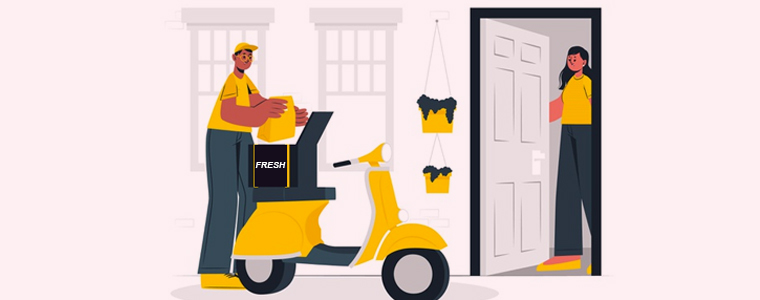
Getting your morning bread and fresh milk delivered on your doorstep that too from the store you purchase from can be a great relief.
The fresh edibles delivery business is the niche you won’t fail on. It hardly requires any investment. The main focus of hyperlocal business is to cater to the needs of people living in a certain geography. The store owner can decide the region or the distance where they would like to serve.
All you need to give express delivery for fresh fruits and vegetables, bakery products, and dairy items. Managing an inventory and keeping the tracks of the demand will help you expand.
2. Groceries
Next in the category is the Grocery home delivery business. A hyperlocal marketplace for a grocery business can give you a kick start. No individual can live without food grains, cereals, millets, or pulses. You can start delivering these day-to-day essentials on the doorstep.
An e-grocery has observed tremendous growth in the last three years. Now after the pandemic, it is the most demanded and successful businesses in the economy.
3. Health and Hygiene
I have put health and hygiene in a single category because the two works together. The hyperlocal business idea does not just stick to delivery services but giving on-demand services is an important aspect. In the last couple of years, e-pharmacies has been a popular concept in India. Now the need is higher than ever before.
COVID-19 outbreak increased the demand for home assistance, nurse facility, medicine delivery, doctors’ home visit, and many more on the line. You can connect with some of the doctors in your area and ask them to join your hyperlocal marketplace on-demand service platform.
Provide Baby care facility, old age caregiving services, home delivery of pharmaceutical products and medicines in your neighborhood. If you live in a small town then it is a great idea for starting a new hyperlocal business.
4. Personal Care
Traveling kilometers for personal care in heavy traffic will waste your weekend. Why not bring the salon to your home? Oh! Yes, I have quoted the line from an advertisement but this can become a reality with the hyperlocal business idea of personal care.
Personal care home services have received a good response in urban cities in the past few years. Urban Company is one of the popular personal care company providing on-demand services. You can start with beauty salon services, Spa and Massage, or hairdressing.
Also, you can make the home delivery of personal care products like soaps, shampoo, floor cleaners, detergents, mops, etc. You will have to make some research before starting this business. For that, you can ask people to fill up a form asking all the personal care requirements for a week.
A good plan can bring success and this won’t need much of an investment. Hyperlocal on-demand services in personal care can be a good option to start with.
5. Expert Hospitality Services
Make a list of all the handyman services a person needs. You can gather all the experts in a place for providing services like plumbing, carpenter, welding, stone works, etc. for your new hyperlocal business. A craftsman or an expert in any of the fields can work with you on a commission basis.
You can take advantage of the current situation and ask people in your neighborhood for the requirements. It would be more suitable for a retailer or an artist to work with you in this crisis.
Handyman implies a person who can do minor repairs and tasks but who does not have the qualifications and experience or credentials for more than minor repair jobs. If the work does not need expertise or mastery then you will easily find many people looking for work.
Start giving work to people and make money for you too. This can be at the top of the list as not many people are into this business.
6. Cleaning Services
Providing cleaning services can be a perfect way to start doing what you love — soon, with a low barrier to entry. Start with your neighborhood and see the response to this. You can hire people on your behalf and provide cleaning services like vehicle cleaning, carpet, cleaning, sofa cleaning services, or garden maintenance services.
Word of mouth can work for this hyperlocal business. Share ads in your neighborhood, and get more bang for your buck by gaining some local businesses as customers. Usually for a comparable amount of work they would pull in a higher paycheck.
7. Pet watching
Do you love pets? Consider turning into a pet sitter. Or even if you don’t then you might find people who do and in the need for work. Start a hyperlocal business with pet watching services or with pet suppliers.
Pet suppliers are equally as important as food or medicine. A business idea needs some strategic planning and if you see many people with pets around you then this can be a good option for starting a hyperlocal business. You will be able to provide the required items on time which gets delayed with existing eCommerce stores.
Join in to start a pet sitting service like Rover or Care.com.
8. Fitness equipment
In my opinion, fitness gyms are the most unhygienic place out there. Many people use the same machinery and equipment which needs sanitization every now and then. You can start a hyperlocal home delivery service by providing fitness equipment or renting them for a few days.
People are more conscious about health in urban areas and this can be a one in a million idea for a newbie with a little investment.
To get the word out, give in-home seminars, customized diet and fitness regimens, and online group boot camps. Don’t forget to load an Instagram feed with motivational quotes, free workout videos, and even nutritious snack ideas — it’s a great way for fitness gurus to create their brands.
9. Logistics
This can be put a bit above in the list but all the mentioned hyperlocal business ideas are equally important. A document delivery, on-demand pick up and drop services, Stationary delivery application can be a great help during this work from home time.
We are well aware of the fact that people are going careless with social distancing. Why not start a business providing delivery services like existing courier companies? Here, the only difference will be the addition of the location factor.
Hyperlocal delivery services will operate in a smaller region with safety and hygiene. You can pick a parcel from one place and deliver it to another in minimum time.
10.Tow-truck
Tow-truck business can be a good choice when we talk about hyperlocal business. With a tow-truck, you can provide services like movers and packers, tie-up with delivery service providers, become a partner with local auto repair shops, motor clubs, auto auction companies, and property owners.
This might need some investment if you do not own a truck or a suitable vehicle but can make a lot of money if planned well.
A tow truck company makes money by charging fees for a tow. A standard charge will include a flat tow charge, a mileage fee, and a storage fee. Hyperlocal tow truck business can be profitable and if done with safety and hygiene, people won’t mind paying a little extra.
Pro tips from the author:
A hyperlocal business has two constraints, time and geo-location. Firstly, identify your small business idea and determine if your business idea works well from home. If you are a beginner, then start as a side business or hobby. Research well before starting up and reach your target audience. You can take the help of a website developer or a mobile application for creating a market place. Make a strategic business plan. Get to work!
If you are considering turning your online business into a marketplace then this is the best time for you. A hyperlocal marketplace business is in-demand and shaping the market trend. Hyperlocal Marketplace needs to be adopted to evolve your business.
What is a marketplace and how it works for an online business? What is the concept of hyperlocal and why one should go for it? You definitely want answers to these questions. In my previous blog post, I have discussed Why Hyperlocal is a new trend after COVID 19 outbreak? There are many challenges faced by the business merchants in the transition process but there is a solution to every problem. The previous blog answers everything about hyperlocal.
In this blog post I will be focussing on hyperlocal marketplace business and why is it flourishing nowadays?
Definition
A marketplace that caters to the needs of a limited geographical area is the hyperlocal marketplace. To build up a marketplace one has to find a vital space. Setting up a marketplace is an erupting business idea.
Different business owners can register on a website or application and sell their products to the consumer in a limited geographical area. Hence, an eCommerce hyperlocal marketplace has been established. If you take a walk around your local market, you will find all the necessary and essentials available. The local marketplace will fulfill all your demands.
The concept of establishing a hyperlocal marketplace sounds fuzzy and it is gaining popularity day by day. In 2020, going hyperlocal is the last thing you will say no to. The near-me hyperlocal business sounds affordable and convenient. You can make a business model and plan it accordingly.
Some of the important factors hyperlocal marketplace is thriving are the Geo-location facility, on-time delivery, safety, and convenience.
These can be considered the key factors for the hyperlocal marketplace because these businesses primarily depend upon the less delivery time and precise location. In other words, delivering a product at a location within time is the only goal for a hyperlocal marketplace business.
Major domains involved in Hyperlocal Marketplace
5 major Industries are dominating the On-demand near me hyperlocal marketplace business. The business of the marketplace is spreading and different industries are taking advantage of the hyperlocal marketplace.
Home Delivery of Consumer Goods:
Fast-moving consumer goods, also known as consumer packaged goods are the products that are always in demand and get sold quickly. Grocery, packaged goods, dairy products, medicines etc.are categorized in top hyperlocal marketplace businesses.
Amazon Grocery is one popular example of grocery delivery in India. It is gaining attention and people in urban areas are opting for it. BigBasket and Grofers are leading the grocery market in India.
Post COVID-19, the delivery apps have become very popular and in order to avoid crowds, people are willing to take advantage of food and grocery home delivery services. Now is the golden chance for local vendors to shine in the dark.
Pre-Book the slot or make the reservations:
The transport market is driving the on-demand industry. Cab services like Ola andUberare the dominators. They are offering food delivery, rideshare, and what not!
Other Hyperlocal Marketplace booking businesses are booking dinners, movie ticket bookings, BookMyShow– movie ticket bookings, Dine Out– Restaurant table booking, Dine Out even offers discounts and deals to the consumer. MakeMyTrip is another popular website for hotel bookings, to book flight tickets or plan a trip and many such exemplary startups are in the market which is on bloom.
Hospitality services:
On-demand services provided by local business owners are looking forward to establishing a hyperlocal marketplace. Housekeeping, beauty salons, Spa and Massage, dog care services are popular these days. Urban Clap is an example of hyperlocal marketplace on-demand services.
Appliances Repair, Electricians, Mobile Services, Technicians, Carpenters, House Cleaning or Pest Control, Packers and Movers, Plumbers are other businesses for the hyperlocal marketplace.UrbanHopperzis another app popular for on-demand delivery services.
Health Care Services:
After the pandemic, the health care industry is gaining a lot more attention than before. The health care services, nurses, baby care, Old age health care are all needed to be taken care of after COVID-19. Considering the availability of space in hospitals, the demand for home health care services is increasing.
Developing countries are unable to provide the needful facilities in hospitals so, a home caretaker or nurse is the best option one can go for. The health care industry has a huge scope in hyperlocal marketplace businesses.
Logistics:
People tend to move on to the hospitality sector. Hyperlocal on-demand near-me services are still evolving. It includes logistics or concierge, which is growing in urban areas. People are taking the help of such services for sending documents or lunch boxes.
Some of the popular startups offering on-demand concierge are Dunzo, a mobile-based concierge services provider in India, Fetchr is popular in Dubai for booking delivery services, Alfred Club is US based and it provides an ‘Alfred’ to households to take care of their weekly errands and many are there. Pidge is a startup in Delhi NCR, they are offering 60 min Pick-up and immediate delivery facility.
If you want to try your hands into on-demand delivery services, this is the right time.
Why Hyperlocal Marketplace is blooming in 2020?
We are aware of the scenario and going through a tough time because of the COVID-19 outbreak. Eventually, life is getting on track, and demand for home delivery is increasing. Hyperlocal marketplace businesses offer home delivery services in the nearby region or zones in a matter of time.
It is in trend because it connects customers with the sellers who are closer to him. It plays with the customer’s psychology for being well served. They get their product or service ordered within a couple of hours.
Satisfaction comes with hardly any effort and cost. The merchants, on the other hand, find it super easy to cater and deliver a customer who is close in geography. The merchants know their customers’ aesthetics, and can therefore play accordingly with their business models. Costs drop appreciably for both aggregator and merchants at the end, and therefore a win-win tactic for both.
How to configure this?
These days a lot of business in the Hyperlocal Marketplace is growing aggressively. Now If you are willing to start an on-demand delivery business and interested in setting up a hyperlocal marketplace business, you can take the following steps:
Select the Industry which you want to provide your services
Choose your Niche: For example, if you want to go for logistics then for the starter, you can deliver medicines.
Develop a Responsive website where your leads will land
The marketing strategy should be based on Target Audience.
Smart Phone is the key: Develop a Mobile App.
Build Partnerships with courier services or other hyperlocal service providers and make a hyperlocal marketplace
Note: In between COVID-19 outbreak, you must take care of security, hygiene, and safety.
If this doesn’t work for you than many tools are available which can help you with hyperlocal marketplace business idea or you can take help from the experts. But this isn’t a difficult task, with little efforts and a good plan you can allow users to take advantage of your offerings and services through Online Store Website and Mobile applications.
Final words:
The hyperlocal marketplace needs robust underlying realtime software architecture that ensures the fastest delivery possible from nearby or local sellers in the targeted regions or zones. Consumers or end-users demand for fresh and consumable products to be delivered by the earliest. The hyperlocal marketplace business can help you grow your business explicitly.
Getting thousands of visitors to your site but missing on the leads! It’s a common scenario but to get potential customers, you should influence the target market with better strategies. Your target audience will depend upon the services you provide. The targeted market could be B2B or B2C concerning the service.
How to analyze quality traffic?
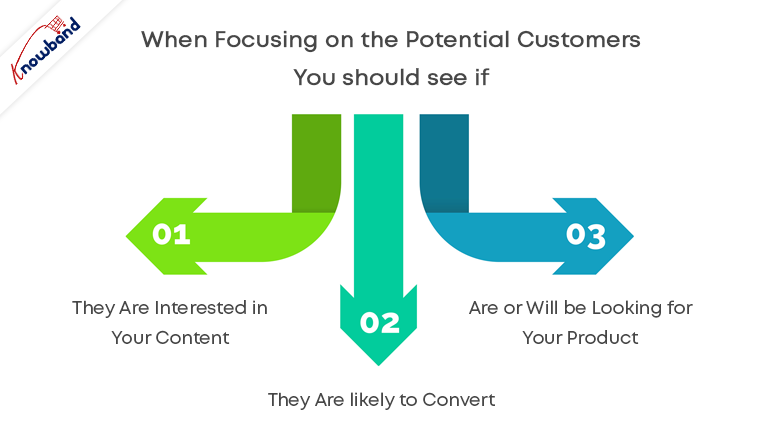
Among thousands of visitors, how many are the leads and take your services? If you are getting a good number of conversions then there is nothing to worry about. If this is not the case then you have to start targeting quality traffic. You must consider the fact that the quantity does not define the quality. Understanding your audience and making them talk about your services can be achieved with quantity but, for quality, your target should be based on buyer persona. When focusing on the potential customers you should see if:
They are interested in your content
They are likely to convert
Are or will be looking for your product
A potential customer is all that you need when you are running a business.
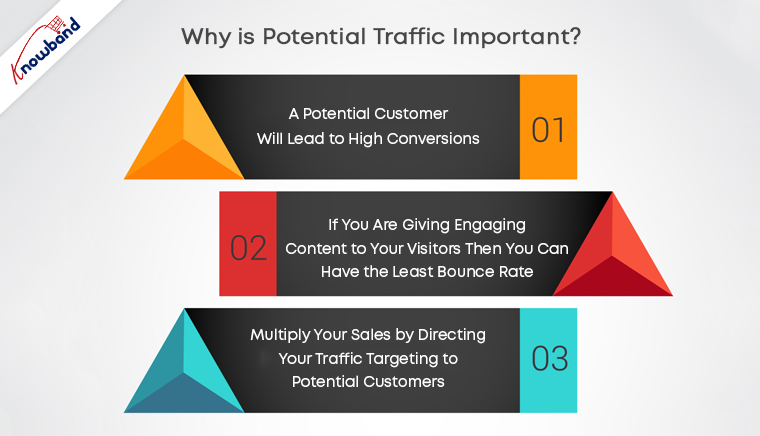
Why is potential traffic important?
Think about it! You are a protein bar manufacturer and you are running promotional campaigns without any filters. This might bring visitors to your site but are they actually going to buy your product? For a protein bar, you should have a B2B target audience as the customer can be of any profession and may differ from a buyer persona.
Let us take another example, you run an eCommerce website selling women’s cosmetics and hair products. Who will be your target audience? Women are more likely to spend on cosmetics. It would be profitable only if women are the target audience.
A potential customer will lead tohigh conversions. Bring targeted traffic to your site and boost your sales.
If you are giving engaging content to your visitors then you can have the least bounce rate. Many visitors leave the page as soon as they land it.
Multiply your sales by directing your traffic targeting to potential customers.
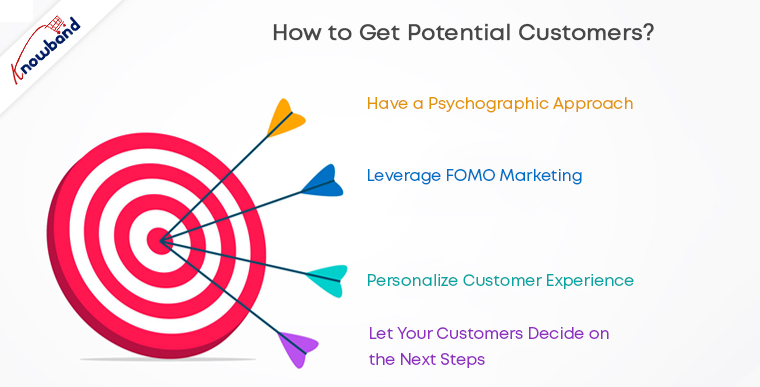
How to get potential customers?
Now you understand the quality audience traits and the importance of potential customers. Now you must be wondering, how to do that? There can be multiple ways to target audiences, like focusing on customer satisfaction and customer quality service. Best way to approach the quality audience is
You can conduct target customer research for the product and services you provide. Compile all your pre-existing data and customer information and start looking into the opportunities with target marketing. Collect more information like their professions, interests to use them in marketing.
Analyze the market to know the competition. When you are into a business be ready with your armor and sword to fight a war against your competitors. Here the armor will be your product service and sword will be a marketing strategy.
No customers are similar. There can be different ways to attract potential customers which can give high conversions. To get good retention and customer conversion you can target potential customers adopting multiple approaches.
Have a psychographic approach: Tell them why your product or service is good for them. You should know the details like buyer’s habits, interests, lifestyle, values, and opinions which can be used in your planning for marketing strategy.
Leverage FOMO marketing: You can make your target audience feel they might fall behind if they are not using your product or services. This is one of the easiest ways to boost sales.
Personalize customer experience: Attract them by giving personalized customer experience.
Prove that your products are better than those offered by competitors: Sometimes you have to play dirty to achieve your goals. Sell your idea as if there is no better option available.
Let your customers decide on the next steps: Your work is to guide them but not making them walk. Show the quality and advantages and let them decide on the next step.
Bottom line
Targeted marketing can lead to potential customers and not just visitors. Focus on providing customer quality services and improved customer experience. Make sure your product or service shows up when customers are looking for it. A planned marketing strategy can bring quantity as well as quality to your store.
Knowband can help you with this thanks to a wide range of modules offered for Prestashop, Opencart, Magento, and Magento 2.
A smooth and fast checkout page is one of the most important aspects of an increased conversion rate. The checkout page is also important because it is the step where the customer decides whether he will complete the order or not. There are two types of checkout pages i.e., Multi-step checkout and One-page checkout.
Nowadays, the One Page Checkout is known as better checkout in comparison to multi-step checkout. There are various reasons for that. The One Page Checkout simplifies the checkout process and saves the time of the customers and reduces the chances of cart abandonment because of its easy and fast layout.
Knowband offers the PrestaShop Single Page Checkout module which replaces your website’s default checkout with a fast and responsive Single Page Checkout and enhances the checkout experience of your customers. This module plays a great role in reducing the cart abandonment rate on the checkout page by allowing the customers to quickly fill in all the required details and complete their orders.
The Prestashop simplified checkout addon offers various advanced features like social login, auto-detect country, auto-address fill that make it easy for the users to fill in their details.
Prestashop One Page Checkout addon is one of the best-selling addons and it has more than 10000+ downloads on the PrestaShop Addon store and more than 5000+ downloads on the Knowband store.
How to replace your store’s default checkout with PrestaShop Fast Checkout addon:
Follow the following steps to integrate this addon into your online store:
First of all, you need to purchase the PrestaShop One Page Checkout module from Knowband.
After buying and downloading the addon, unzip it in the modules directory of your PrestaShop store.
After the PrestaShop One Page Checkout plugin will be available and ready to be installed in the module list.
Click on the install button to install it on your PrestaShop store. After installing it successfully, the addon will be ready to configure.
Other Compatible Modules with PrestaShop One Page Checkout:
1. Store Locator and Pickup module:
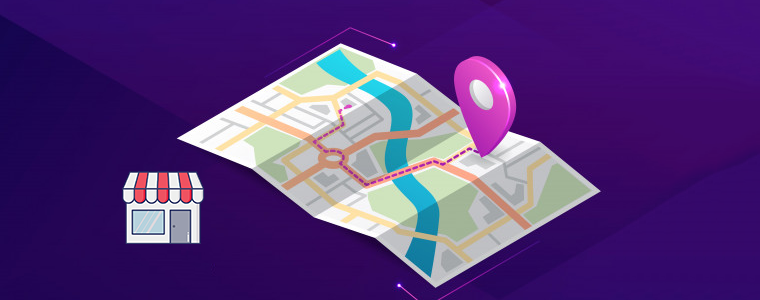
Being a store owner, it is really important to let your customers know about the actual geolocation of your physical stores. Knowband offers a Store locator and Pickup module which allows your customers to find and locate your stores near their locations.
They can also place Takeaway orders to pick up the product from the store using the Store locator and Pickup addon. The addon is mobile responsive and offers smooth functioning. This addition to your store will improve the checkout experience.
According to research, nearly 70% of the customers leave the cart abandoned on an eCommerce store. Checkout page abandonment is very common.
With the PrestaShop Abandoned Cart module, you can identify the abandoned carts on your online store and can recover them by sending tailored follow-up emails. You can also highlight your exclusive discounts in the reminder emails. It encourages buyers to come back to your store and complete their orders.
There are times when customers get frustrated! For instance, they initiate purchasing an item, and later at the time of checkout, they find that the product is not available in their locations. It is frustrating. Right? This leads to a low customer retention rate for your online business.
With the Product Availability Check by Zipcode module, it is easy to allow your customers to check if the product is available in a particular location. This can be done by entering the zip code. You can also add a search box on the product page to let your customers check the product’s availability before adding it to the cart.
If you want to implement this in your store then click here.
4. Mobile Login module:
Being an eCommerce store owner, it occurs registrations with fake email addresses on your website. With the PrestaShop Mobile Login module, you can allow your store visitors to register using mobile numbers with SMS OPT verification.
With this add-on, you can also implement a secure registration and login process on your PrestaShop store. In addition, you can allow the user to register without an email address. Know more from here.
5. Google reCaptcha module:
Spam registrations and spambots can be harmful to your website as they can steal the website’s data or can delete it.
With Knowband’s Google reCaptcha module, you can prevent your website from spamming. By implementing Google reCaptcha on various pages of your website including the Registration page, Login page, Contact page, and Forgot Password page, and the checkout page. With the PrestaShop Google reCaptcha module, you can prevent the spambots and drive quality traffic to your website. This module is compatible with PrestaShop One Page Checkout.
Social Login is gaining popularity nowadays as it saves users from creating new accounts and remembering new login credentials. With the PrestaShop Social Login module, you can allow your website’s visitors to log in through the most popular social media networks including Facebook, Google, Instagram, LinkedIn, Twitter, etc.
Offering login with social media accounts not only eases the login process but also reduces the chances of failed logins in your store. It also helps to reduce the abandoned carts on the checkout page as the customer doesn’t require to create a new account. Know more about this module from here.
7. Cash on Delivery with Fee module:
Nearly 18-20 % of the abandoned carts are caused because the users don’t trust the security in online payment on a new eCommerce website. With Cash on Delivery with Fee module, you can allow your customers to place the orders with cash on delivery option with an additional fee. You can provide these options to those customers who don’t want to go through the online process. Know more about this module from here.
Conclusion: So, these are the compatible modules with the PrestaShop One Page Checkout module which offers to add various advanced features to your online store. For any eCommerce assistance or custom module development, you can always trust Knowband as we are delivering the best customer support for 12 years. Write us at support@knowband.com and our team will be happy to help.
When exploring your Instagram or Facebook, you always see feeds that are of interest. Google’s discover feed also shows you the content which you like and would like to spend time on. Naturally, this makes you feel exclusive, and you spend more time without keeping the time track.
Can you give the same experience to your customers while shopping? Ecommerce brands like Myntra or Amazon try to target their inactive leads with personalized email marketing. Giving your customer a personalized shopping experience in this competitive environment could be the right plan to survive in a long race.
Understand the shopping journey of buyers with data and use it well for customer experience personalization. With that, customers who get exclusive treatment will do word-of-mouth marketing.
As an eCommerce store owner, you might have given thought to this. But, you may struggle with How to do it?
Know your customer personally
When you are spending a lot of time and money on focused target marketing, you just don’t need a customer who will make a one-time purchase but your business demands a loyal one. For target marketing, you can consider gathering demographic and psychographic details from a customer. The demographic information can be collected from registration forms but for psychographic information you need more data. To get the details like the interests, values, profession, and lifestyle, you can add custom fields to your registration page.
Proving your customer with loyalty points or rewards at every step of the form filling process will encourage them to fill it. This way, you can get more relevant information for future marketing and product personalization.
You can always ask for:
Their first name
Birthday
products they’re interested in
A preferred channel of communication
Some might like receiving emails but in a limited number while other millennials prefer receiving an SMS just after the purchase is made. It is good to ask the preferred channel of communication for targeted marketing. You can even ask for their interests and genre if a person is buying a book from your store.
A large number of people have no issues if a company spoof into the customer’s information which can provide them with a wow experience. From a report, it has been found that 76% of customers expect companies to understand their demands and requirements. So, people like getting a personalized experience, and it is now a trend that can be followed by an eCommerce store owner to compete with others in the market. Personalization can lead to impulsive buying.
Better to communicate with your customers
Remind your customers about the products they liked to buy or visited but did not make the purchase. You can send a push notification for back-in-stock products. You can ask them to look into their wishlist to reduce the abandoned cart.
It is crucial to choose the right means of communication for interacting with your customer. The selection of a communication channel should be based on the data you have collected. Customers often receive promotional emails and notifications which grab their attention and make them shop more.
Putting efforts in the right direction can help you boost conversion rates and customer retention. Millennials prefer texting overcall. You can use a chat app to provide a solution to their queries. This will be a great deal to give them more customer experience personalization.
Effective use of data for persona
You have the data in your system and what a waste if you are not using it well. Your system knows your customer better than you do.
Have you ever been in a situation when you called a person with the wrong name? This happened to me once, and I never want that to happen again. It instantly loses trust in a relationship. Send emails or greet them in-store by calling their name. This builds up an interactive connection between you and your customer.
You can take the help of segment email marketing by categorizing your customers according to their psychographic data
Understand the need of your customer as per their geographic location. Implement geolocation-based marketing strategies. Add a store locator to your website. In-store shopping is still a trend in millennials.
PrestaShop modules you should not miss on
Do you know that you can enhance the personalized customer experience by adding extensions to it?
It is challenging to keep your customers at a checkout page or the product page when they are doing two things at a time. You must have some striking, captivating website features which will keep them attentive and focused on their purchase. Why not with personalized features that you can add with these modules?
Collect more information
With PrestaShop Custom Registration Fields, the owner of the PrestaShop store will collect information about the customer by adding custom fields to the registration form of the website. Additional Order Forms/Field Manager addon for PrestaShop is another module that can help you gather more information. Custom fields on the order form can be generated with this PrestaShop Additional Order Forms Manager without making any adjustments to the code on the web page.
How to use it?
You can ask your customer to fill up the details which can be optional. You can add this field to the registration form. This way you can collect information about birthdays, anniversaries, or any of the interests which can help you promote your products. You can send a personalized message on their birthday with a greeting or any discount coupon. Store owners can use additional information to develop their services and eventually make more profit from their company.
Celebrate birthdays or anniversaries
You can give discount vouchers or coupons to your customers on their Birthday. Birthday Coupon -PrestaShop addon is a module that can inspire your customers to shop from your store on their birthdays.
How to use it?
You can send an email with a personalized message on their special day. This email will include the birthday coupon or discount voucher. The voucher sent through the mail will be valid for a limited time. The addon comes with multiple default templates. You can use it for various occasions.
Make them loyal customers
It is a dream for brands to have loyal customers. From research, it is found that about 30% of people like to buy the same brand and around 40% choose the same brand if they are offering personalized products. For customer retention and conversions, you can give loyalty points or reward points to your customers.
The PrestaShop Reward Points addon incorporates the reward points feature into your PrestaShop store and allows the admin to offer the rewards point to online shoppers every time they purchase items.
How to use it?
Store owners can give reward points to the customer after every purchase they do. This comes with a set of terms and conditions. The module helps the admin to add multiple rules for redeeming those points. Customers can redeem those points at some point of purchase which will keep them engaged in your store.
There are some rules like Cart Rule, Product Rule, and Behaviour rule for loyalty points. Store owners can offer loyalty points on a specific cart amount, product quantity, based on the payment method, particular product or category, shipping services, etc. It can be given to new customers while placing their first order.
Display recently viewed items
Automatic Related Products addon for the PrestaShop store can help you show the relevant products to your customers. This feature can be added to multiple pages of your eCommerce store.
How to use it?
The feature will show related products to your customers, and this will motivate them to see more and more on your eCommerce store. If they are not satisfied with the one product, they can see more until they get the one.
It has a simple configuration, and the admin can ask customers to provide more information about the product. If they like the product or not? If they need any modifications? By collecting additional customer details, the sellers can better represent them. As a result, online shoppers will have the same user experience with this PrestaShop Additional Field Module on the Product tab.
Attractive email subscription module
Spin And Win – Entry, Exit, and Email Subscription Popup by PrestaShop have a gamified interactive look. It attracts the buyer’s attention and allows them to win offers like discount coupons or free shipping. This is one of the best sellers of PrestaShop and a fantastic module to collect the email addresses of your customer.
How to use it?
You can Get Personal in Email Marketing and send personalized Emails using the information which is provided by the customers. The emails should be sent based on customer behavior. You can go for a personal recommendation to offer a personalized customer experience to your customer. Try to re-engage your leads with promotional messages or pop-up notifications. Email marketing is a free and reliable option to give a customer personalization experience to users.
Greet your customer
Greetings are most valuable when you are building a relationship. Customer-trader relationship is most important when it comes to business. You can use a Better thank you page module for your PrestaShop store.
How to use it?
Add a Better thank you page module to your PrestaShop store and use it to show a pop-up when the customer is leaving your store or after the successful purchase. Also, you can add customized banners or discount coupons for their next purchase. This way, it can help you boost customer retention and make your customer satisfied.
Final thoughts
Increase your sale by providing a personalized shopping experience to your customers. In this era of millennials, Personalisation is the only way to attract a loyal customer base to your store. Create Special Campaigns Based on user behavior and make them feel unique. They don’t like to be treated as a number but an individual. So, It’s time to boost your sales with a customer experience by providing personalization.
An eCommerce store owner observes maximum cart abandonment when a buyer reaches the checkout page. What factors are responsible for cart abandonment and acting as conversion killers? Talking about the statistics, it is been observed that sixty-nine out of a hundred people abandoned their cart on the checkout page. Optimizing your checkout process is as important as the website optimization.
There might be many visitors to your blog posts or product pages. But, are they giving you any business? If not, then below are 9 most common checkout conversion killers that drive your customers away.
1. Mandatory Registration during Checkout:
Forcing your customers to set up an account before they can complete their transaction could kill your conversions. Therefore, make sure that your website always allows customers to shop as visitors without having to register.
You can provide them guest checkout facility or social login option which will make it easier for them without taking much time.
2. Long and complicated Process:
Nothing is more irritating than filling in super-long forms with complicated fields before you make a purchase. Stop enticing consumers to buy additional items with pop-ups. They sometimes interrupt the checkout process and end up doing more damage than good.
So make your signup form simple and quicky. Make sure that they include relevant drop-downs, radio buttons, and an indication of optional information. Most importantly, hold field labels so that consumers can quickly fill out what they need.
3. Lacking or Weak Product Details:
It’s just profanity! How do you picture someone buying from you when you don’t have a convincing, thorough explanation of the product. Forget about that. Online shopping is like an impersonal activity. The best way to persuade a customer to buy is through words and amazing images! Start putting some bewitching images to your product description for not making your customers head off.
4. Never-ending loading time:
Do you like waiting for someone or something? Neither you nor is your customers would like that. Optimize your checkout page for speed. Analyze and cut off the extra fields and graphics from the page which can be a conversion killer. Long loading time will demotivate your customer and encourages them to leave the site.
5. Lack of payment options:
You can provide several payment options already available for the checkout. The mode of payment is a necessary element to focus on. In the competitive market place you must have an online payment option but having multiple modes can be advantageous. You can put some common secured payment options on your checkout page. Payment gateways provide encryption to keep your customer’s information secure. It provides a more streamlined and convenient experience for them — especially on mobile devices.
6. Not being mobile-responsive:
A growing amount of online transactions are taking place over mobile devices. Almost any way you look at the numbers, millennials are more open to accepting and more likely to participate on mobile devices than their older counterparts. Customers who shop on their smartphones and tablets have less time than they do on desktops. Buttons need to be bigger and easier to reach, shape fields need to be minimized to speed up the checkout process, and labels and text need to be clearly visible. Ensuring that the checkout process is designed for mobile shoppers is important. You can lose many if your website doesn’t work well with mobile.
7. Extra Shipping and Hidden Costs:
Imaging, you are buying something online. The product costs $20 and then you move to the checkout page where you see the cost raised by $5. This was the cost they were charging as taxation. You will be discouraged and might leave the checkout process immediately.
If you don’t reveal all the expenses in advance, you’re turning your customers away. 23 percent of customers cancel their purchases because they do not realize the additional costs in advance. Therefore, make sure that you display all costs right on your product page to make the customer experience easier. If you are charging extra for shipping, make sure to highlight it with the product cost on the product page. This can be a conversion killer and will add another order to your abandoned cart list.
8. Not enough Product reviews:
Product reviews are an essential part of the branding and marketing of an online store. They help create trust and loyalty, and they usually define what sets the goods apart from others. Reviews help your store increase sales, and you can persuade customers to leave more of them. When the comments are found to be credible and correct, they will most certainly listen to them.
9. Website isn’t Secure:
Customers don’t always like using their credit cards online, so it can be even more difficult if you’re a new small business that still builds confidence in your audience. As an online retailer, you need to make customers feel comfortable about the security of your checkout process. The positive thing about incorporating PayPal Checkout is that PayPal is an internationally recognized payment brand.
A simple mention of secure payment on the payment section will reassure your buyers that there won’t be any foul play.
Final Thoughts:
In order to stop cart abandonment, you can install a checkout module to your eCommerce store which will be incorporated with all the important payment gateways, customizable fields, social login options, and much more. By adding One Page Checkout addon to your store you can get rid of all these conversion killers. Knowband offers One Page Checkout modules for PrestaShop, OpenCart and Magento stores.