How is 2016 Black Friday weekend a big event for retailers and shoppers?

Shopping enthusiasts around the world are always looking for reasons to satisfy their shopping urge. The American customers had witnessed great shopping deals and offer through the recently concluded Thanksgiving Day. Once again, the shoppers are getting new reasons to cheer up with this Black Friday weekend that is around the corner.

The coming weekend is definitely a jackpot for global shoppers as great offers and sales are about to begin and will continue till the next New Year of 2017. Apart from the Black Friday, there is another mega event called Cyber Monday that will further boost the online shopping for online stores. Next to complement this shopping treat will be a month long Christmas and Hanukkah celebration that will drive millions of customers, eCommerce conversion rates, and sales. Let us explore more about Black Friday weekend and other holiday predictions with the help of statistical data given by Adobe Digital Insights and Experticity.

  • Black Friday of 2016 is expected to be much bigger than ever. As per an estimate, the sales are expected to exceed by $3 billion, which is an 11.5% increase over the last year Black Friday sales.
  • The next event scheduled for Black Friday also known as Cyber Monday is also expected of having sales more than $3 billion, which is an increase of 9.4% over last year sales.
  • This 2016 year will see 5% of customers driving around 35% of the revenue.
  • This Black Friday weekend sales of 2016 will witness 25% of the top products being sold, which is a growth of 11% from last year and accounting to a total of $91.6 billion.
  • 2016 is expected to be a great year for retail as the holiday sales will surge up to $91.6 billion, that accounts for 11% increase compared to the last year.
  • Based on the popularity of social mentions, the top five holiday gifts for this holiday season will be Pokemon Sun/Moon, Barbie, Legos, Oculus and PlayStation VR.
  • This 2016 holiday season will emerge as a clear winner for REI in terms of its customer base and employees. The customers will be happy with the exciting shopping offers while the employees will get a day off that will together account for higher sales and conversion rates for the company.
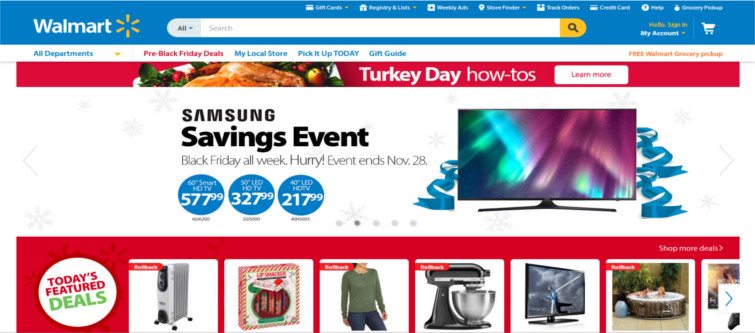
  • One of the biggest retail chains, Walmart will increase the wages of its employees and will achieve Return on Investment (ROI) in terms of bumper sales and customer engagement.
  • The biggest beneficiary of this holiday season will be retail associates as 94% of the people talk about their friends and family regarding attractive deals and offers. This will definitely be a good breeze for malls, shopping centers, and customers in India who are actually hit by the recent demonetization drive.
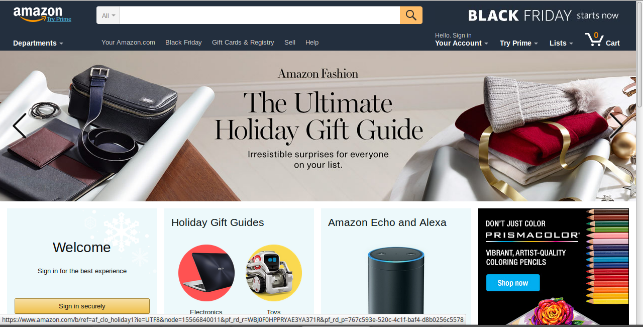
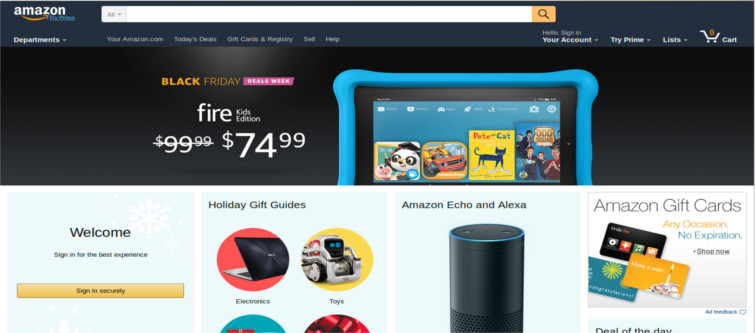
Amazon is making the most of this holiday season sales with its Lightning sales.

To give cheers to its global customers around the world, Amazon initiated the Black Friday sales 12 days earlier starting from 14th November with its exciting Lightning Deals. Its global site is showing appealing shopping deals and offers on various categories like electronics, books, toys, clothing, sports equipment, personal care, home care, and other such departments.

Final tips

It is important to showcase the similar exciting shopping offers and deals on your eCommerce store to remain in sync with the upcoming holiday season. Stock up the inventory of your online store and improve the functionality of your Magento, OpenCart, PrestaShop, Shopify, WooCommerce and other platform based stores with feature loaded eCommerce extensions. This upcoming holiday season is your chance to ramp up your product sales and eCommerce conversion rates.

Related Stories:

E-Commerce Apps that are a must in this demonetization scenario

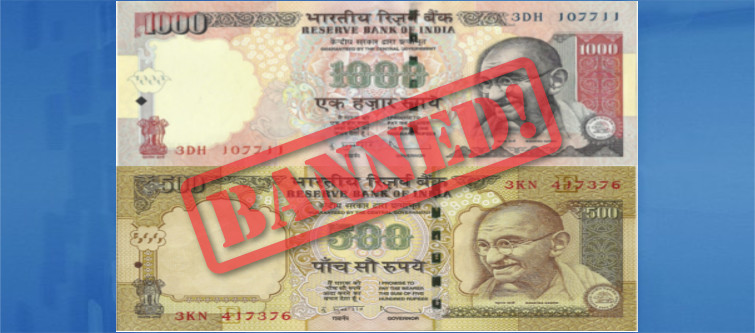
The demonetization drive which was historically announced by Prime Minister Narendra Modi on the evening of 8th November, 2016 was a game changer in the Indian economy. It was a bold economic reform step that changed the entire political, social and economic landscape. With a single stroke, the higher demonetization notes of 500 and 1000 value were suddenly reduced to a waste paper within the midnight of 8th November.

The wide range of businesses across India was affected significantly with this demonetization drive. Most of the businesses were either having a great day or crashed badly with this ban on 500 and 1000 notes. However, eCommerce is one such business area that had a mixed day due to this recent demonetization drive. While there are certain eCommerce players that faced tough days due to decrease in CoD (Cash on Delivery) orders, others had an unusual great business with the rise in digital payments.

Here are the certain eCommerce apps that can help in improving conversion rates for your business. Take hints from this blog that can explain how demonetization affect eCommerce services in India and which are the apps that can be your savior.

1. Transportation-

E-Commerce apps have made the booking of transportation rides easier without any hard cash requirement.

While businesses are hit with the sudden ban on 500 and 1000 notes, eCommerce companies related to the transportation have mostly remained unaffected. If you are short of cash and want to travel somewhere, you need to have the apps like Ola, Uber and others on your smartphone. These eCommerce transport companies follow mostly the digital modes of payment through their closed wallets, Paytm, and other such mediums. Recently, Uber has also launched the special wedding traveling services for Indian customers considering the wedding season around.

Apart from the cab services, there are eCommerce apps like Jugnoo and Ola for availing auto rickshaw ride facility.

2. Groceries- 

Install eCommerce apps for the quick online grocery purchase.

With busy lifestyles of people, buying groceries manually through a local market or supermarket chain has become a thing of past. Like other things, eCommerce companies are now cashing on the groceries market with their apps. With these apps, people can easily purchase grocery items irrespective of the deficient cash supply due to this demonetization drive.

There are eCommerce mobile apps like Grofers, BigBasket, Nature’sBasket, ZopNow, and others that allow easy grocery purchase through digital payment options. Flipkart, a major eCommerce player in India is also planning to venture into the grocery operations from next year. Thus, if you are short of currency due to this demonetization drive, these are the grocery mobile apps at your rescue.

3. Recharge and payment options-

Perform payment of utility bills and other tasks easily with the help of eCommerce recharge mobile apps.

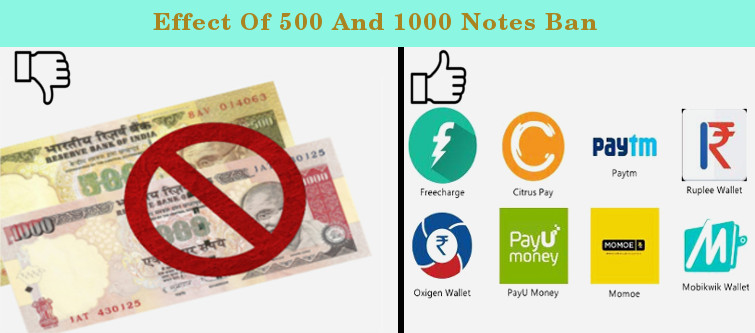
With the cash payments becoming difficult due to this financial reform, digital payment companies are having the last laugh. More and more people are now opting for cashless transactions through the help of various digital payment options. This is the blog which will help you to understand the impact of demonetization on eCommerce digital payment options. Most of the people are now using cashless methods for mobile recharge, utility bills, movie tickets, hotel booking, online shopping, food ordering, flight/train and bus tickets instead of direct cash payment.

The digital payment companies like Paytm, MobiKwik, PayUmoney, FreeCharge, and others have seen a tremendous increase in their customer base along with the daily customer transactions.

4. Food-

Order food easily with eCommerce mobile apps during this demonetization scenario.

Don’t worry if you are having a scarcity of hard cash due to the demonetization move, you can still order food online. People can sacrifice their other luxury splurges and expenditure, but the food is the basic requirement of every individual. There is a host of eCommerce mobile apps such as Zomato, Swiggy, Foodpanda, and others that can help in ordering online food through digital payment options.

5. Medicines-

With eCommerce mobile apps, customers can purchase medicines through cashless transactions.

We all know that demonetization drive was relaxed for the hospital, petrol pumps, railway stations and other places but still it was not implemented fully across pan India. With the demonetization drive, it was a bit difficult to buy prescribed medicines with old currency notes of 500 and 1000 value. To ease out the suffering of these people, there are eCommerce mobile apps like Netmeds, Zigy, and others that allow people to buy medicines online. These apps don’t require hard cash but provide credit/debit or other digital payment options for buying medicines online.

6. Household services-

Avail any household services quickly with the help of these eCommerce mobile apps.

There are virtually mobile apps for every other household facility be it  plumbing requirements, pest control, car washing or any other services. You don’t need to roam around and look for the solution of your household problems with the presence of various mobile apps. There are eCommerce mobile apps such as UrbanClap, Helpr, and others that can offer household services through digital payment options. So, don’t run with hard cash in your hand to resolve various household problems.

In the nutshell

Demonetization is the current flavor in the present business scenario as the recent ban on 500 and 1000 notes have made a gross impact on the purchasing power and behavior of people. Well, the situation may continue for some more days but your business can’t be on the “wait and watch” mode till then. If you are indulging in any of the above eCommerce business, it is time to avail the eCommerce plugin development services of Knowband for a quick business makeover.

The eCommerce extensions of Knowband are packed with multiple features and offer digital payment options to boost your conversion rate optimization efforts. So, contact our eCommerce site for developing feature packed extensions for your Magento, OpenCart, and PrestaShop stores.

Liked This? You’ll Like These Too

How can you boost eCommerce Conversions with your site deals?
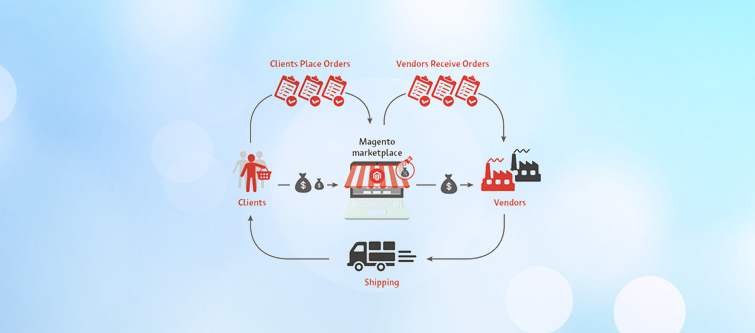
Shopping deals are a great way to grab the instant attention of your targeted customers towards your eCommerce store. Remember that “You are not the only one in the race” and thus you need to take required efforts to boost your store sales. If you are unable to get customer focus at the first instance only, your sales are bound to suffer.Having promising shopping deals on a site does not guarantee you more product sales and eCommerce conversions. There can be numerous reasons that can be the hindrance for the success of your shopping deals on your eCommerce store.

1. Reveal your shopping deals prominently on your website-

Display shopping deals prominently on your site for higher sales and conversions.

If you can’t feature your shopping deals in a better way, it will be good for nothing. Your targeted customers will only engage with your site for a product purchase only if it contains some exciting shopping deals for them. Create a home page banner about your shopping offers and deals for better customer engagement and sales.

The home page of a website is the first thing where any visitor lands and hence they are the best place to feature your shopping deals.

2. Include only available products on your shopping deals-

The redirecting page of your shopping deals should be functional for your site visitors. It would certainly be a nightmare for your Magento site if it can’t deliver you desired conversion rates and sales. Don’t blame your Magento One Page checkout process for its inefficiency as there could be the number of reasons for the low product sales and conversions.

One common mistake that I have found on numerous sites is that the site deals are leading to “page not found” or “end of product stock” pages that immediately turn off a site visitor. If your visitors are unable to find out the product mentioned in the shopping deal, they will leave a site in the middle causing shopping cart abandonment.

3. Give a personalized touch to your customer orders-

Customers are selecting your eCommerce site for a product purchase among other available sites, so make them feel special about the same. You need to give a personalized touch to your customer orders by providing them free gift wraps, personalized message/sticker, free/upgraded shipping services, and other such facilities.

This personalization will make your customers feel more valued and will make them loyal to your eCommerce store. It will further help in boosting your product sales and eCommerce conversions.

4. Show urgency on your shopping deals-

Urgency on your shopping deals persuade customers for a quick product purchase.

Your site visitors will engage immediately with your online store if your displayed shopping offer/deal is available for a limited time period. Don’t forget to include phrases like “Limited offer”, “Offer expires on ….”, “2 more left in the stock” or any other such statements. All these CTA statements can not only grab immediate attention of your customers but can also arouse customer attention towards your store. Once, the customer know the limited time period of your shopping deals, they will be encouraged to go for higher product purchase on your site.

5. Offer multiple payment and shipping options with your deals-

It will certainly be in the interest of your customers if you can offer them multiple shipping and multiple payment options. Don’t force them to make payment through a specified option only but include more payment options with the help of feature packed checkout extensions. Add popular payment options on your site that can make customers more comfortable while doing an online purchase through your site.

6. Show important updates about shopping deals to your customers-

Customers will appreciate the fact if you can provide timely price related alerts about your shopping offers, new products or any other crucial product update notification. Providing regular updates to your customers will help in building a loyal customer army within a short time. Moreover, it will compel your visitors to make a quick product purchase on your eCommerce site.

Finally….

It is important to showcase your displayed shopping deals in the most engaging manner for getting instant customer attention and sales. Remember, visitors on a site are always looking for great shopping deals and offers, so don’t disappoint them at all. Deals are the first step towards achieving eCommerce conversions and the checkout process is the last step in the final destination. So, take the first step wisely to make the maximum business impact.

Liked This? You’ll Like These Too

How is demonetization affecting the eCommerce and other business sectors?

With the big announcement that came on 8th November, 2016 regarding the ban on Rs 500 and Rs 1000 currency notes, there were widespread tremors experienced by the people in India. While most of the people were hailing it as a “masterstroke” move against black money, currency counterfeiting, and terrorism. There were certain sections of people in society, which were making hue and cry about the move that has brought unnecessary problems for them. Here is our detailed study about the impact of demonetization on various types of businesses in India. The ban on Rs 500 and Rs 1000 currency notes have restricted the shopping ability of people through cash. Along with this, the ATM withdrawal limit of Rs 2,500 has complicated the entire matter further. Let us take a quick look at the various business sectors that are affected by this demonetization move. The decision has definitely hurt the conversion rate optimization practices in a big way.

E-Commerce- 

E-Commerce sales are affected due to the ban on currency notes of 500 and 1000 notes.

With the ban on Rs 500 and Rs 1000 currency notes, eCommerce players were forced to stop “cash-on-delivery” payment modes on their site. Certain eCommerce players like Flipkart and Snapdeal made restrictions on the order purchase value to below Rs 1000. While Amazon India stopped CoD orders from Wednesday, a day after the big announcement.

These eCommerce companies also stopped receiving old denomination notes of Rs 500 and Rs 1000 notes and paid more emphasis on other means of digital payments. The demonetization move has hurt the eCommerce conversions of various companies from Flipkart to Zomato, which is a food discovery and delivery portal with other companies that mainly generate revenues through hard cash that accounts for around 60-70% of total orders. With fall in CoD orders, demonetization has led to jump in digital payment options for making online transactions.

As per a research done by the Forrester Research, “The cash on delivery share will come down and it will force customers to make payments online. Initially, in the next 1-2 months it may hurt ecommerce companies.”

This drop was further attributed to the curb on black money due to this demonetization move which was used to make the purchase through various eCommerce stores. According to the statement of Amrish Rau, CEO of PayU India, “About 40% of CoD was driven by black money according to a study done two years ago.” He further stated that “This will have a serious impact on GMV as not all CoD will move digital payments. In the rural economy where consumers are still not that comfortable with digital money yet and who are still adapting to the internet will stay away.”

With the scarcity of cash, it is definitely taking a toll on the conversion rate optimization practices and eCommerce sales are eventually dropping.

Real estate- 

Hard cash is one of the reasons for the downfall of the real estate sector.

It is one of the business segment that is hard hit with this current financial crunch. The hard cash offers an effective working capital for builders and thus this financial constraint can be a severe blow to this aspiring business sector. The demonetization move could hurt the customer demands for home and could force builders to decrease the price of their real estate properties.

This real estate fall is mainly attributed to the cash paying tendency of the customers. Vinay Khattar, who is the head of research at Edelweiss Securities stated that “But, in the long run, due to affordable prices and low supply, this sector will experience positive demand scenario.” Apart from this, housing finance companies are also witnessing pressure on their credit quality as well as growth. All this has been happening due to the fall in real estate prices that will affect the loan against property (LAP) business.

Steel, fertilizers and agrochemicals- 

                    Fertilizers and agrochemicals are the items that are affected by the demonetization move.

The impact of currency ban on Rs 500 and Rs 1000 notes is having an adverse effect on a number of business areas. The demonetization is causing problems for the sectors like steel, fertilizers and agrochemicals. This is because the transactions in these areas are mainly done on the cash basis and not through online payment methods. In addition to this, metal companies related to steel will also be affected severely as they handle transactions through cash basis currently.

Final words of wisdom

With this current currency ban on Rs 500 and Rs 1000 notes, the businesses that are solely dependent on cash payments are bound to suffer. Whereas, the businesses like eCommerce that offer other online payment options will have a limited impact. So, it is entirely your business decision to choose which side of the fence after this demonetization step.

Those involved in the eCommerce business can take the help of eCommerce plugin development services of Knowband store. The company can help in developing customized eCommerce extensions for your Magento, PrestaShop and OpenCart stores for better business growth.

Liked This? You’ll Like These Too

How is the demonetization move a boon for digital payment companies?

Since the Indian independence in the year 1947, the demonetization move to ban 500 and 1000 Indian currency notes is one of the biggest economic overhauls. The Indian Government headed by Prime Minister, Narendra Modi has decided to ban the old 500 and 1000 currency notes from the midnight of 8th November, 2016. The issued notification also informed people about the introduction of new currency notes and the selected use of old currency notes at various places till the midnight of 11th November, 2016.

The new currency denomination will be in the form of 500, 1000 and 2000 notes. Additionally, the people having the old currency notes of 500 and 1000 value can get them exchanged for new currency notes from 10th November onwards.

Well, the move has been hailed as the “masterstroke” move against black money, fake currency, and corruption, there have also been certain murmurs around. The tremors of demonetization were felt across the wide range of business spectrum but it was really a golden opportunity for eCommerce companies. Due to the ban on 500 and 1000 notes, people are having a hard time in buying groceries, dresses, cosmetics, electronic durables, and a host of other items through hard cash. In situations like this, online payment and digital wallet options have suddenly gained the huge attention. Let us offer you a quick tour of how the eCommerce companies reacted and took this bold decision in their strides.

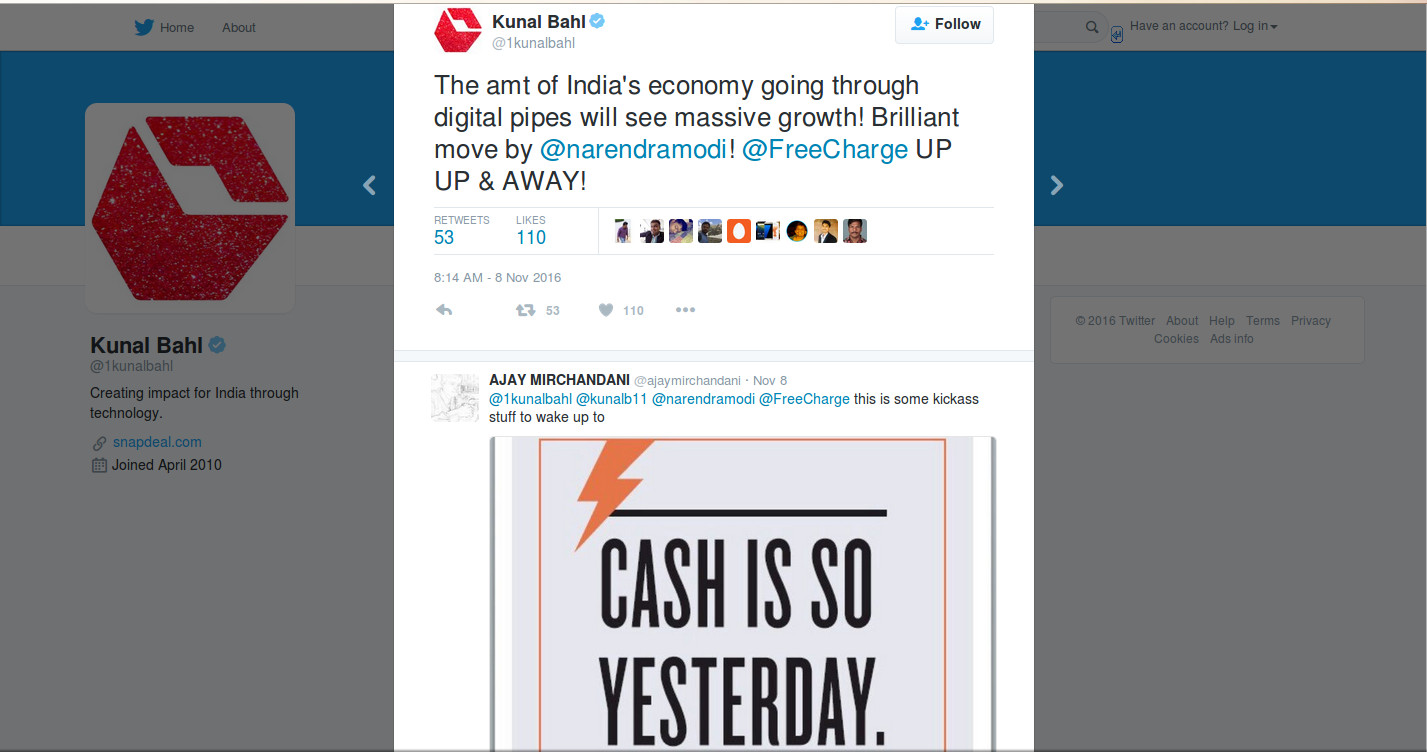
Kunal Bahl, who is the co-founder and CEO of Snapdeal, an eCommerce marketplace platform expressed his opinion about this announcement through his tweet mentioned below:

Apart from Snapdeal, digital companies, as well as other eCommerce startups, have appreciated this big-bang move. Kunal Bahl further added that

“With this, the quantum of India’s economy moving through the digital pipes will witness massive growth. Both Snapdeal and FreeCharge are committed to supporting all such initiatives.”

Naveen Surya, who is the chairman of Payment Council of India (PCI) and the managing director of ItzCash stated,

“We welcome this extremely bold and much needed step by Prime Minister Modi and the government to cure us from disease of cash in our society. I along with Payment Council and India and ItzCash greatly admire this move and provide our full support.”

Trupay, a unified payments interface (UPI) company, which offers bank to bank payment solution was all praise about this great move. In the words of Rahul Gochhwal, a co-founder of Trupay,

“During the changeover period of phasing out old currency notes we really believe that a lot of people will move towards digital payments options due to curbs on roll out of new currency. People will now look at and embrace new age digital payments systems which are far more efficient to enable direct bank to bank retail payments.”

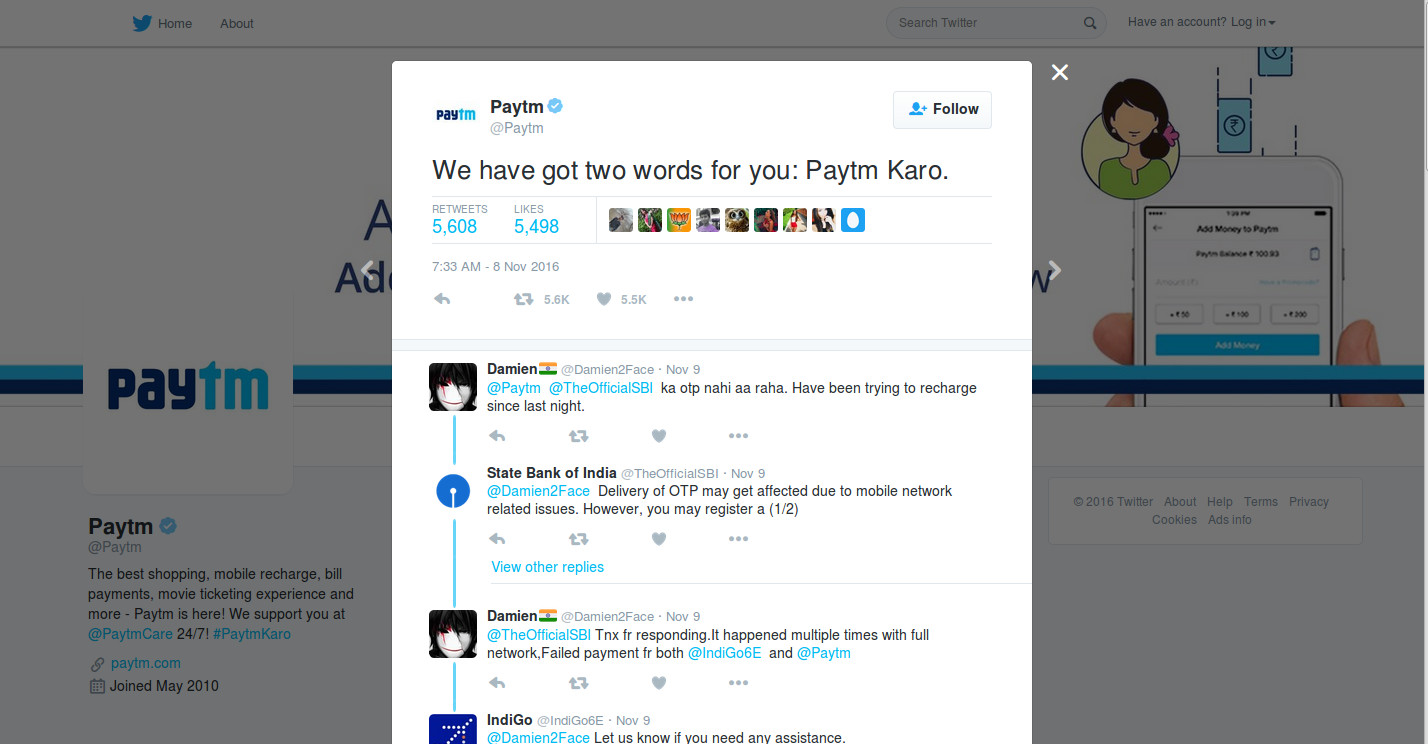
Paytm, a popular digital wallet company took it Twitter to convey their reaction by pushing forward their famous tagline.

Speaking with The Economic Times, Paytm founder, Vijay Shekhar expressed his views as

“In ecommerce, we will see more consumers do digital payments, CoD will reduce which means ecommerce will become more scalable in the long term. This is the best time to build a financial tech company in India. Every part of the country now wants digital to be successful.”

He also welcomed the decision whole heartedly.

Similar sentiments were echoed by Bipin Preet Singh, CEO and co-founder of MobiKwik, another digital wallet company. He considered the present economic reform as a milestone in the history of India. He said,

“Within a 50 day period, a billion Indians will change their payments behaviour – we will move from cash only to a cash-free economy. This a strong step taken by the Modi government and will benefit the growth of digital payments and digital banking in India.”

Digital payment and eCommerce companies are finding the present economic situation as the most lucrative option for their business and want to fully capitalize it. E-Commerce companies like Snapdeal, ShopClues and others are launching their own digital wallet payment option to offer a streamlined transition for customers who were earlier opting for “Cash on Delivery” (COD) method.

This is definitely a big radical change that will surely transform the way billions of Indians make their regular payments for various day-to-day services. If you are one of the eCommerce store owners, it is the ideal time for you to get involved in this marathon of digital payment. Start offering multiple digital eCommerce payment options and encourage customers for a quick online product purchase.

You can avail the wonderful eCommerce plugin development services of Knowband in this regard. The company can deliver you feature packed customized eCommerce plugins for digital payment on Magento, PrestaShop, and OpenCart platforms. So, be a part of this financial reform and achieve big with your eCommerce store.

Liked This? You’ll Like These Too

How to drive eCommerce Conversions through email marketing?
Emails are omnipresent and their impact has been mammoth in the business world due to their high utility. It is still one of the most reliable medium of formal or business communication at the most competitive price. In the course of extending its scope, email marketing is now actively used in the fields like business promotion, product sales, customer targeting and retargeting, customer retention, finding out new prospects and other such critical tasks.

The field of email marketing needs to be utilized in the best manner for grabbing higher conversion rates and sales among your competitors. Let us explore this email marketing in detail with this interactive infographic shown below:

By understanding the role of email marketing in a business environment, it will not be difficult for any business to grab its share of conversion rates and sales. These promotional and marketing emails have the potential to improve your business fortunes without burning a major hole in the pocket of various businesses. Do follow the tips mentioned in the infographic above and reinvent your email marketing strategy for a quick turnaround.

Liked This? You’ll Like These Too

Why are Marketplace sites more successful than the Inventory Model?

Marketplace like Amazon, eBay, Alibaba are known to everyone today. It was a time when these sites had their dominance in their home country only. But looking at the stats for the reach of these sites in the global context shows us the figures that shout their presence in almost every country on the globe.

The globalization of eCommerce sites has only been seen in the past decade when a new model of eCommerce was introduced. It’s the marketplace model of eCommerce. eBay was the first entrant here. A series of development has been noticed in the past few years with the growth of the marketplace model. But what is a marketplace model of eCommerce? Before discussing that, I would like to illuminate a few points on the eCommerce scenario before the introduction of the marketplace model.

What is/was the case before the marketplace hit the floor?

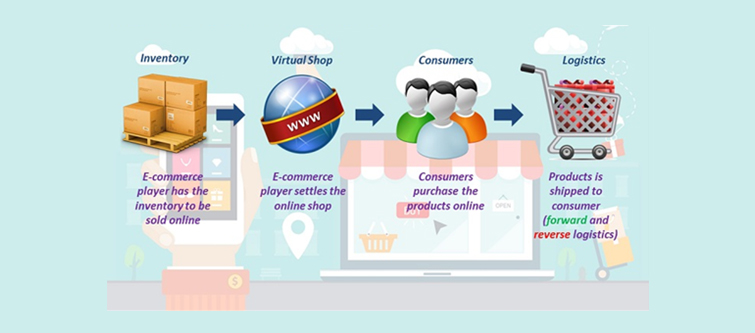
The inventory model of eCommerce has been on the market for long enough. We can say the actual eCommerce started with the inventory model. According to the FDI policy “Inventory model of eCommerce means an eCommerce activity where the inventory of goods and services is owned by the eCommerce entity and is sold to the consumers directly”.

It clarifies the inventory model that all the products are brought directly from the eCommerce firm itself and it is the firm itself who manages the shipping of the items to the consumers. Taking the case of Flipkart which has evolved from an inventory model to multi-vendor model of eCommerce. An Indian eCommerce firm based in Singapore, which was started as an inventory model, later in 2013 it also took the path of the marketplace model.

Inventory model of eCommerce indicates a direct B2C relation between the firm and the consumers.

Earlier before the marketplace joined the game, firms were in direct relation to the consumers. The orders were received by the eCommerce firm through its site interface and then fulfilled only by the firm itself. The firms had a direct partnerships with the delivery services who were responsible for delivering the dispatched item to the consumers. One of the major characteristics of the inventory model was that firms have to manage their own inventory of products in their warehouses and this was also one of the major drawbacks of the inventory model of eCommerce. Managing such a large inventory of products was a risky task and even a complicated one.

What happened when the marketplace finally arrived?

It was the arrival of the multi-vendor model, which completely revolutionized the way eCommerce firms worked by then. In order to extend their reach to the corners of the world, eCommerce firms adopted a new B2B layer between the firms and the consumers where the consumers directly contact the firm but the fulfillment is done by the new layer which is also called as vendors or sellers. The eCommerce sites started accepting the seller/vendor registration and allowed them to sell on the firm’s site.

The official definition laid by FDI for marketplace site says”Marketplace model of eCommerce means providing an information technology platform by an eCommerce entity on a digital and electronic network to act as a facilitator between buyer and seller”

Multi-vendor sites are the firms that allow a huge, distributed population of buyers and vendors to find prices, products and transact with each other on a third-party platform that is trusted, safe, reliable, and transparent. In return, these marketplace sites charge some commission from the sellers on each sale. Some of the multi-vendor platforms like Amazon, Flipkart, and others provide the services and products as fulfilled by the firm itself. If you have noticed, you might see certain lines in the description of certain products like “Fulfilled by Amazon”. These lines mean that the particular product will be delivered to the consumers by the inventory of the firm itself and the delivery will be too handled by the firm itself. If we consider the marketplace model in technical terms then these kinds of products are also called “Admin’s product”.

Marketplace model of eCommerce provides a platform to different vendors and sellers to sell from a third party website.

Marketplace sites provide more options to choose from- It is not only the availability products that matter but the prices of those products also matter. On this site, when vendors see a large number of other sellers also selling the same product at a different price, then it generates a competitive environment that encourages the improvement in product quality, service quality, reduction in price, etc. Therefore marketplace sites are often preferred by the buyers.

Perfect UX for users- The competition does not only exist between the sellers, but also the marketplace sites compete with each other too. This competition encourages the marketplace sites to offer tempting deals and additional offers. In addition to this, marketplace sites keep experimenting with their UI and UX optimization in order to provide the convenient user experience to the buyer so that they remain stacked to their site only.

It takes away the burden of pure inventory- Now the firms do not have to necessarily manage their own inventory. The inventory is maintained by the sellers and also the delivery in most of the cases. There are certain sites that operate as hybrid ones and manage their own inventories too. However, the pure form of the marketplace does not include inventory management by marketplace firms.

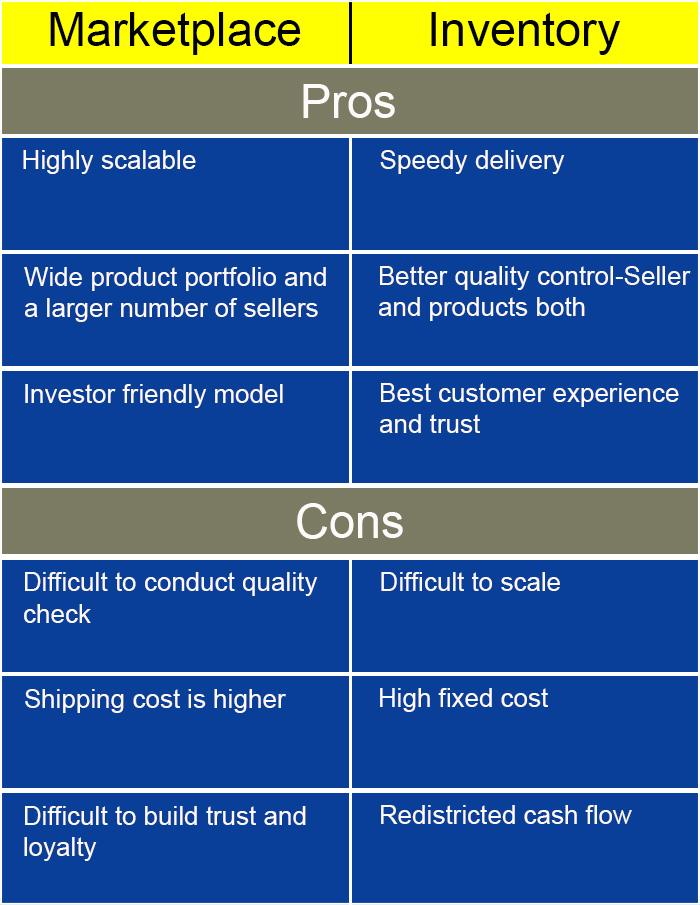
A small comparison with both pros and cons.

This model is overall a new trend which was introduced a long ago but has gained popularity in the past few years. With some of the pros, it also has its cons, but overall it is still in a developing phase where new ideas and innovation are introduced each day. PrestaShop Marketplace module is a similar innovation by knowband that can easily convert an inventory model PrestaShop site to a marketplace site. You can find more about how to convert an eCommerce store into a marketplace site in “How to get a marketplace site in 8 easiest steps?“.

Liked This? You’ll Like These Too

How to get a Marketplace site: a step by step guide

When you have a limited number of customer base and sales, it is important to think big and go for a major store overhaul. Getting just an eCommerce store will not guarantee you maximum conversions and sales as there are other players in the race. You would not have to lag behind now as there is a golden opportunity to transform your online store into a marketplace store. The term Marketplace is  not  new  to the  eCommerce marketplace. It was a time when someone has to go through a lot technical coding and planning for implementation of an eCommerce site. With the introduction of CMS platforms like Magento,  PrestaShop, OpenCart, Magento 2 the gap between an excellent business mind and an online site is now has been reduced to the minimal. Now, you would not have to suffer the market pressure due to the absence  of an effective eCommerce store that has a much larger customer base and  site traffic. All you need to do is just install the Multi seller Marketplace extension for a major transformation of your eCommerce store. Let us now discuss the various ways by which the Marketplace module can be of great help to your online business.

3 Easy Steps to get your own Marketplace site and start accepting seller registrations:

Step 1: Choose and install a marketplace extension for your eCommerce store.

Choosing a Marketplace extension is even a tougher task. A large number of developers are already offering their competent Multi seller extensions and some are very popular too.
Look for the basic features in the Marketplace module:

a). Which is competent to accept seller registrations.

b). Which is competent to manage even a large number of sellers.

c). Which allows admin to approve and disapprove sellers registrations and even block the already approved sellers at any time.

d). Which allows the approved sellers upload and manage their own products.

e). Which allows the sellers to control manage their own delivery and shipping process.

f). Which has an efficient reporting system that allows the admin and sellers both to track all the respective sales and transactions?

g). Most of all, which allows the extension of the marketplace functionalities by able to choose from a large number of already available Marketplace addons.

However, you can also try the free version for Prestashop, Magento, etc platforms  and  later  upgrade  to the  paid  version  when you  find  it satisfying. It’s a demo version to check the compatibility and testing, has some restrictions but can be useful in testing the compatibility  with your online site. There are a large number of expectations you can make with a marketplace Magento extension, but these are some basics that all marketplace extension should possess.

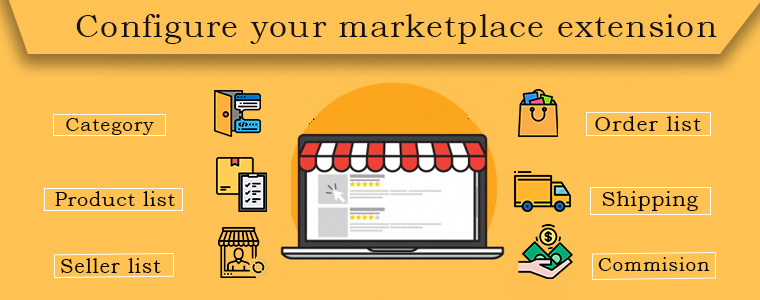
Step 2: Configure your marketplace extension

After installation, a configuration panel is provided by these extensions where you can personalize and set up the extension for use.You have to enable the extension from the back end and then perform the configurations. You can set the commission rate or fixed commission price  you want to take from the Sellers.

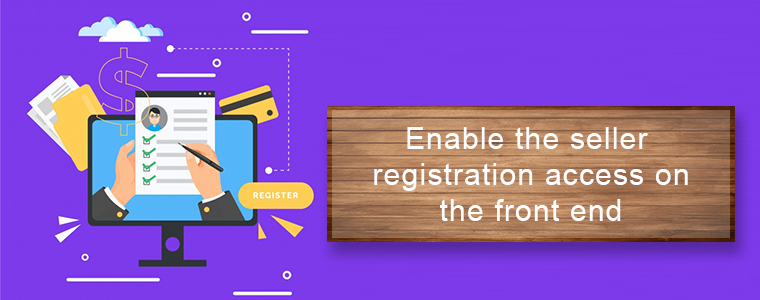
Step 3: Enable the seller registration access on the front end

After configuration, your new Multi seller extension is ready to use. Now you are ready to accept the seller registrations. The front end customer registration panel will now show an option to the users to also register as a seller. Any registration request will now be notified to the admin. You can set your email id to receive the notification when one arrives.

Final words

Now you need to review and accept the seller registration requests. Any seller who is approved will be allowed to show his products on your site and upload any number of products. All the products uploaded will be first reviewed by you and after you approve them they will be visible on your site.These are the 3 simple steps you can take to get a marketplace site for you. Take the advantages of a large number of modules and extension that are already available. Always choose a CMS platform whose modules and extensions are easily available.

You Might Also Like:

Why you should sell on an eCommerce Marketplace?
5 Ways to Attract Sellers on your Online Multi vendor Marketplace
2019 Holiday Calendar: How can a Seller Attract Customers on a Marketplace during Holiday?
How is Multi vendor Marketplace module a good bargain for store admin?
How to Launch a Marketplace like Etsy and Ebay?
Why Marketplace is in trend?

Come ottenere un sito di Marketplace: una guida passo passo

quandoMercato?is? not? new? to?the? eCommerce?marketplace.?It?was?a?time?when?someone?has?to?go?through?a?lot?technical?coding?and?planning?for?implementation?of?an?eCommerce site. With?the introduction?of?CMS platforms?like?Magento,??PrestaShop,?OpenCart,?Magento 2?the gap between an excellent business mind?and an?online site?is?now?has?been?reduced?to?the?minimal. Now, you?would not have to?suffer the?market pressure due to the absence? of an effective eCommerce?store?that has?a?much larger customer base?and? site?traffic. All you need?to do is just install?the Estensione per più venditori?for a major?transformation of?your eCommerce store. Let?us now discuss the various ways by which the Marketplace module?can?be?of?great?help?to?your?online?business.

3 Facili passaggi per ottenere il tuo sito di Marketplace e iniziare ad accettare le registrazioni del venditore:

Passo 1: scegli e installa un'estensione marketplace per il tuo negozio eCommerce.

scelta

Guarda

un). Quale è competente per accettare le registrazioni del venditore. b). Qual è competente per gestire anche un gran numero di venditori. c). Che consente all'amministratore di approvare e disapprovare le registrazioni dei venditori e persino bloccare i venditori già approvati in qualsiasi momento. d). Che consente ai venditori approvati di caricare e gestire i propri prodotti. e). Che consente ai venditori di controllare gestire la propria consegna e il processo di spedizione. f). Quale ha un sistema di reporting efficiente che consente all'amministratore e ai venditori di tenere traccia di tutte le vendite e le transazioni rispettive? g).?Soprattutto, che consente l'estensione delle funzionalità del mercato grazie alla possibilità di scegliere tra un gran numero di funzionalità già disponibili Addon del Marketplace. Però, Prestashop, Magento, piattaforme ecc

Passo

Dopo

Passo

Dopo

Parole finali

Adesso

Potrebbe piacerti anche:

Perché dovresti vendere su un eCommerce Marketplace?
5 Modi per attirare i venditori sul tuo marketplace online multiplo
2019 Holiday Calendar: in che modo un venditore può attirare i clienti su un Marketplace durante le vacanze?
In che modo il Multi vendor Marketplace costituisce un buon affare per l'amministratore del negozio?
Come lanciare un mercato come Etsy e Ebay?
Perché il mercato è di tendenza?