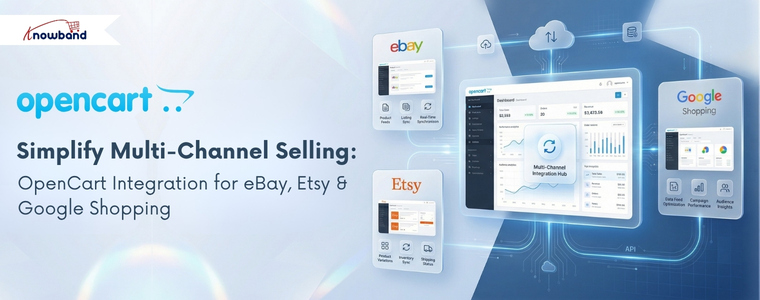
Introduction: One Store, Three Powerful Sales Channels
Research from Shopify’s 2024 Commerce Report confirms that merchants selling on three or more channels generate significantly more revenue than single-channel sellers. The logic is simple that more visibility means more buyers. But managing separate platforms manually leads to stock errors, missed orders, and wasted hours.
So here is the real question: What if you could manage Google Shopping, Etsy, and eBay all from your OpenCart backend without logging into each platform separately?
That is exactly what the right set of OpenCart integration modules makes possible. Knowband builds each of these connectors specifically for OpenCart merchants who want reliable, low-maintenance multi-channel selling.
Marketplace selling has become an important part of the multichannel ecommerce strategy. According to a 2024 DHL report, 63% of ecommerce businesses sell on at least three online platforms, showing how common it has become for merchants to reach customers through more than one sales channel. In the case of OpenCart, while the opportunity to explore existing marketplaces may help reach a wider discovery of products, it also presents the problem of maintaining consistency in listings, inventory, and orders. This is where selling on the top marketplaces with an OpenCart store can be considered as part of a multichannel selling approach.
OpenCart Google Shopping Integration Module
The OpenCart Google Shopping Integration module connects your product catalog directly to Google Merchant Center. This module auto-generates a Google-compliant XML feed, maps your categories to Google’s taxonomy, and keeps prices and stock levels updated in real time.
Key Highlights
- Automated feed generation: No manual XML exports needed
- Real-time price and inventory sync: Supports real-time updates from your store to Google Shopping
- GTIN, MPN, and brand field support: improves product eligibility and visibility
- Feed scheduling: submit updates hourly, daily, or weekly automatically
Why Google Shopping Matters for your Opencart Store
Google Shopping targets buyers who are already searching for your product. A clean, accurate feed from the OpenCart Google Shopping Module puts your listings in front of high-intent shoppers without requiring a large ad budget. Furthermore, free listings alone can drive consistent, qualified traffic back to your store.
OpenCart Etsy Marketplace Extension
The OpenCart Etsy Marketplace Extension bridges your OpenCart catalogue with Etsy’s marketplace, which attracts over 90 million active buyers looking for unique, handmade, and vintage products. It handles Etsy’s specific listing requirements, custom variations, renewal cycles, and category tags, all managed from OpenCart.
Key Highlights
- Product variation sync: Maps OpenCart options like size, color, and material to Etsy listing variants
- Listing renewal management: Provides many synchronisation features like relisting, listing, and many more
- Tag and category mapping: Pulls relevant keywords from OpenCart to improve Etsy search visibility
- Order import: Etsy orders flow directly into your OpenCart dashboard
Why Etsy Marketplace Matters for Your Opencart Stores
Etsy’s audience actively searches for products they cannot find on mainstream platforms. If your store carries handmade, customizable, or niche items, this extension puts them in front of exactly the right buyers. Moreover, centralised order management means you never lose track of an Etsy sale again.
OpenCart eBay Marketplace Connector
The OpenCart eBay Marketplace Connector, also referred to as the OpenCart eBay Marketplace Extension, links your OpenCart store to eBay’s global marketplace, one of the highest-traffic e-commerce platforms worldwide. Furthermore, automates product listing, bidirectional inventory sync, and order management between both platforms.
Key Highlights
- Bulk product listing: List your entire OpenCart catalogue to eBay in one action
- Bidirectional inventory sync: A sale on eBay instantly updates stock in OpenCart
- Automated order import: Ebay orders appear in your OpenCart backend without manual entry
- Pricing rules: Apply platform-specific markups to account for eBay fees automatically
Why eBay Matters for Your Store
eBay draws buyers who compare prices across sellers before purchasing. Getting your products listed there increases competitive visibility significantly. Furthermore, the OpenCart eBay Marketplace Extension ensures your stock numbers stay accurate across both platforms, eliminating the risk of overselling.
Why Running All Three Together Makes Sense
Each platform serves a different buyer intent. Google Shopping captures search-driven traffic. Etsy attracts niche and handmade product seekers. eBay pulls in price-conscious, high-volume shoppers. Together, they cover a wide spectrum of the buying journey.
When all three connect to a single OpenCart store, inventory updates once and syncs everywhere. Orders from all channels land in one dashboard. There is no switching between platforms, no spreadsheet reconciliation, and no overselling risk.
Conclusion
Multi-channel selling is no longer optional for growing OpenCart stores; it is the standard. The OpenCart Google Shopping Integration Extension, the OpenCart Etsy Marketplace Extension, and the OpenCart eBay Marketplace Connector each solve a specific visibility problem. Together, they turn your OpenCart store into a fully connected, automated sales hub.
Start with the channel that fits your product type best. Then expand. The infrastructure is already there