OpenCart Multi-Channel Integration: Sync Google Shopping, Etsy, and eBay from One Store

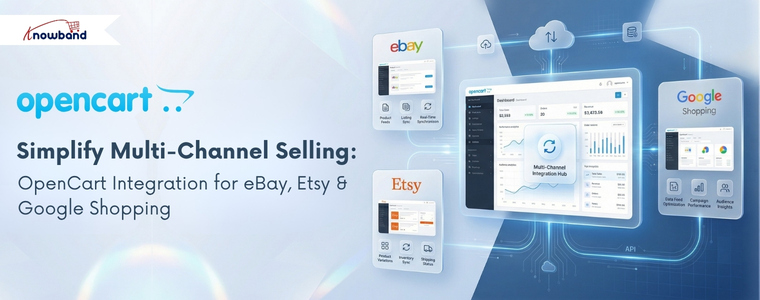
Introduction: One Store, Three Powerful Sales Channels

Research from Shopify’s 2024 Commerce Report confirms that merchants selling on three or more channels generate significantly more revenue than single-channel sellers. The logic is simple that more visibility means more buyers. But managing separate platforms manually leads to stock errors, missed orders, and wasted hours.

So here is the real question: What if you could manage Google Shopping, Etsy, and eBay all from your OpenCart backend without logging into each platform separately?

That is exactly what the right set of OpenCart integration modules makes possible. Knowband builds each of these connectors specifically for OpenCart merchants who want reliable, low-maintenance multi-channel selling.

Marketplace selling has become an important part of the multichannel ecommerce strategy. According to a 2024 DHL report, 63% of ecommerce businesses sell on at least three online platforms, showing how common it has become for merchants to reach customers through more than one sales channel. In the case of OpenCart, while the opportunity to explore existing marketplaces may help reach a wider discovery of products, it also presents the problem of maintaining consistency in listings, inventory, and orders. This is where selling on the top marketplaces with an OpenCart store can be considered as part of a multichannel selling approach.

OpenCart Google Shopping Integration Module

The OpenCart Google Shopping Integration module connects your product catalog directly to Google Merchant Center. This module auto-generates a Google-compliant XML feed, maps your categories to Google’s taxonomy, and keeps prices and stock levels updated in real time.

Key Highlights

  • Automated feed generation: No manual XML exports needed
  • Real-time price and inventory sync: Supports real-time updates from your store to Google Shopping
  • GTIN, MPN, and brand field support: improves product eligibility and visibility
  • Feed scheduling: submit updates hourly, daily, or weekly automatically

Why Google Shopping  Matters for your Opencart Store

Google Shopping targets buyers who are already searching for your product. A clean, accurate feed from the OpenCart Google Shopping Module puts your listings in front of high-intent shoppers without requiring a large ad budget. Furthermore, free listings alone can drive consistent, qualified traffic back to your store.

OpenCart Etsy Marketplace Extension

The OpenCart Etsy Marketplace Extension bridges your OpenCart catalogue with Etsy’s marketplace, which attracts over 90 million active buyers looking for unique, handmade, and vintage products. It handles Etsy’s specific listing requirements,  custom variations, renewal cycles, and category tags, all managed from OpenCart.

Key Highlights

  • Product variation sync: Maps OpenCart options like size, color, and material to Etsy listing variants
  • Listing renewal management: Provides many synchronisation features like relisting, listing, and many more
  • Tag and category mapping: Pulls relevant keywords from OpenCart to improve Etsy search visibility
  • Order import: Etsy orders flow directly into your OpenCart dashboard

Why Etsy Marketplace Matters for Your Opencart Stores

Etsy’s audience actively searches for products they cannot find on mainstream platforms. If your store carries handmade, customizable, or niche items, this extension puts them in front of exactly the right buyers. Moreover, centralised order management means you never lose track of an Etsy sale again.

OpenCart eBay Marketplace Connector

The OpenCart eBay Marketplace Connector, also referred to as the OpenCart eBay Marketplace Extension,  links your OpenCart store to eBay’s global marketplace, one of the highest-traffic e-commerce platforms worldwide. Furthermore,  automates product listing, bidirectional inventory sync, and order management between both platforms.

Key Highlights

  • Bulk product listing: List your entire OpenCart catalogue to eBay in one action
  • Bidirectional inventory sync: A sale on eBay instantly updates stock in OpenCart
  • Automated order import: Ebay orders appear in your OpenCart backend without manual entry
  • Pricing rules: Apply platform-specific markups to account for eBay fees automatically

Why eBay Matters for Your Store

eBay draws buyers who compare prices across sellers before purchasing. Getting your products listed there increases competitive visibility significantly. Furthermore, the OpenCart eBay Marketplace Extension ensures your stock numbers stay accurate across both platforms, eliminating the risk of overselling.

Why Running All Three Together Makes Sense

Each platform serves a different buyer intent. Google Shopping captures search-driven traffic. Etsy attracts niche and handmade product seekers. eBay pulls in price-conscious, high-volume shoppers. Together, they cover a wide spectrum of the buying journey.

When all three connect to a single OpenCart store, inventory updates once and syncs everywhere. Orders from all channels land in one dashboard. There is no switching between platforms, no spreadsheet reconciliation, and no overselling risk.

Conclusion

Multi-channel selling is no longer optional for growing OpenCart stores; it is the standard. The OpenCart Google Shopping Integration Extension, the OpenCart Etsy Marketplace Extension, and the OpenCart eBay Marketplace Connector each solve a specific visibility problem. Together, they turn your OpenCart store into a fully connected, automated sales hub.

Start with the channel that fits your product type best. Then expand. The infrastructure is already there




Why you should sell on Etsy Marketplace? : mCommerce presence of Etsy

Etsy is a unique marketplace that mainly deals in the online trading of handmade crafts and vintage items which includes jewelry, toys, sports items, etc. It is a platform where sellers can make money out of their art and creativity and can earn a huge chunk of profits. Selling on Etsy Marketplace is still a dream for many sellers so to know the process of selling on Etsy, you can have a look at how to sell on Etsy Marketplace.

mCommerce popularity of Etsy:

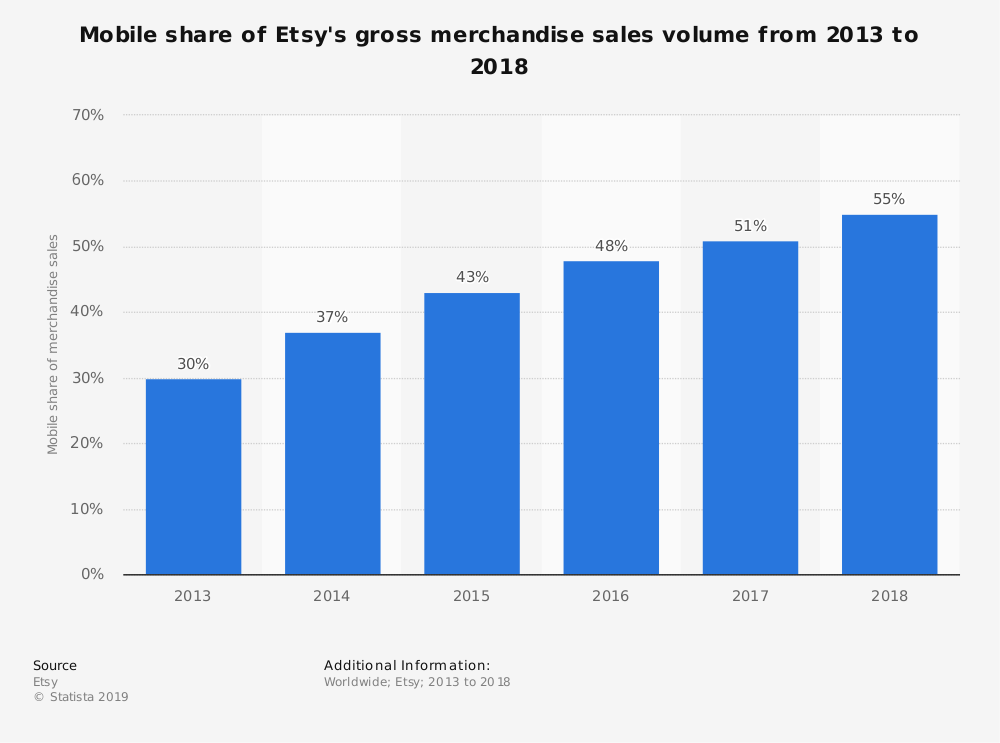
The usage of mobile apps is continuously increasing day by day. Etsy has a great mobile app that works efficiently and is been used by many customers worldwide. In 2018, 55% of the company’s gross merchandise sales were generated through mobile devices. Therefore, it’s the mobile app is offering good sales and profits.

However, the increased usage of mobile apps does not assure you of massive sales and profits. For that, it’s important to rank your products high on the Etsy search results. Sellers need to be patient and should implement the best practices to achieve their goals. However, if you’re concerned more about the product ranking on search results, you can have a look on “How to increase the sales of the Etsy Shop, It contains strategies to skyrocket your product ranking on Etsy and acquire more customer attention which will compel them to go for instant purchase.

Benefits of selling on Etsy Marketplace:

Earlier, there was no way for small vendors to sell their hand made products among huge no. of audience. These craftsmen used to sell their products in fairs, open markets, or under consignment. However, the introduction of Etsy Marketplace helped these small merchants to sell their products online as it is a quick, moderate, and easy way to access millions of customers worldwide resulting in good profits. It enabled sellers to set up their brand shop with all the facilities provided without any advanced investments. Being an eCommerce store owner for any CMS platforms like PrestaShop, Magento, Shopify, and OpenCart, they can sell on Etsy and leverage the following benefits.

Benefits are listed as follows:

1. Personalize your store:

The chance to personalize your storefront is given by fewer Marketplaces only like Etsy. Etsy gives sellers a golden opportunity which enables merchants to list their products accordingly, put the brand logo, and create personalized taglines and product-related policies. This will help sellers to enhance their brand image and become popular among customers which in result will provide immense sales.

2. Attract to a huge audience:

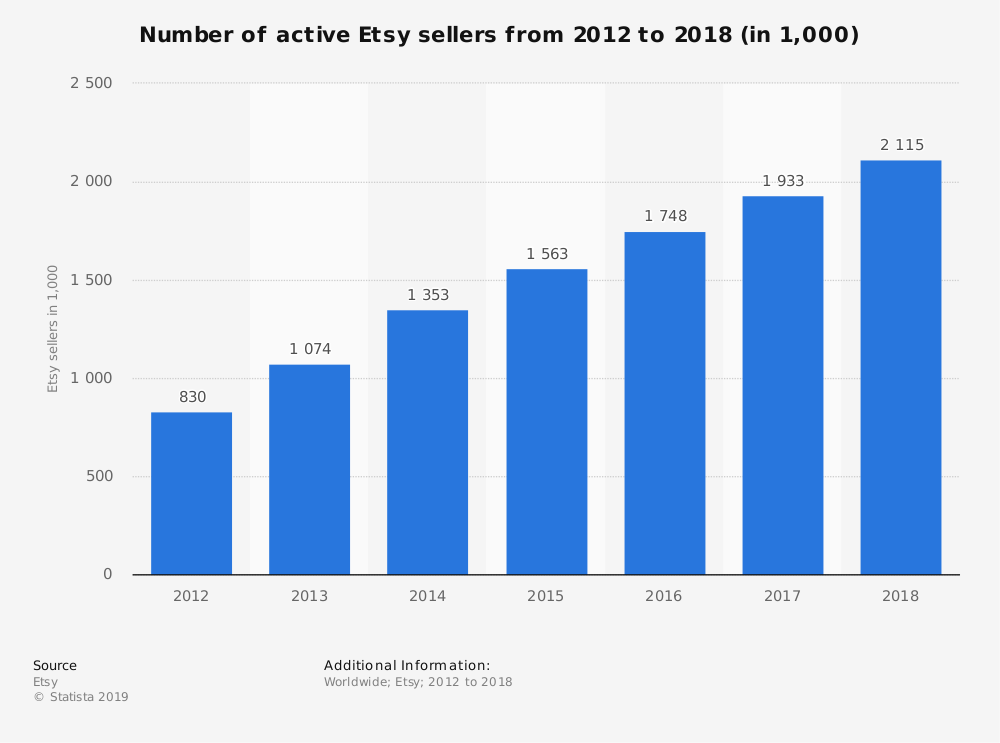
As we already got to know above that Etsy has 39.5 million active buyers. Undoubtedly, sellers have high chances to make good sales and profits as customers testimonials are showing their love towards Etsy. Also, it automatically provides sellers the accessibility to millions of customers all over the world. This enables them to increase their cross border sales too.

3. Customer Engagement:

It is another flexibility offered by Etsy to its third-party sellers. Etsy allows their sellers to:

  • Leave their social media handles,
  • Offer discounts and coupons on their products,
  • Collect emails to send reminder notifications.

These strategies help in engaging the targeted audience and also put sellers in charge of their product listings. On the other hand, it increases customer engagement on Etsy Marketplace which can compel customers to go for instant purchase.

4. Low cost of Startup:

As Etsy Marketplace has all things set up in one place, the retailer has to hardly make any investments other than some few expenses. Thus, the minimal cost is involved in selling on a Marketplace as a comparison to selling on your eCommerce website. Etsy will only charge:

Monthly Subscription Fee for selling on their platform and, listing fee or commission which is a standard amount for every product they listed on the Marketplace’s catalog.

5. Increased Brand visibility of your store:

If you are a newcomer in the eCommerce industry and trying your best to mark your presence on customers, Etsy Marketplace will help you to enhance your brand visibility and gain customer’s trust which will directly compel customers to go for instant purchase and this will result in increased sales and revenues.

6. Marketplace’s Powerful and supportive community:

Etsy makes you feel like family which indirectly brings you immense sales. Etsy has its forums and teams which always remain connected to the sellers and help in every possible way. This helps in building up the confidence of sellers which in total makes the whole Etsy Marketplace strong.

Finally,

Selling on Etsy is the least complex way to ensure good sales and revenues. Selling on Etsy Marketplace is not an easy goal to achieve so luckily if sellers get a chance to sell on Etsy, then the above-mentioned benefits will help them to ensure good profits. Regardless of the marketplace, you choose to sell on, it’s important to be aware of the latest trend going on in the eCommerce industry and implement it for a profitable business in the future.

Selling on Etsy Marketplace was not that easy before. KnowBand offers Etsy Integrators for various CMS platforms like PrestaShop, Magento, Shopify, and OpenCart, which allows sellers to integrate their eCommerce store with Etsy Marketplace via API integrator. With its seamless technology, sellers can easily present their products among the larger audiences and encourage brand awareness as well.

Find more related articles here:

  1. How to Sell on Etsy Marketplace?
  2. How to Launch a Marketplace like Etsy and eBay?
  3. How to rank your products up in Etsy search results?
  4. How to add or update the shipping profile in Etsy Marketplace?
  5. How to add production partners and connect with listing in Etsy Marketplace?
  6. How to add or activate/deactivate a product in Etsy Marketplace?

How to Sell on Etsy Marketplace?

Whenever we think of buying handcrafted products online, the first word that comes in our mind is Etsy. Etsy Marketplace is a professional seller community that mainly focuses on handmade products or vintage items and craft-oriented products like jewelry, clothing, health and beauty and many more. It can also be considered as the C2C platform because the merchants listed on Etsy are majorly small business owners. The amazing shopping experience on Etsy makes it one of the most popular Marketplaces all over the world.

                                                        Source: Statista

This seller’s guide is a doorway for all the aspiring sellers who are looking forward to selling on Etsy Marketplace.

Top-selling items on Etsy

Etsy is a unique e-commerce website mainly focused on handmade or vintage items and supplies, as well as unique factory-manufactured items. To sell an item on Etsy, it’s important yo keep a check on the ranking of your products too in the search results.

Before we start we should have a look at the top-selling items on Etsy Marketplace:

  • Jewelry.
  • Clothing
  • Craft Supplies and Tools.
  • Kids and Baby.
  • Vintage Items
  • Homemade or Specialized Candies.
  • Party decorations.
  • Vinyl and heat transfer supplies.

While the best sellers on Etsy Marketplace includes a wide range of categories, like jewelry, bags, clothing, home decor and furniture, toys, art, as well as craft supplies and tools.

Cost to Sell On Etsy

There are 4 various types of fees applied when you list your products for sale on Etsy Marketplace. These are as follows:

a) Listing Fee:

Listing your products online on Etsy Marketplace costs sellers an amount of 0.20 $ (excluding variations) for 4 months. For example, if you sell vintage items of which belong to 4 different categories or variations, it will cost you 0.80 dollars(4 x $0.20).

After 4 months, sellers have to renew the listings either manually or they can set an auto-renew option, and again the cost applied would be 20 cents per listing

The additional quantity is also charged by $0.20 that sells for only one transaction. It means if there are more than 1 listing in 1 order then, $0.20 will be charged on each item. For more information, you can go through the following link: Multi-Quantity Fees

b) Shipping Process Fee:

The shipping charges are set as it is used to deliver the product on a given address. Shipping charges are variable depending upon the weight of the product, location distance and shipment carrier company.

c) Transaction fee:

Under this, 2 types of fees are included. First is the shipping transaction fee and constitutes 5% of the shipping process fees.

Then the second fee comes is the transaction fee which constitutes 5% of the total value of the product. An additional 3% fee is imposed for choosing Etsy’s “Immediate Checkout”.
Apart from being reasonable, Etsy Marketplace provides you the flexibility to sell products from your online store. Thus, if you have a Magento store, you can easily sell Magento products on Etsy.

d) VAT:

Firstly we should know that there are 2 types of VAT fees: Processing fee VAT and seller services VAT.

After charging all kinds of fees, VAT is imposed if sellers use them They will only be imposed if you use fees like Etsy payment processing fee, deposit currency conversion, promoted listings, Google Shopping ads, and Targeted offers.

Now all the Manufacture related information is been given. So, let’s move further to discuss the process of selling on Etsy Marketplace:

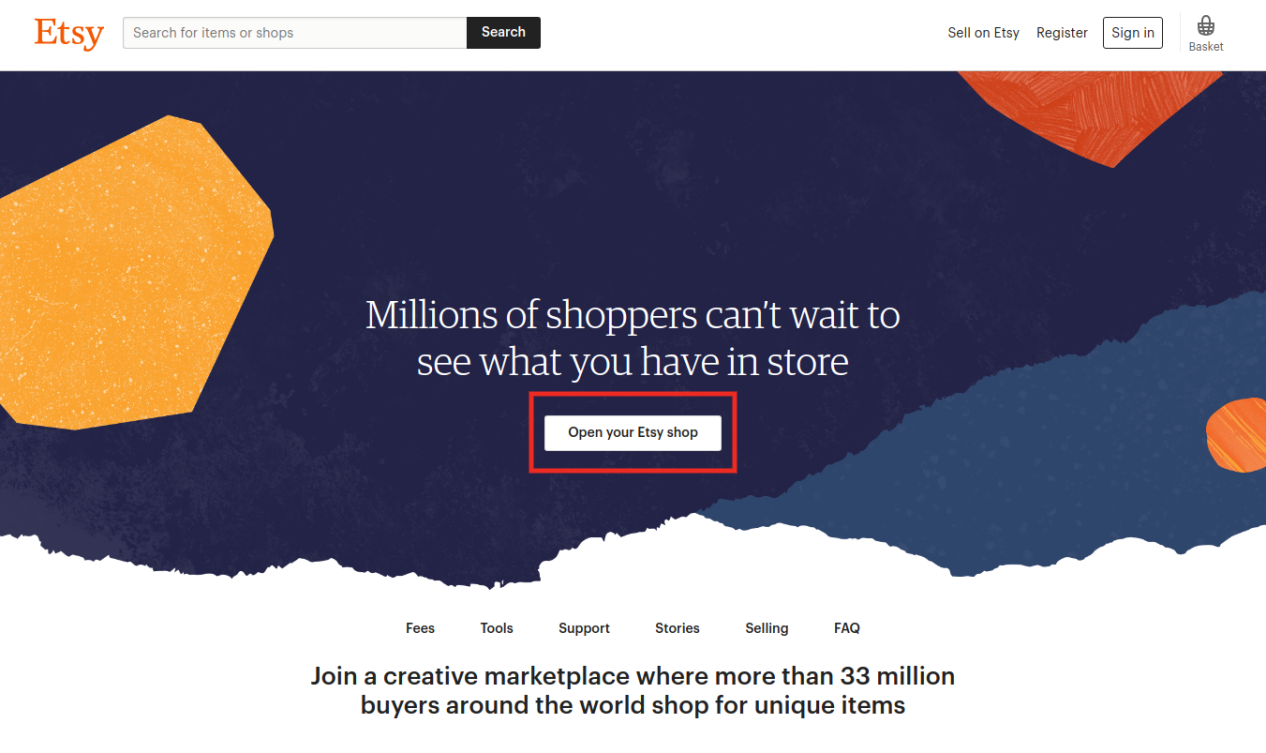
Step 1: Get Started

Firstly, create your seller account on Etsy and go through the Etsy policies and ensure whether Etsy Marketplace is ideal for your business or not.

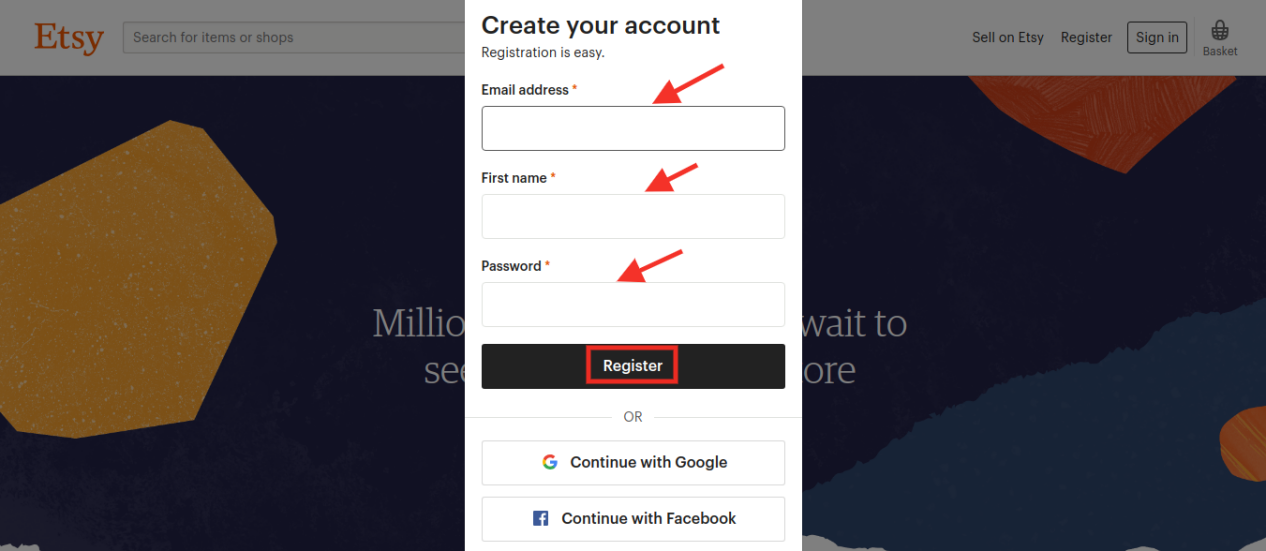
After creating your Etsy account, register your profile by entering the email address, username and password or you can directly signup through your social media account.

Step 2: After Creating Profile Create Your Own Shop

Click on the “Sell on Etsy” option, After clicking on this option, you will be redirected towards your shop page and now you have to enter some information as follows:

a) Shop Preferences
b) Name your Shop
c) Stock your shop
d) How you’ll get paid
e) Set up billing

Step 3: Section utilization of Etsy shop

This section is been included with various steps in which sellers have to upload a shop logo and cover photograph, etc. Sellers have to also update the shop’s “About” section. Leverage the facility of your shop segments to make your customers discover your shop products and go for the instant purchase.

Step 4: Branding and advertisement for the advancement of the Etsy shop

Creating an Etsy shop is not a complete process, it’s really important to make your brand shop popular on Etsy. Sellers should ascertain their shop details optimization for Etsy Search. Sellers can take a step forward and include a shop location so that your shop could be located by nearby customers. Sellers should focus on promoting their shop either through free or paid ads. They can offer great offers and discounts to their customers so that customers can go for instant purchase.

Step 5: Managing the shop by maintaining good SEO

Sellers should ensure to meet all the requirements after you cover all the above procedures for Etsy’s Dealer Insurance Approach. Sellers should be in contact with Etsy’s Survey framework and should have an idea to make their first deal.

For a good online business on Etsy, maintaining good SEO is very important which can help to increase customer engagement and optimization of the website.
Sellers should keep an eye on the following points:

  • The rate of customer engagement in your Etsy shop.
  • The reviews (either positive or negative) by your customers.
  • Product Listing Quality factor
  • Inbound links

For more information in one picture, you can have a look at the tips to rank your products up on the search results on the Etsy Marketplace.

Who pays for Shipping on Etsy buyer or seller?

Shipping charges vary from product to product. Some products are delivered without delivery charges where sellers bear the shipping cost while some products have added delivery charges and customers have to pay for it It varies from product to products. Some of the products are offered free shipping where sellers bear the cost of shipping whereas, some require buyers to pay for shipping. It depends upon the order value, shipping destination, and the shipment method chosen by the buyers.

Finally

Etsy is a global marketplace. Selling here is an opportunity for sellers who want to make money out of their talent and creativity. Etsy Marketplace is the one-stop solution for these artists and they can sell their products to earn a huge chunk of profits. They also get a chance to access a huge no. of the audience all over the world which increases your cross border sales too.

How KnowBand can help you to sell on Etsy Marketplace?

Knowband offers Etsy Integration Extension which is a smart solution for an eCommerce store owner to clear out the complexities of selling products on Walmart. It works by providing an API Integrator between an eCommerce store and the Walmart marketplace. It bridges the gap between your eCommerce store and Etsy with the help of which sellers can easily map their product listings on the Marketplace website. Once the integration is successful, the admin can update all the product listings on Walmart Marketplace from the back-end without even visiting the Marketplace site. Available for different CMS platforms like PrestaShop, Magento, Shopify, and OpenCart, sellers can easily download and install it on their website without any inconvenience.

For more information, contact us via support@knowband.com.

Find out some more related articles here

  1. How to Launch a Marketplace like Etsy and Ebay?
  2. How to add or update the shipping profile in Etsy Marketplace?
  3. How to sell on Walmart Canada?
  4. How to sell on Walmart Marketplace?
  5. How to create Seller Account in eBay Marketplace?

How to Launch a Marketplace like Etsy and Ebay?

With an increase in customer’s demand and advancement in technology, Marketplaces like Etsy, eBay, etc have already started gaining popularity. Creating an Online Marketplace like these Marketplaces requires lots of efforts and strategies. The marketplace is one of the most profits generating business. An online merchant can earn a huge profit from the commissions paid by the sellers. The store admin need not invest in inventories of products.

Why should we create an online Marketplace?

The Marketplace is an eCommerce platform where multiple buyers and sellers are connected on a single platform. Multi-vendor store bridges the gap between users and retailers. Multiple retailers integrate to sell their valuable items on the Marketplace. Retailers need to get themselves registered at the Marketplace and be a part of the large shopping organization. The marketplace can help an admin to increase the customer retention rate and earn from listing seller products, seller services, seller commission in addition to its sale.
The demand and reach of the Marketplaces are expanding every millisecond. It’s never too late to build your Marketplace.

What are the benefits of building a Marketplace?

Some of the salient benefits of building a Marketplace are:

  1. Admin can earn from charging the sellers to list their items.
  2. In addition to the seller listing earnings, the Marketplace admin can also charge a commission for every sale.
  3. Enhanced traffic as buyers will get all their favorite brands at a single platform.
  4. Increased customer retention rate as items of various retailers are available in abundance.
  5. Admin need not worry about the inventories anymore and can even earn a huge amount by selling the products of third party vendors.

What is the Prerequisite for creating an online Marketplace?

1. For creating a Marketplace like Etsy, eBay the admin can follow either of the basic approaches:

A) If the merchant is planning to start his business. He can directly build a Marketplace like a website.

Website Script

If the admin is new to the online business, he needs to find a good eCommerce solution. The most preferred eCommerce platform options are:

B) If the admin is having an eCommerce store then there are various Marketplace extensions available in the Market to simply upgrade the store into a fully-featured Marketplace.

2. Merchant Panel:

Progress of a Marketplace mainly depends on its two main stakeholders i.e buyers and retailers. Details of buyers and sellers are very sensitive and need to be secured and protected. A Merchant panel to manage the seller list and listing of products is mandatory for running a Marketplace.

3. Effective Notification system:

A Notification system is required to keep the sellers and customers updated about any change at the Marketplace.

4. Feedback panel:

Review and Rating platform to monitor the customer’s valuable feedback needs to be there. Feedback sent by the customers is important for the growth of the eCommerce store.

5. Seller dashboard:

A dashboard for sellers to manage their product listings is required in a Marketplace.

How to build your Marketplaces like Etsy and eBay?

There is no denial in this fact that Marketplace is a great source of revenue for store owners. But to run a successful multi-vendor store is not a cup of tea for everyone. The total cost of building a fully-fledged Marketplace may vary from place to place. In various places, the cost of building a Multi vendor store is too lengthy and costly but the availability of the Marketplace modules has lessened the pain and it’s now easy and cheap to build a Marketplace like Etsy and eBay. To start building your Marketplace like Etsy and eBay you must keep the two basic pillars of the Marketplace in mind i.e., seller and buyers. A Marketplace can never run without its sellers and customers.

1. Patience and a plan

Patience is the key mantra in the way of your Multi vendor business. Patience is required in the initial stages of setting up the multi-vendor store. Keep your patience with you till both sides’ sellers and customer communities have established. The period required for the establishment is somewhat greater than an inventory based eCommerce startup where we build our supply chain. However, in the marketplace, both the customer and seller communities are required to build which eventually requires more time to run. The multi-vendor store may take a few months to prove their real worth in the meanwhile the admin needs to look for the target area and start focusing on that.

Etsy is one of the examples which started from a niche market (Vintage, handmade products, and books respectively) and later widened its target area. Thus the admin needs to stay focused, steady and patient with its plan.

2. Emphasis on the initial investment

Never rush for the initial investment decision. The online merchant needs to give himself some time to calculate the worth of its own business as everybody is not a Microsoft owner who has no scarcity of dollars. Some businesses show huge success with early big deals but it’s not possible to buy the speed while building a Marketplace. Emphasis on the initial investments would take your business furthermore on the runway.
Plans like big teams and big offices in the early stages of the multi-vendor store launch can be avoided. Initial marketplace investments are mostly required in two functions:

A. Building the marketplace site, and
B. Building the supply chain with the buyers and sellers community.

3. Target on the niche market

Etsy marketplace started as an eCommerce platform for Vintage and handmade crafts and later expanded its target area to other categories. As of now, Etsy even accepts the integration and the merchants can sell their goods on the oldest and successful multi-vendor store from their stand-alone eCommerce sites. Successful business though may provide you with diverse and rich quality stuff in one place but none of them has started from there where they are now. This narrowly targeted approach steadily grew up into a diverse market and the result is a successful online place like Etsy.

Action plans for targeting certain types of product categories and sellers can be adopted to gradually expand outside the niche of the circle.

4. Niche users utilities

From the above point, it’s clear that successful marketplaces are built from a niche to the masses. During the initial period, the emphasis is required to provide better user experiences to the early on-boarders. Before making plans to appeal the masses focus on user engagement for both the early sellers and customers.

Etsy in its budding stages did a superb job as a marketplace for handmade crafts which ultimately led to its expansion to other categories. Thus before focusing on the broader section first make sure the marketplace is doing justice in the narrow section which ultimately will take you to the enhanced section automatically.

5. Build a community with your Niche users

Focus on the utilities of the targeted Niche users and support them from time to time. Various social media platforms are available that can be used to build a community. Online Merchants can approach these platforms to expand their reach and build a healthy community. Like the Meowing tons that focused on the women who like cats and started selling the cat accessories, cat utilities, and cat theme accessories for women. Women Cat lovers shared a major part of the US population and thus it turned out to be a successful startup with more than 500 thousand followers on different social media platforms.

6. Focus on Stats

While building your Multi-vendor business the online merchant needs to have a vision and trust in himself. Having a vision is important to achieve success in the business but blind faith leads often leads to falling. Tracking your progress and reassessing these steps from time to time will enable you to calculate what is working for you and what is not.

If the stats are not in favor, the admin can rethink them and find measures to turn the result in its favor. Moreover, you can’t run a successful marketplace just with your vision, the online merchant needs to stay tuned with the latest stats and facts.

Measures to be taken care of in your online marketplace.

If you have been a vendor ever that experience can help you to get the best from the third-party sellers. Similarly having practical experience as a customer will help you to address the issues faced by the customers on the eCommerce site. For running a successful multi-vendor store equal attention must be paid to both the sellers and customers. Build a personal connection not only with your sellers but also have a strong customer relationship. A strong customer base will help you to approach the sellers for your multi-vendor store, in the same way, a large number of sellers and product variety can compel the visitors to shop from your site. Moreover, advertisements involving celebrities can play a major role in attracting both sellers and end-users.

How to get the customers?

As discussed earlier, some of the strategies the merchant needs to follow to bring the traffic on their site are:
1. Focus on the niche market.
2. Create a strong customer base
3. Take measures for customer retention.
4. Pay attention to the follow-up emails and social media engagements.

How to get the retailers on your site?

Once the Marketplace is established and you are clear about the niche, things will turn to be fruitful in your way. After you have conquered a place in the market, attracting the sellers will be easier.

Finally,

The steps discussed above will guide you in giving a correct start to your business. Building your own Marketplace business is a hard job as compared to a one-sided inventory model, but once the Marketplace is properly established and is going in the planned direction then things would start kicking and would setup your footwell and firm in the Market. Till then stay in touch with the latest trends and techniques to give your business new wings to fly high with both sides being well established.

For any query, feel free to contact support@Knowband.com

Related Stories: