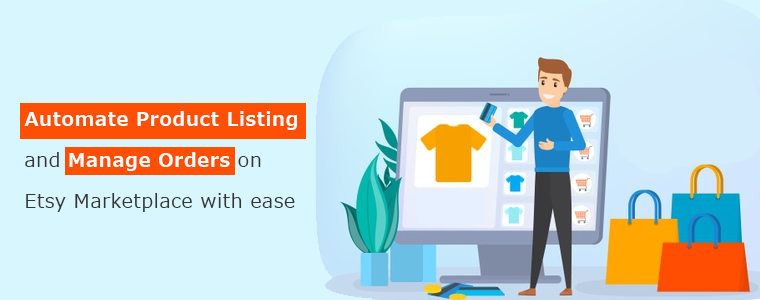
Automate Product Listing and Manage Orders on Etsy Marketplace with ease

Selling on popular platforms expands your business growth and gives you a platform where millions of customers visit every day. Etsy Marketplace is one such opportunity where sellers can reach the zenith. With the aid of Etsy Marketplace Integration extensions, every seller can dream about selling on Etsy with ease.

Etsy is a community of one of a kind. Etsy is a worldwide online marketplace where individuals come together to produce, sell, and purchase and collect unique products. It supports independent creators. There is no warehouse for Etsy, just millions of people selling the stuff they love. The entire selling process is easy, helping you directly connect with manufacturers to find something extraordinary.

Why Do You Need a Marketplace Integration Extension?

If you are a seller or a manufacturer of creative products then this is the platform you are looking for. Managing things over two different platforms can be time taking and required extra effort twice. To save you from this problem, KnowBand created some super-smart marketplace integrators that connect your eCommerce store with the Etsy Marketplace and allows you to manage everything from your store. There are two main reasons you need a marketplace integration module:

  1. It Saves Time
  2. Reduces Extra Efforts

Beyond this, there are several benefits of using a marketplace Integration. Integration of the Etsy API offers the best solution for the listing of goods and synchronizes the product specifics such as price, definition, photos, inventory, etc. to the ongoing Etsy store.

Sellers can handle the shipping and order processing for the Etsy shop from their own eCommerce platform with the use of the Etsy API integration module.

Sellers can also configure cron jobs in order to simplify the synchronization method.

KnowBand’s Etsy Marketplace Integration has Proven to be Useful to Sellers

It’s the best time to share some excellent news on the client’s reviews! The Marketplace integration module is connecting many eCommerce stores to Etsy to sell seamlessly. With all-new capabilities, the plugins will help you scale your business much more easily.

The Etsy Marketplace Integration Module has proven to be so useful to sellers that they have been able to seamlessly operate multiple stores with it. We were in constant contact with them at KnowBAnd, understanding their needs, assisting them in their growth, and developing additional features for the much-loved App. Let us now explain what these are. than before.

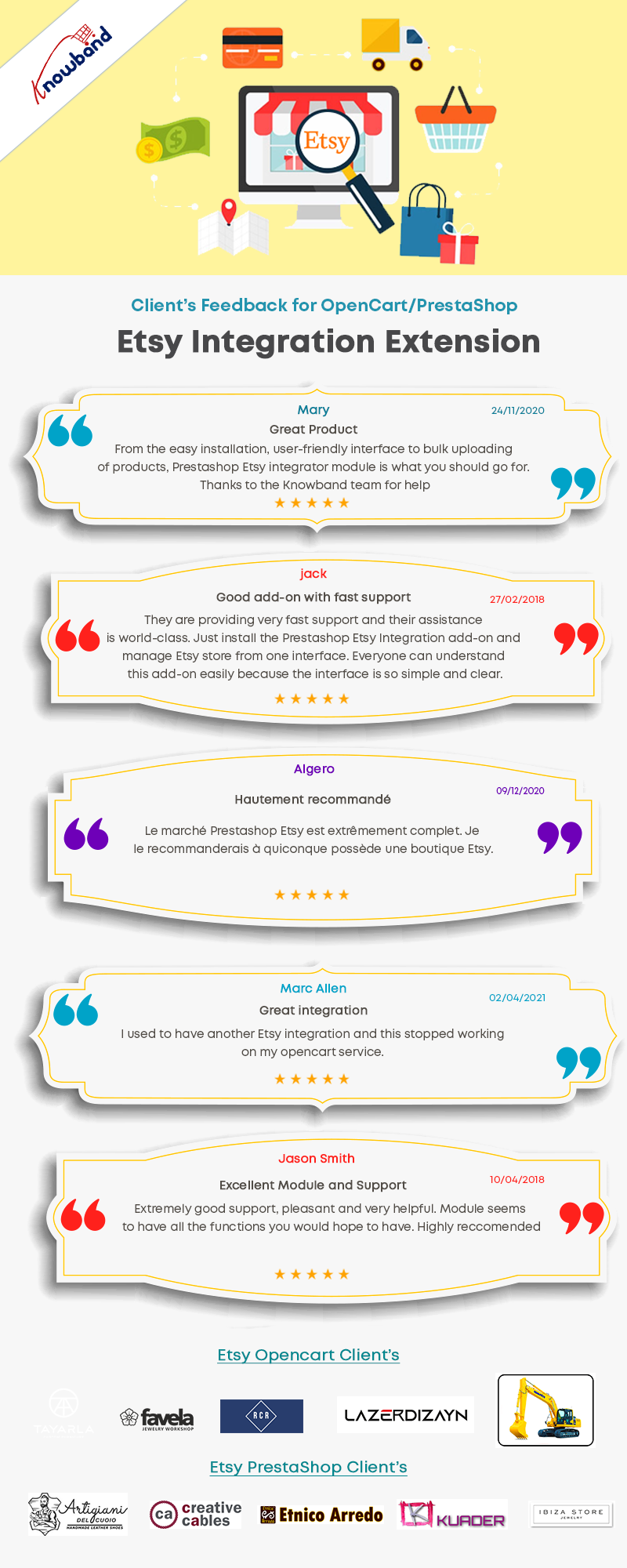
Clients are happy with KnowBand’s Etsy Marketplace Integration Facilities
How Etsy Marketplace connector helps in selling Products on the Etsy platform?

The Etsy marketplace integration is a tool that enables sellers to list and sell their products on the Etsy marketplace with ease. This module reduces the efforts of listing and inventory management.

In four easy steps, you can connect Etsy and your eCommerce store:

  1. Create an Etsy seller account: An Etsy seller account must be created by the Magento store administrator.
  2. Etsy’s Setup App: Create a marketplace app on Etsy.
  3. Install and Configure: After you’ve set up the seller’s account and the app, you’ll need to install the Etsy integration plugin in your shop. Configure your Etsy shop to meet your needs.
  4. Start Selling: The products in the marketplace are now ready to be sold. The Etsy Magento Integration extension’s admin interface makes it simple to process orders received from the marketplace.

KnowBand’s Etsy-Marketplace Integration Module for major eCommerce Platforms:

The Etsy integration extensions for various eCommerce platforms such as Magento, Prestashop, OpenCart, and Shopify are provided by KnowBand. With more than 10 years of experience, KnowBand’s development team has developed seamless solutions for various eCommerce stores.

The Etsy integration extensions developed by KnowBand are flawless and have been tested for the respective platforms by the Prestashop, OpenCart, and Magento developers. All the criteria of the PrestaShop, OpenCart and Magento testers have been met by the integration extensions.

How to sell PrestaShop Products on Etsy Marketplace?

To sell your PrestaShop products on Etsy Marketplace, integrate your PrestaShop store with KnowBand’s PrestaShop Etsy Marketplace Integration module.

How to sell OpenCart Products on Etsy Marketplace?

For selling your OpenCart products on the Etsy store, link the two using the marketplace integration extension developed by KnowBand.

How to sell Shopify Products on Etsy Marketplace?

Shopify is growing rapidly and to help you bring your Shopify products to Etsy, KnowBand’s  Etsy – Shopify Integration is an amazing plugin.

How to sell Magento Products on Etsy Marketplace?

We also have developed the Etsy-Magento connectors for both Magento and Magento 2 eCommerce websites.

How does Etsy Marketplace Integration assist the sellers?

Store Synchronization Made Simple

It synchronizes the entire eCommerce store products to your marketplace profile in real-time.

Inventory Management and Quick Product Listing

Moreover, it allows the store merchant to enter products in bulk. Also, the seller can create multiple profiles for the Etsy store.

Order Management

The eCommerce store’s admin can process the order from the admin interface just like any other order. The Etsy connector has a dedicated tab for specifying order statuses.

Shipping Management

The admin can develop their own shipping templates for Etsy customers, and they can offer an unlimited number of shipping alternatives as well as map shipping entries to the templates they’ve created.

Cron to automate the process

By executing cron in the back-end of the Etsy Integration plugin, the admin can add, remove, relist, or update product descriptions and pricing. There is no need for manual synchronization with the crons provided by the Etsy integrator.

Top Features of Etsy Marketplace Integration for PrestaShop, OpenCart, and Magento Platforms:

Facilities offered to Etsy Sellers with Marketplace Integration plugin in a nutshell:

  1. User-Friendly Interface
  2. Allows uploading of the products in bulk with ease
  3. Map Attribute and category of eCommerce store products with Etsy marketplace characteristics attributes and category
  4. The tags can be defined by the store admin when creating the profile, and these tags will be synced with the Etsy shop. Tags aid in the visibility of products in search results.
  5. This extension allows the store administrator to create templates for the shipping
  6. Gives you complete control of inventories. The administrator can look at the errors that happened throughout the product listing process.
  7. The ability to sync the actual or special price of the products is available in the Etsy Integration Extension. The type of price – Actual or Special – can be chosen by the store admin when building the profile.
  8. You can easily manage orders from your eCommerce store
  9. There is an option to hide the out-of-stock products.
  10. The secondary language is also supported by this extension.
  11. Set a custom price for items listed in the Etsy store. The Etsy Integration Extension enables store administrators to list things on Etsy at varying prices.
  12. The store owners now have the opportunity to reveal tax breakups in the order of Etsy.
  13. Set the product image size from the admin to sync on Etsy Marketplace.
  14. The admin can set the maximum quantity (Alter Quantity) of products to be synced to Etsy.

There are several features added to the Etsy Marketplace Integration Module which is available for all the major eCommerce platforms such as PrestaShop, Magento, and OpenCart.

Click on the links below to take the demo tour of the Etsy Marketplace Integration Module:

Conclusion: The marketplace integration module is easy to install and configure. The Etsy connection module saves online businesses time and effort by providing an intuitive product, inventory, and order management system. The Etsy integrator walks you through simple steps to get started selling on Etsy with this connection.

For the first 3 months after purchasing the Etsy Integration Extension, Knowband offers totally FREE technical support. We’re even helping you list the products in the ETSY store. Sellers can easily start selling from their existing eCommerce store with the help of the Etsy integration module and reach a wider audience.

KnowBand has everything to uplift your eCommerce business

Every seller who is having an eCommerce website and planning to expand on a marketplace like ETSY, eBay, or Google Shopping can explore the Knowband’s marketplace integration modules here.

Also, you can create your dream website like Etsy Marketplace using a Multi-vendor marketplace plugin. You can discuss your requirements at support@knowband.com. Our team will be happy to help you.

Advantages of Having Magento 2 Multi Vendor Marketplace extension over other platforms

A marketplace must stand out from the competition to achieve a reasonable solution that would benefit everyone. Many physical stores have been converted to online stores to ramp-up the eCommerce operations. There is a silver lining to the COVID outbreak for the marketplace businesses that flourished throughout the pandemic.

Magento 2 Multi vendor Marketplace extension has several features that will advantage the admin, seller, and the customer. You don’t have to add other modules for raising a ticket or to run a discount deal. The Knowband’s Marketplace module for Magento 2 platform is fully configurable and any non-coder can install it in few simple steps.

Many visitors, guest customers, or current customers face issues while shopping in a marketplace. Not only customers but sellers do face issues and to solve it, you must have a customer seller ticket system. This is not it but with Magento 2 multi-seller marketplace your customer can easily return products.

This article is to highlight the features which make the Magento 2 Multi vendor marketplace a complete package amid the marketplace modules available.

The seller can go on a vacation mode

Yes, you read that right! If a seller wants to take a break from the marketplace then he can. The multi-seller marketplace extension allows the seller to go on vacation mode. The sellers have to raise a request to the admin of the marketplace to temporarily disable their marketplace store after the admin’s approval.

The seller will submit the vacation request from a separate section of the seller’s dashboard. After the approval, the profile will get inactive for that time of vacation.

The single invoice even if the customer shop from different sellers

The invoice management functionality of the Marketplace module for Magento 2 is very useful. The customers will not always like the products from a single seller but they generally buy from different ones.

Getting so many invoices can confuse them so the invoice management process is simplified by the Magento multi-vendor marketplace plugin. The customer will get only one invoice for the order placed in one go.

The seller can run deals on Magento 2 Multi vendor Marketplace

For their products on Magento 2 Multivendor Marketplace, sellers can create several discount coupons. The coupons created will enable the seller to encourage customers to buy more to take advantage of the discounts.

Seller is free to add banners, shop logo, and custom HTML content on the seller page for a separate product range. Seller enhances the exposure of the brand by incorporating banners, logos, and shop info. There is no need for any other module to run deals on a marketplace.

Isn’t it a rewarding feature!

Bulk upload of the products from seller dashboard

What will happen if a seller has to list the products individually? It will take much time and effort for this simple task. Now, the seller can save their time and efforts as the Magento 2 Multivendor Marketplace allows bulk upload of the products.

The seller can upload a product list in .CSV format and this will enlist the products in a few clicks. The Time Saver Module!

Easy return and refund functionality

What happens when a product you bought from an online store does not fit you? Either you will exchange it or raise a return request. What if the eCommerce store does not have a return option? This makes you feel disgusted and you will never look back to that very same website due to the poor customer experience.

With the aid of Magento 2 Multi vendor Marketplace, customers do not need to undertake any special procedure for return/refund/replacement requests. This can be accomplished classically. Even if the consumer purchases the products from different vendors and returns the products of a specific vendor, the invoice will be sent only to that respective vendor.

Customer can raise tickets

Any customer can directly raise a customer-seller request in case of queries or questions regarding products or services. Customers can do it from the front end of the marketplace and see the status of the previous tickets.

Final Words:

The Magento 2 Multi vendor marketplace can be an advantageous platform to start a marketplace as it does not require any additional module to manage the invoices, running deals, or to bulk upload the product list. It helps you handle all the sellers and customer orders effortlessly. Inventories are no more a headache as every seller can manage it from the seller dashboard.

To see the demo you can visit the marketplace website or click here to see the tutorial video. KnowBand team has developed solutions related to every eCommerce business and is always available to assist you with your online business website issues.

The marketplace Module is now available for OpenCart and PrestaShop Platforms.

‘Chicken-and-egg’ problem of marketplace startups- 6 tips for building your own

Marketplace is one of the most profit generating business in the contemporary eCommerce market. Businesses are flourishing with the new approach where they do not have to invest in inventory of products, but still make huge profit from commissions earned from the sales made by sellers on the site. It’s all butter, isn’t it?

Undoubtedly, marketplace is a treasure of revenue generation, but like every precious treasure, it is also not so easy to acquire. Otherwise, we would be seeing every other site becoming a marketplace to hunt the treasure. From supply chain management, customer support, product quality, marketplace reputation to bringing the sellers and customers on the site, a marketplace is a challenging business.

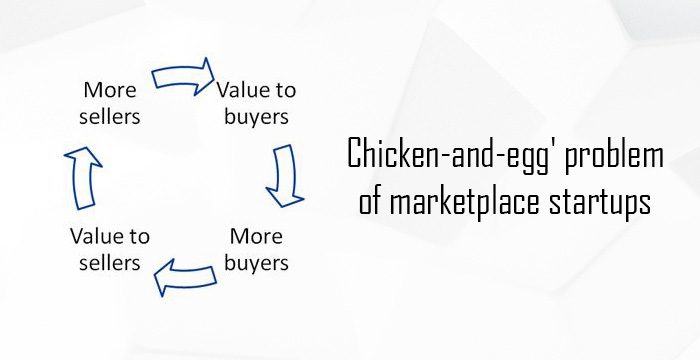
A marketplace business cannot acquire customers if there are no or only a few sellers on it, and would not be able to convince a seller to sign up if there are no customers on the site. That’s the chicken and egg problem of a marketplace where you get stuck between whom to bring first- sellers or the customers. Luckily, despite these challenges, successful marketplaces do exist.

In this post I have focused on how you can deal with the chicken and egg problem of the marketplace and understand why it’s not only about developing a marketplace site but developing a marketplace business on the whole.

What is the chicken-and-egg problem?

Which came first? Same can be said for seller and customers on marketplace sites

If there are buyers, but only a few sellers to fulfill the orders, stock won’t be enough to fulfill all the orders. So, the buyers will leave unhappy out of the product scarcity and probably not return back.

Yet, if there are no buyers on the site, how would you convince a seller to sign-up?

With no buyers for their products, seller’s won’t find your site beneficial for them. Even if they sign up, list their products, and wait for the buyers to come, there is no guarantee that a sale would be made soon enough. In case if they receive an order after months of listing, you can’t say if the product is still available in the stock with the seller, or it is fresh enough to maintain the quality. So, ultimately customers won’t get a quality service from the site, ruining the site’s name.

Supply is the biggest challenge behind a marketplace business. With this chicken-and-egg problem, it takes a while to build a marketplace business. A new platform generally lags in creating enough value for attracting new users. Whether, it is the customers or the sellers, they won’t join you until you have something valuable for them.

Certainly, this is a huge issue for your startup, but as I said, despite these blockages, successful marketplaces do exist. So, stay tuned because we are going to discuss how can you survive this tough time while getting traction and building your supply and consumer base in the long run. Here are the six tips:

1. It’s all about patience and a plan-

Have patience till you establish the both sides-seller and customer community

It’s a probable case that you might not see the signs of traction even after months of the startup. In this case, you should comprehensively reassess your business model and market. The nature of this time period is somewhat opposite to an inventory based eCommerce startup. There you build your own supply chain by stocking products by yourself. In marketplace, you need to build both the customer and seller communities; you will need more time to prove your value to both the sides.

It might take a few months for a marketplace to finally get and prove that value. However, in the meantime, you need to identify a niche for your business and start focusing on that very specific target. Used by most of the successful marketplaces, with niche market targeting your main investment would be the time spent in canvassing sellers. Etsy and Amazon are the two such examples, which started from a niche market (Vintage, handmade products, and books respectively) and later expanded to the broader section.

So, until you get to that level, you need to stay focused, steady and patient.

2. Take a close look on your initial investment-

Experts have different opinions on level of initial investment in marketplace promotion

The level of initial investment in a marketplace business is a matter of debate. Some experts say making big up front investment signals the entities that you are serious about the business and would stay focused in the long run. So there would be stability. It would also make your suppliers and producers comfortable about your intentions to keep the business running. Experts support this view by giving the examples of big upfront investments by several businesses like Microsoft’s launch of Xbox. They made a huge commitment by spending around $500 million for promoting the platform.

However, my views are inclined with the other side of the experts who believe in regulating the burn rate during the initial periods. You need to give yourself some time to build the value for your business first. The reason is, not everyone is Microsoft, who has no scarcity of dollars, plus an already build business value. While some businesses might score huge success with early big deals, you cannot buy the speed when it comes to building a marketplace. Regulating your investments in the initial period would save the fuel and take you furthermore on the runway.

So take a careful look at your initial burn rate. There is no need for big teams, and big offices early on. Most of the initial marketplace investments are made only in two functions: Developing the marketplace site, and building the supply chain base with buyers and sellers community.

3. Tighten your target on the niche market-

Focus on a target market and apply efforts to win that niche

Successful marketplaces may function as a repository for diversity of products and choices at the same place, but none of them has started in the same phase as they are there now. The example of Amazon and Etsy marketplace in the first point advocates this view. Etsy started as a destination for Vintage and handmade crafts and later expanded itself to other categories. Today, Etsy accepts integration even with stand-alone eCommerce sites and platforms. While Amazon started as an online bookstore and evolved as a huge marketplace of everything you can imagine buying. Even Amazon accepts integration with other eCommerce sites and eCommerce platforms.

Both of the entities tightened their focus in smaller vertical before they expanded into the bigger market. This narrow focus steadily became their largest USP and traction. Today, you won’t think of a better online place than Amazon to buy books , even if it is no more a mere bookstore and same goes to Etsy for handmade crafts.

The growth outside the niche would be an organic process that would develop in time. If the growth doesn’t start organically, you can help yourself to speed it up by targeting on seller acquisition efforts. You can prepare action plans targeting certain types of product categories and sellers, and then gradually expand outside the niche of the circle. You may use your geographical location as an advantage by first expanding the reach to local level before going for national and international level.

4. Focus on your niche users’ utilities-

Performance in the niche market decides the fate in the broader section

It is now an understood fact that successful marketplaces are built from a niche to the masses. During the niche period, it is important to optimize the experiences of your early on-boarders before you can start appealing the masses. By focusing on user engagement for your early adopters (both sellers and customers) you will increase the likelihood of being discussed by them in their circle, and that discussion would contain something promotional for you.

For example, Etsy did a fantastic job as a marketplace for handmade crafts which led to carry on its legacy even after it expanded to other categories. Amazon did a fantastic job as an online bookseller in the US before it evolved into a marketplace giant with a reach across the globe. And, a bit different but relevant example, Mc Donald’s did a fantastic job with its hamburgers in the US before expanding to other products and other countries.

All these entities, took a special care of their early adopters before the expansion, as a result, their legacy continued even with the new products and new audiences. So, before focusing on the broader section, make sure your marketplace performs excellently in the narrow section, ultimately taking you to the broader section organically and automatically.

5. Build the community with your Niche users-

A community of users can only be made if you focus on their utilities, and support them from time to time. Social media is the best platform to build a community. Utilize this platform to expand your reach to the users.

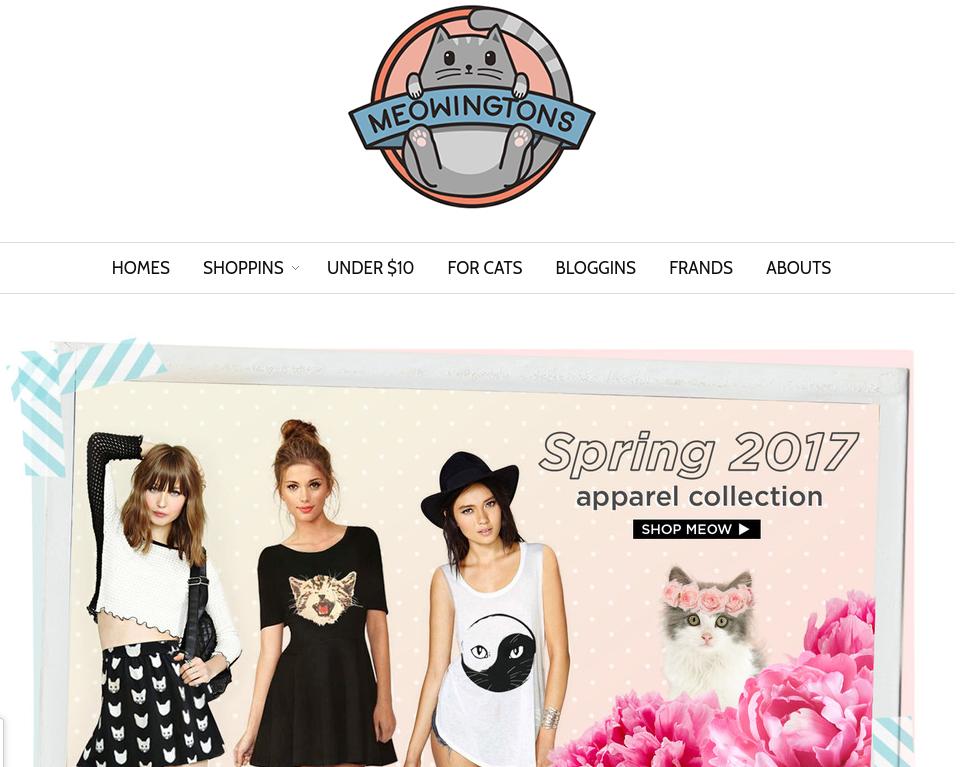
Meowingtons is a perfect example of how you can focus on your niche to take a leap to the broader section. It started with the thinking that out of the whole US population, there is a good share of women population. Out of the whole women population, there is a good share of women who like cats. So, it focused on the women who like cats an started selling the cat accessories, cat utilities, and cat theme accessories for women. Today, it is a successful startup with more than 5 lacs followers on different social media platforms.

6. Trust your vision, but follow the stats-

You might find people not believing in your vision. Do you need to stop right there?

The market is full of conceptions. Everybody have their way of doing things. You might get ridiculed by some of them regarding your vision. You will find people suggesting to back-off when your start doesn’t happen with that pace.

Well, when building your marketplace business, or expanding it to newer boundaries, you have got to believe in your vision, but do not have a blind faith in your ideas. If you are going right, you would definitely find the positive signals at different phases of the business. Keep a track on your development and re-asses the steps you have taken and how they have worked for you. Have a survey from your early adopters about their experiences, audit the repeat customers and repeat sales, track the pace of seller sign-ups and their views about the user experience on the site.

If there are no positive signs of traction, and stats are not in favor of your ideas, rethink about continuing further. You cannot make a successful marketplace business with just visions, you have to stay tuned with the stats and facts.

Having discussed some of the basic tips and tricks of starting an online marketplace, let us now take a look at how can you take care of this chicken-and-egg problem. Whether a huge chuck of customer base will attract the sellers or a large number of vendors will motivate the customers to shop from your site is still an issue.

Some of the strategists think that attracting the seller first is a better option. However, as per my personal experience, working on your niche market and creating a strong audience base as a single vendor site may help attracting the third-party vendors as well. And once the sellers will start pouring in, the product range will increase and store visitors will get more option to shop from your site. Here are some of the tips to deal with chicken-and-egg issue.

Final Say

Summing up the entire thing, I would discuss some of the key points that can help you take care of this problem for your online marketplace. Take a look:

Starting off the platform as a producer can help you dive into every nook and corner of the industry. Working at the ground level can help you identify the bottlenecks of your shopping store. Having a practical experience as a vendor can help you get the best from your third-party sellers.

Create a network of not just customers, but vendors as well in the very beginning. You can leverage the power of your network in the wrong run. When it comes to a marketplace, building a personal connection with your sellers is as important as having a strong customer relationship.

Acquire high-value users before you approach the vendors to be a part of your online marketplace. It’s kind of a vicious circle. The quality customer base and motivate the sellers to sell on your site. Moreover, a large number of sellers and product variety can give compelling reasons to the reluctant visitors to shop from your site.

It may sound conventional, but getting celebrity endorsements is definitely one of the ways to attract both sellers and end-users. Getting the partnership or endorsement from someone who has a fan base and help you channelize your long-term vision.

How to get the customers?

Discussed below are some of the strategies that can help you bring traffic and boost conversions of your site.

As mentioned earlier, focusing on the niche market and creating a strong customer base as a single-vendor site is a must. Incentivize your potential customers.
Instead of just focusing on customer acquisition, make sure that you take up steps for consumer retention. Follow up emails, social media engagement are some of the ways to keep them engaged.

How to get the third-party sellers to sell your site?

Once you have established yourself in the niche and the target market, attracting the sellers will get way more easier. Additionally, you can opt for the following tricks to increase the number of vendors of your site.

Finally,

The six tips we just discussed should allow you to give a correct start to your marketplace business. Building both sides of the marketplace simultaneously is a hard job than a one-sided inventory model, but once you reach the scale, things would start kicking and would establish your roots well and firm. Till then have a little patience, and give your business enough runway to fly high with both sides being well established.

Liked This? You’ll Like These Too