Reasons to Choose Multi-Vendor Marketplace over Single Vendor Online Shop

Consider yourself as an example. While going for online or offline shopping, 9 out of 10 times you will choose a single store where you can find all the essentials without visiting 2 or 3 different shops. Adding the example in real life, modern customers prefer shopping malls while purchasing. Because not only do the shopping malls provide all the product categories in a single place but also save a lot of time for the customers.

The Multi-seller marketplace trend is also rising in the eCommerce industry. Nowadays, more and more sellers are turning their single-vendor online stores into multi-vendor online stores. Before discussing why and what are the benefits, let’s get some details about the online marketplace.

What is Multi-Seller-Marketplace?

The multi-vendor marketplace is an eCommerce shop where you can find more than one online seller selling the same or different product categories. However, if we discuss the hierarchy, the shop admin manages all the sellers and the online shop.

In other words, in exchange for letting the sellers register their products on the admin’s online store, the admin charges commissions from the third-party sellers.

If we try to differentiate the single-vendor and multi-vendor online shops. The single-vendor online shop is managed by a single admin who manages everything from product listing to orders.

On the other hand, in multi-seller marketplaces, the store admin allows third-party sellers to register their products on the eCommerce shop.

Reasons to Go with Multi-Vendor Marketplaces!!
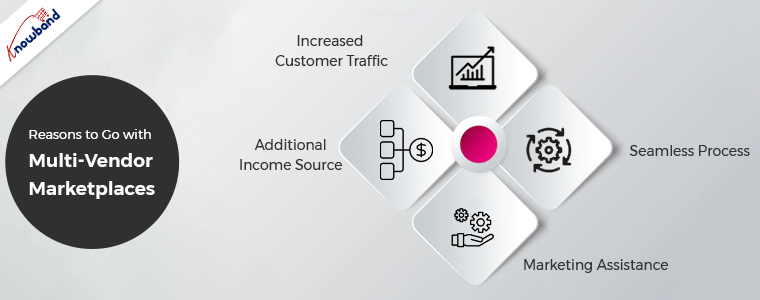
Various reasons are attracting online sellers to convert their online shops into multi-vendor marketplaces. Although it is a bit of a tricky task to manage the different sellers. Yet, things become easy if you use Knowband Multi-Seller Marketplace Addon for building your marketplace.

Moreover, in the below-mentioned points, we have tried to figure out some of the most sounding reasons to go with online marketplaces.

Additional Income Source:

The other reason behind the success of multi-seller eCommerce marketplace is that marketplaces provide additional income sources to the business. Not only you can earn from getting commissions on sales done by third-party sellers. But also, marketplaces built with Multi-seller marketplace add-ons allow the store admins to charge monthly subscription charges from the sellers.

Thus, building your eCommerce multi-vendor marketplace with the multi-seller marketplace module can add rapid boosts to your business turnover.

Marketing Assistance:

While managing your single vendor shop becomes costly because of a lot of marketing expenses. On the other hand, you will not have to worry about marketing your multi-vendor marketplace.

The reason is that along with you, there will be other sellers promoting their products on their end. The same will not only bring traffic to your website but also, will be beneficial for both sellers and admins. Also, along with the traffic brought by the sellers, you will get the chance to present your product dashboard in front of a relevant customer base.

Increased Customer Traffic:
Increasing the number of products and categories will not just increase the number of products and categories. Moreover, you will be having increased chances of getting more traffic to your online website.

The reason behind the same is that you will not be the only seller in your eCommerce shop. Moreover, customers which are interested in a vast variety of products will be shopping from your online store because of the variety of sellers.

The following factor adds significant value to the brand name and provides incredible boosts to the brand-customer reach.

Seamless Process:

Although managing multiple sellers along with all the commission flows and order management sounds a bit tricky one. Yet, if choose the correct option to go with, things become easier.

Likewise, Knowband Multi-Vendor Marketplace module allows the PrestaShop, OpenCart, and Magento 2 online sellers. To turn their single-vendor eCommerce shop into a fully channeled online marketplace.
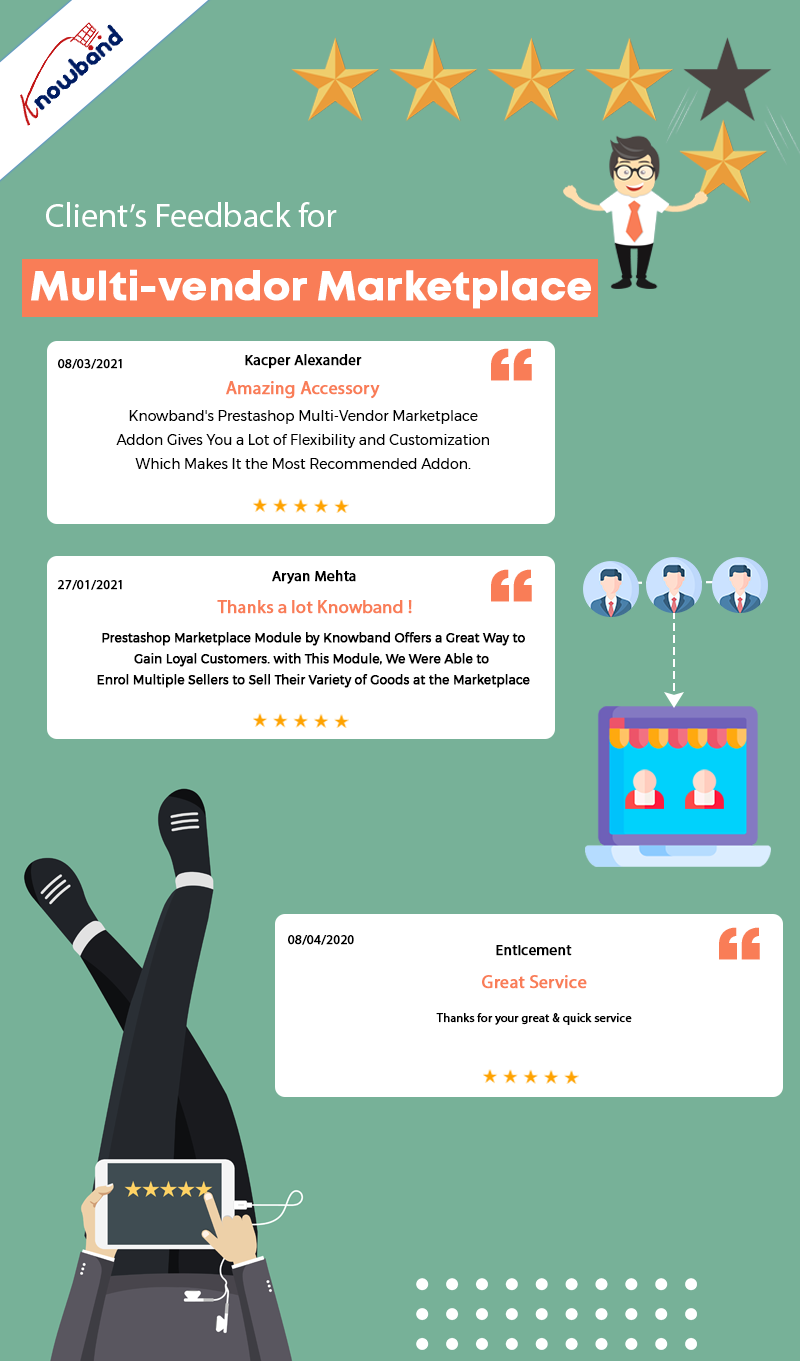
With the help of Knowband Marketplace, the store manager can manage all the doings from seller approval to seller order management. Moreover, if you are not even familiar with coding or technical skills, you will find the Knowband Multi-Vendor Marketplace the perfect option.

In the End,

Keeping up with the market competition these days is a hard nut to crack. Not only the number of online retailers is increasing day by day. But also, you can find various other merchants dealing in the same product categories as yours. Thus, it becomes a must to implement new and effective ideas to grow an online business.

Likewise, building an online marketplace like eBay and Etsy could be the next game changer for your eCommerce business. Moreover, if you are having queries regarding multi-vendor marketplace extensions, you can always drop us a mail at support@knowband.com.


5 revenue generation models multi-vendor marketplaces can use

What’s your ultimate objective with your multi-vendor marketplaces website? It’s selling more and more, or earning more and more?

Sounds weird? Let me explain

The line asks a simple question that what is more important to you- generating more sales or generating more revenue from your online marketplace site?

It seems pretty obvious that you can generate revenue only if you are selling. So, is selling more important because it automatically generates the revenue?

Maybe! Perhaps! Etc.

What if I tell you that your marketplace site does not depend on sales alone to generate revenue. There are other revenue generation models that can act as an integral part of your business model. They can operate in parallel to the sales by monetizing the services that your marketplace site can offer in addition to the marketplace products.

Here is a list of 5 monetization mechanisms or revenue generation models that you can use on your marketplace site to generate some extra revenue from your business:

1. Advertising Revenue Model

Advertising is one of the most popular and oldest revenue generation models. You can generate revenue by renting out advertising space on your site. The websites showing their Ads will pay you based on the respective advertising model. Here you can adopt two different models of advertisement:

Cost per Mille (CPM): CPM, which is also called as Cost per Thousand impressions is an advertising model that allows you to charge in proportion to the number of Ads displayed to the site visitors.

Cost Per Click(CPC): CPC model generates the revenue based on the number of clicks a particular Ad is receiving by your site visitors.

You can use any of the two advertising models to generate revenue on your marketplace site by simply showing ads to your visitors. While doing this, make sure your website design is optimized enough to place the Ads where it does not overshadow your main revenue generation model that is selling your products.

You have to be cautious about the website design to make sufficient white spaces for showing the ads. Otherwise, contact a web designer who would tweak the design as per your requirement for advertising.

2. Sponsored Site Channel model

Typically a site that wants to promote its contents on another site would have to pay for showing its Ads. This revenue model is not exactly the revenue generation model but a cost-saving model.

Here the companies or two sites enter into a ‘contra-deal’ agreement where neither of the two sites needs to pay for advertising. They commit to promoting each other’s content as a ‘give and take’ format.

3. Freemium revenue model

Many web services and marketplaces use this model to generate pretty decent revenue. The central idea behind the freemium model is to provide as many users with the free services and encourage them to upgrade to the paid version of the same.

In one of the approaches, you provide your users with a free trial with limited access and give an option for upgrading to the paid service to acquire the full advanced features and access.

PS: Here the access to the service or features is limited, but is given for an unlimited period.

For example, we provide the Free Magento Multi-vendor Marketplace extension with some restricted features for an unlimited period. The customers can choose to keep using the free restricted version for as long as they want or can unlock the full features by purchasing the Magento Multi-vendor Marketplace extension, Prestashop Marketplace addon, and OpenCart Multi seller Marketplace plugin for the respective fields.

Another example could be Dropbox which provides free 2 GB could data storage to the free users.

There is another approach in the same model where a fully-fledged trial of the full product or services is offered to the users for a limited period of time. The users are given an option to either stop using the services after the trial period or pay for it to keep using.

PS: Here the access to the service of product features is full but the time period for trial is restricted or limited.

For example, Amazon offers full access to its “Amazon Prime” service for free one month. After that, you can either stop using it or subscribe to the monthly subscription to use it for more time.

You can use these models to offer some premium services and generate extra revenue. You can adopt a similar approach like Amazon Prime which provides free same-day shipping to the Prime members.

4. Subscription or membership model

Subscription-based revenue generation is one of the oldest models, and it is still in full-fledged today.

A marketplace site has uncountable ways to leverage this model to generate some extra revenue from the business:

  • Membership for sellers: Asking sellers/vendors/merchants to subscribe to a membership for registering a seller/merchant account on your marketplace.
  • Membership for customers: Asking customers to subscribe to a membership for availing benefits like free shipping, same-day delivery, Shipping package insurance, early access to flash sales, etc.
  • Membership for customers part-2: There is another kind of membership for customers that marketplaces selling virtual products like MP3s, Videos, Software, etc can use. Here, basically, your main revenue generation would be through the premium members only.

For example, Netflix videos library allows only the subscribed users to see the videos. It primarily follows a subscription-based revenue model.

5. Sales commission Revenue model

Of course, I had to include this point. Taking commission from the seller/vendors/merchants on their sales is the primary revenue generation model on which a large number of marketplaces are surviving.

The entire community of sellers and retailers follow this model. There are a number of online marketplaces that allow the e-merchants to sell their products to a larger chunk of customers. The only difference is how and how much commission sellers need to pay for selling on a marketplace. Earlier the complexities of dealing with the inventory management and order processing of the two stores intimidated the e-sellers to go for multi-channel selling. However, the work has become easier now. Knowband offers a line of feature-rich marketplace integrators to the eCommerce sites that are based on the CMS platforms like Prestashop, Magento, OpenCart, Magento 2, and others. With the help of these intuitive integration solutions, you can keep your marketplace shop in sync with your online shopping sites.

Here are some examples of the online marketplaces that allow multi-channel selling:


The sales commission revenue model is not that simple as it seems. Different marketplaces use different approaches to earn the commission. You need to first decide the commission model that you want to use and then customize your Seller management panel to handle the commissions as per your requirement.

Similarly, if you own an online marketplace, charging the commission and managing multiple vendors becomes even more difficult. However, managing the commission model becomes effortless with the help of the various CMS plugins like Magento multi-vendor marketplace, Prestashop multi vendor marketplace addon, or OpenCart marketplace module.

You need to be also aware that most of the multi-vendor marketplace extensions support only the per-product-sale commission. If you want to use any other commission model, then you might need to use an extension or get the requirements developed by an expert eCommerce development company.

Liked This? You’ll Like These Too