WooCommerce vs PrestaShop vs OpenCart vs Magento vs Shopify

Choosing the right platform is one of the most important decisions when you are starting an online store. With so many options available, it can become tiring to decide which platform best fits your business needs.  If you are looking best platform to start an online store, then you are at right place. Each platform offers different benefits and flaws in terms of usability, scalability, cost, and features. We at Knowband already manage these stores as we provide the service for these platforms. This will help you in choosing the right platform for your store.

This article provides a practical comparison of five popular e-commerce platforms, WooCommerce, PrestaShop, OpenCart, Magento, and Shopify, based on key factors such as ease of use, performance, customisation, scalability, and overall cost. You will also learn the e-commerce platform pros and cons. 

Additionally, understanding these helps your business select open source ecommerce platforms that aligns with your business goals.

Key Factors to Consider When Choosing an E-Commerce Platform

Before comparing platforms, as a store owner, you need to understand the core factors that will play a crucial role.:

  • Ease of Use: If you are technical or non-technical, you first need it to be simple to set up and manage products, your entire catalogue and orders.
  • Customisation & Flexibility: Platform should have the ability to modify design and functionality according to your business needs.
  • Performance & Speed: Additionally, there is a major factor that is how well the platform handles traffic and large catalogues
  • Scalability: Also, scalability is the factor your platform can grow with the business
  • Cost: Cost is one of the most important factors as it should be affordable not too expensive.

WooCommerce: Ideal for WordPress-Based Stores

WooCommerce is one of the most used e-commerce platforms and works as a plugin for WordPress. Furthermore, its popularity makes it unique due to its simplicity and flexibility, especially for businesses already familiar with WordPress.

Key Feature  of the WooCommerce

  • Easy to use, especially for WordPress users
  • Massive plugins 
  • Strong SEO capabilities
  • Highly recommended for content-driven stores and blogs

Limitations of WooCommerce

  • Performance can be reduced with large catalogues without optimization
  • Requires paid plugins for advanced features like wishlist 
  • Heavily dependent on hosting quality

Knowband recommends it as the best e-commerce platform for small businesses, medium-sized businesses, bloggers, and entrepreneurs looking for an easy way into online selling.

PrestaShop: Feature-Rich and International-Friendly

PrestaShop is an open-source platform designed specifically for e-commerce. This is the best e-commerce platform for startups. Moreover, it is particularly popular in Europe and offers strong built-in functionality. Furthermore, unlike wordpress it offers the basic functionalities, wishlist, abandoned cart, designs and many more.

Key Highlights of Prestashop

  • Support for multiple currencies and languages
  • Support many advanced taxes and shipping options
  • Strong back-office dashboard
  • Handles large catalogues efficiently

Limitations of the Prestashop

  • Requires moderate technical knowledge
  • Paid modules can increase costs
  • Smaller extension marketplace than WooCommerce

We recommend it to international sellers and businesses that need advanced e-commerce features without heavy reliance on plugins.

Prestashop Plugins

Explore all the plugins that will make your prestashop store more professional


Install Now

OpenCart: Lightweight and Performance-Focused

OpenCart is known for its simplicity and speed.  Additionally, it provides essential e-commerce features without unnecessary complexity. This OpenCart platform also supports built-in tools for coupons, discounts, and special prices like prestashop

Strengths of the Opencart

  • Lightweight and fast
  • Simple admin interface
  • Built-in multi-store functionality
  • Low hosting requirements

Drawback of the Opencart Platform

  • Smaller extension ecosystem
  • Limited advanced features
  • Smaller community compared to competitors

Knowband recommends it to small businesses with straightforward needs and limited budgets that prioritize performance.

Opencart Extension

Give the advanced features to your Opencart store Using Popular Extensions


Install Now

Magento: Enterprise-Level Power

Magento is what the big players use when they need a serious, robust, enterprise-grade solution. Here, Big player refers to the major enterprises and retailers that have a large volume of products through their stores. This Magento Platform is best ecommerce platform for large businesses.

Key Highlights of Magento:

  • Magento scales to handle millions of products and transactions
  • Inventory and customer management tools 
  • Customisation is easy in Magento
  • Built to handle large product catalogues 

The Downsides of Magento are:

  • Learning Magento is a bit difficult for store owners
  • Professional developers are required
  • Hosting and keeping it running will cost you high money

Magento Plugins

Let Knowband Manage Your Magento Plugins, while you only work on selling.


Contact Us Now

Shopify: Everything is handled by them

Shopify takes a totally different approach than other platforms. They handles everything for you unlike others. It’s fully hosted, which means they deal with the technical things while you focus on selling

Key Features of the Shopify

  • You can easily have a store there
  • Shopify handles the hosting, security, and performance. The store owner only focuses on selling.
  • Customer support is highly active
  • A variety of plugins on the app store when you need extra features
  • Perfect for dropshipping or selling across multiple channels (social media, in-person, etc.)

The Downsides:

  • Monthly fees that add up over time
  • Transaction fees on certain plans (unless you use Shopify Payments)
  • Less control over the backend compared to platforms you host yourself

Shopify Custom Development

Let Knowband handle your Shopify store seamlessly, so you can concentrate on scaling your store and brand.
Contact Us Now

Pricing Plans of all the Platforms: WooCommerce, Prestashop, Opencart, Magento and Shopify

Platform Initial Cost Hosting Cost Theme & Extension Cost Development & Maintenance Overall Cost Suitability
WooCommerce Free (WordPress plugin) $5–$30/month (shared to managed hosting) Free to $200+ (plugins & themes) Low to medium, increases with customization Best for small to medium businesses
PrestaShop Free (open-source) $10–$40/month $50–$500 (modules & themes) Medium, often requires developer support Suitable for growing businesses
OpenCart Free (open-source) $5–$25/month $20–$300 (extensions & themes) Low to medium, limited for complex needs Ideal for small businesses
Magento Open Source Free (software only) $50–$200+/month (cloud or dedicated hosting) $100–$1,000+ (extensions & themes) High due to complexity Best for large or fast-growing stores
Magento Commerce (Adobe) Paid license Included or enterprise-level hosting Often custom-built Very high (enterprise development) Enterprise-level businesses
Shopify Monthly subscription Included $0–$350 (themes) + paid apps Low, fully managed platform Best for beginners & fast launches


The conclusion is that there’s no magic “best platform” that works for everyone. It really comes down to what you need for your specific situation.

WooCommerce is fine when you want flexibility, and you’re already comfortable with WordPress. PrestaShop has built-in features that international sellers actually need. OpenCart keeps things simple and fast. Magento gives enterprise-level businesses the scalability they require. And Shopify just makes everything easy if you want a managed solution.

Your decision should come down factors about cost, your technical skill and your business size. Moreover, you can also switch platforms eventually as your business evolves. 

About Knowband

Knowband is a sub-company of Velocity Software Solutions Pvt. Ltd., a leading technology company specialising in e-commerce development and digital solutions. Knowband provides a wide range of ready-to-use plugins, extensions, and custom development services for popular eCommerce platforms like prestashop, WooCommerce, Opencart, Shopify and Magento.

With a strong focus on innovation and performance, Knowband helps online businesses enhance functionality, improve user experience, and increase conversions.


New Year 2026: Unlock the Key to eCommerce Store Growth Using the Knowband Plugins

As we step into the New Year 2026, the team at Knowband extends warm greetings to all online store owners, e-commerce professionals, and enthusiasts. A new year brings with it a sense of renewal and fresh opportunities, making it the perfect moment to reflect on achievements, learn from challenges, and set meaningful goals for the months ahead. The world of online commerce is constantly evolving, with customer expectations, technology, and shopping habits changing faster than ever. For online store owners, staying informed and adaptable is key to sustaining growth and maintaining a competitive edge.In this blog, we aim to provide insights into the key e-commerce trends of 2026 and share practical tips that online stores can implement to stay ahead. These strategies are designed to help businesses not only meet but exceed customer expectations, streamline operations, and prepare for a productive year ahead.

Below are some thoughtful success tips that online stores can consider as they plan for growth and sustainability in 2026.

Improve User Experience for Better Engagement

First of all, a smooth user experience plays a major role in online success. When customers easily browse products and complete their purchases, they are more likely to stay in the store. Complicated checkout processes often lead to frustration and lost sales. One Page Checkout simplify the checkout process by reducing steps and making it faster. As a result, customers enjoy a better shopping experience and store owners see improved conversions.

Reduce Cart Abandonment with Smart Strategies

Along with a better user experience, reducing cart abandonment should be a top priority. Many customers leave their carts without completing purchases due to distractions or doubts. Knowband’s Abandoned Cart Reminder plugins help recover these lost sales by sending timely emails or notifications. Furthermore, these reminders encourage customers to return and complete their orders, which helps increase revenue without extra marketing effort.

Build Customer Trust with Social Proof

In addition to convenience, trust is an important factor in online shopping. Customers often rely on reviews, ratings, and easy login options before making a purchase. Knowband plugins that support social login and customer feedback help build trust and confidence. Moreover, when customers see positive reviews and can log in quickly, they feel more comfortable completing their purchases.

Focus on Mobile Shopping Growth

At the same time, mobile shopping continues to grow rapidly. More customers prefer using smartphones to shop online, which makes mobile optimisation essential. We at Knowband help store owners to create Android and iOS apps easily. These apps also supports the all high level features that are necessary, helping businesses stay connected with customers and promote offers effectively.

Want to launch your mobile app?

Discover the Mobile App Builder and get your app live in just one week!
Build, customise, and launch your mobile store effortlessly

Integrate Today!

Personalise the Customer Experience

Moreover, personalisation helps stores stand out in a competitive market. Customers appreciate personalised offers and messages that match their interests. Knowband plugins enable store owners to deliver targeted promotions and relevant content based on customer behaviour. This not only improves customer satisfaction but also encourages repeat purchases.

Data-Driven Decision Making

Data will continue to guide e-commerce strategies in 2026. Store owners will rely on insights from customer behaviour, sales patterns, and performance metrics to improve their stores.

Using data to understand what works and what doesn’t will help businesses make smarter decisions and adapt quickly to changes.

Strengthen Customer Retention Strategies

Finally, retaining existing customers is key to long-term success. Loyal customers are more likely to return and make repeat purchases. Knowband plugins support better post-purchase communication and ongoing engagement, helping businesses build long-lasting relationships with their customers.

We at Knowband

To support online stores in achieving their goals in 2026, we offer a wide variety of plugins for popular platforms, including PrestaShop, OpenCart, Shopify, WooCommerce, and Magento, helping merchants add advanced features, streamline operations, and adapt to the evolving e-commerce landscape with ease.

Additionally,  we also provide custom development tailored to the unique needs of each business. Our team of experienced developers and e-commerce experts works closely with store owners to understand their challenges and implement effective strategies that enhance performance and user experience. 

Conclusion

To sum up, success in the New Year 2026 will depend on providing a smooth and enjoyable shopping experience, adopting smart strategies, and focusing on customer satisfaction. By paying attention to trends, optimizing operations, and continuously improving the store experience, online businesses can set themselves up for steady growth throughout the year. For expert guidance or support, feel free to reach out to us at support@knowband.com. Wishing everyone a prosperous New Year 2026!

Make This Christmas Profitable with Knowband E-commerce Solutions

The holiday season has come, and it’s the season of peak sales. Customers especially wait for the season, looking for deals, festive products, and a seamless online experience, making Christmas the perfect opportunity to boost sales and expand your customer base. However, standing out in the crowded online marketplace with competition can be challenging. This is where Knowband e-commerce plugins come in, offering a suite of tools to help your store maximise profits, engage customers, and create an unforgettable holiday shopping experience.

Whether your store is on prestashop, opencart, Magento, Shopify or WooCommerce, don’t worry. At Knowband, you get the solution for whichever platform you are on.

So let’s explore the plugins that will help your store make more conversions

1. Spin & Win: Wheel of Fortune Exit and Entry Popups Plugins

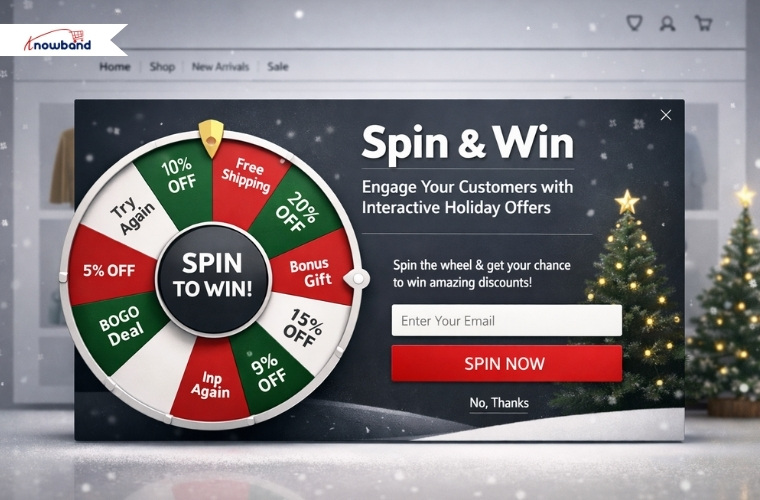
One of the most effective ways to grab customer attention during the holidays is through interactive games, which provide discount codes and offers. This Prestashop Spin & Win Addon allows you to set up a virtual “Wheel of Fortune” pop-up that appears when a customer visits your site (entry pop-up) or is about to leave (exit pop-up). Moreover, customers can spin the wheel to win discounts, free shipping, or other promotional offers. Not only does this gamified experience increase engagement, but it also encourages conversions by giving customers a fun incentive to make a purchase. 

Knowband’s Presatshsop Spin & Win Module ALSO helps the customers to do email marketing as it provides email marketing tool integrations such as Klaviyo, Mailchimp, Sendinblue and many more.

During the festive season, a small discount or a holiday offer can make all the difference in turning a hesitant visitor into a paying customer.

2. Website Decorator: Make Your Store Christmas-Ready

Creating a festive atmosphere on your online store is essential for drawing customers in and enhancing their shopping experience. The Prestashop Website Decorator module from Knowband allows you to transform your store into a holiday wonderland with Christmas theme decorations in the header, footer or random place. From snow effects and twinkling lights to festive banners highlighting sales, these visual enhancements make your store feel seasonal and inviting.

 A well-decorated website not only captures attention but also encourages customers to spend longer browsing times and increases the chances of purchases. Customers are more likely to spend time exploring a store that feels alive with holiday cheer.

3. Gift Card Manager: Give Your Customers the Gift of Choice

On the Christmas occasion, sales of gift cards increase as customers want to gift the gift cards to their friends, family members and relatives. Thus, adding a gift card option will enhance the sale and overall purchase experience for the customers.

Knowband has developed this module especially for this purchase. This Prestashop Gift Card Manager also encourages repeat visits, as recipients are likely to return to your store to redeem their credit. By integrating this module, your store can cater to last-minute shoppers and increase overall sales while providing a convenient gifting option.

4. Product Stickers Plugin to  Highlight Festive Deals

Standing out in a crowded online store is crucial, especially during high-traffic periods like Christmas. The Knowband’s Opencart Product Sticker and Label Extension helps you add eye-catching stickers on products, highlighting special offers, urgency discounts, or festive tags like “Christmas Sale” or “Holiday Special.” Moreover, these stickers make it easy for customers to identify the best deals at a glance, guiding their purchasing decisions and boosting sales. Even a small visual sign like a festive sticker can have a significant impact on customer behaviour, encouraging them toward products you want to promote during the holiday season.

5. Abandoned Cart: Remind your customers 

Adding a reminder to the customer who left their items in the cart will be a game-changer. Before that, a store owner has to know the customer who abandoned their cart. No matter if your customer was an existing customer, a new customer or a visitor, with the setup cron in Prestashop Abandoned Cart, it shows the abandoned cart added in real time with statistics.

 By automatically sending reminders and offering discounts to customers who leave items in their cart, you can encourage them to complete their purchase. During the holiday season, a timely reminder combined with an exclusive Christmas discount can make all the difference. Therefore, this Opencart Abandoned Cart Reminder Plugin ensures that you don’t miss out on valuable sales opportunities and helps maximise revenue during your busiest season.

Knowband for All Platforms

Knowband’s e-commerce solutions are designed to be versatile and compatible with major platforms like PrestaShop, OpenCart, Magento, Shopify and WooCommerce. This cross-platform compatibility ensures that no matter which saas platform you are using, you can implement these modules seamlessly and take advantage of their features. From small businesses to large online stores, Knowband’s plugins provide the flexibility and scalability needed to succeed during the holiday season

Final thoughts

Christmas is the perfect time to boost your online store’s revenue, but it requires the right strategies and plugins to make your store stand out. Hence, the plugins like Abandoned Cart, Gift Card Manager, and Website decorations not only give your store a professional vibe but also increase sales & conversions.

These modules not only enhance the shopping experience but also help you maximise profitability during the holiday season.

No matter the size of your catalogues or the platform you use, using knowband’s plugins, you can make this Christmas your most profitable yet. Transform your store into a holiday shopping destination and watch your sales skyrocket with these powerful, easy-to-use e-commerce solutions

Google Play Policy & API Updates Effective August 31, 2025: What Developers Need to Know

Google Play has announced a comprehensive set of policies and API updates that will come into effect on August 31, 2025. Importantly, these changes are part of Google’s continuous efforts to strengthen user security, improve app quality, and ensure consistency across its ecosystem.

For developers and businesses with apps on the Play Store, these updates are not optional. Furthermore, failing to comply with the new requirements could result in apps being removed from the Play Store, preventing new users from discovering them and limiting access for existing users.

In this article, we are providing a comprehensive breakdown of the new policies, their technical implications, and how developers can prepare.

Target API Level Requirements

First and foremost, one of the most critical changes in this update revolves around target API levels.

New Apps & Updates: Starting August 31, 2025, all new apps and app updates submitted to the Play Store must target Android 15 (API level 35) or higher. Additionally, this ensures that apps leverage the latest security features and performance optimizations provided by the Android operating system.

Existing Apps: Meanwhile, apps already published on the Play Store will need to target at least Android 14 (API level 34) to remain visible to users with newer devices. Consequently, apps that fail to meet this requirement may remain installed for existing users but will no longer be available for download by new users.

Extension Option: Fortunately, Google is offering a short grace period. Developers can request an extension until November 1, 2025, through the Play Console. However, this should be treated as a backup option rather than a primary strategy.

Why this policy matters to your mobile app

Essentially, apps targeting outdated API levels miss out on the latest security patches, privacy controls, and performance improvements. Therefore, this requirement ensures that all active apps remain compatible with modern devices and meet user expectations.

Play Billing Library

In addition to API requirements, another key change relates to in-app purchases and subscriptions.

All new apps and app updates must now use Play Billing Library version 7 or newer. Notably, this is a significant update as it impacts how developers handle in-app purchases (IAPs), subscriptions, refunds, and payment flows.

Moreover, Google emphasises this requirement to improve transaction security, provide a consistent purchase experience, and reduce fraudulent activities.

Similar to the API level requirement, developers may request an extension until November 1, 2025, to migrate to the new library.

SDK & Development Tools

To ensure a smooth transition, Google strongly recommends developers use the latest Android SDK and associated development tools.

Specifically, the SDK Upgrade Assistant in Android Studio helps developers identify outdated dependencies, upgrade API levels, and resolve compatibility issues.

As a result, this reduces manual effort, minimises migration errors, and ensures that apps take advantage of new frameworks, improved APIs, and enhanced security controls.

Ultimately, staying updated with the Android SDK isn’t just about compliance; it’s about future-proofing your app. Apps built on outdated SDKs may struggle with compatibility on new devices, leading to crashes and poor reviews.

Scoped Storage & File Access

Meanwhile, Google introduced Scoped Storage in Android 11, and by 2025, it will become an enforced standard.

Moving forward, apps will no longer have broad access to external storage. Instead, they must:

  • Store files in app-specific directories
  • Use the MediaStore API for media files
  • Leverage the Storage Access Framework (SAF) when users need to select specific files

Impact on developers: Consequently, apps that still rely on legacy storage permissions may face rejection or functionality issues on Android 15. Therefore, migrating to Scoped Storage ensures smoother performance, stronger security, and better user trust.

Deprecated APIs

Furthermore, Google has clarified that apps relying on deprecated or outdated APIs may face rejection during Play Store review.

Essentially, deprecated APIs are those that are no longer recommended because newer, more secure alternatives exist.

As a result, continuing to use them increases the risk of crashes, security vulnerabilities, and poor performance on modern devices.

News and Magazines Apps

If your app falls under the News and Magazines category, there’s an extra requirement you can’t afford to miss.

Specifically, developers must submit a special declaration in the Play Console.

Notably, the deadline for this was August 27, 2025, slightly earlier than the general policy update.

Ultimately, this declaration ensures that apps categorised as news sources meet standards for credibility, transparency, and responsible content distribution.

How Knowband Can Help

If your store is built on PrestaShop, OpenCart, WooCommerce, or Magento 2, Knowband has you covered.

Our Mobile App Builder Module is already fully compatible with Google’s latest policy changes.

Here’s what we offer:

  • Hassle-free update process for your eCommerce app without interrupting your business operations
  • Guaranteed compliance with the new target API level requirement and all other Google Play policies
  • End-to-end support from our expert team for smooth migration, testing, and deployment
  • Proven track record of helping thousands of merchants successfully launch and maintain Google Play-compliant apps

With Knowband, you can focus on growing your business while we handle the technical compliance and optimisation for your mobile app.

Final Thoughts

In conclusion, the August 31, 2025, Google Play deadline is approaching fast, and for Android developers and eCommerce store owners, it’s a milestone that cannot be ignored. Unfortunately, missing these updates could result in app removal, loss of visibility, reduced downloads, and disruption of your business operations.

However, by acting early and adopting the right strategies, you can ensure your app stays compliant, secure, and optimised for the latest Android ecosystem.

With Knowband’s Mobile App Builder, you get a hassle-free, future-proof solution designed for PrestaShop, OpenCart, WooCommerce, and Magento 2 stores. From guaranteed Google Play compliance to delivering a seamless shopping experience for your customers, Knowband helps you stay ahead of deadlines and competition.

Don’t wait until the last minute, upgrade your store app with Knowband today and keep your business growing without interruptions!

Explore:

Step-by-Step Guide to Launch Your eCommerce Mobile App with Knowband

Today, most people shop on their phones, so making the buying experience easy and smooth is a must. With mobile commerce on the trend, having your own app can give your brand a competitive edge.

That’s where Knowband’s Mobile App Builder comes in. Whether you’re using PrestaShop, Magento, OpenCart, or WooCommerce, Knowband makes it incredibly easy to turn your online store into a sleek mobile app with no coding required.

If you’re thinking about launching your e-commerce app, here’s a step-by-step guide to walk you through the entire process.

Step 1: Choose the Right App Builder for Your Platform

First things first, go to Knowband.com and select the Prestashop Mobile App Builder module that matches your store’s platform. Whether you’re running on PrestaShop, Magento 2, OpenCart or WooCommerce, there’s a version tailored just for you.

Once you’ve purchased the module, you will receive a downloadable ZIP file along with setup instructions.

Step 2: Install the Module on Your Website

Next up, it’s time to install the module on your site, and the good news is that it’s a pretty straightforward process. 

Depending on the platform you’re using, the steps may vary slightly. If you’re using PrestaShop, you can easily upload the module right from the admin panel. 

For Magento 2 users, installation is typically done using Composer or via FTP, whichever you’re more comfortable with. 

If your store is built on OpenCart or WooCommerce, the installation is even easier; it just takes a few clicks within the extensions or plugin section of your admin dashboard.

Once the Opencart Mobile App Builder Extension is successfully installed using FTP, you’ll see the Mobile App Builder panel show up right in your backend.

 Moreover, store owners can start set to begin customising their app’s design and functionality.

Step 3: Customise the App Design and Features

Knowband gives the full control to the store owner to customise the app based on the store’s needs.

Using the Mobile App Builder module, you can easily set up banners, sliders, featured product sections, countdown timers, and more. Furthermore, you’ll also be able to tweak the theme colours, fonts, and layout, so your app matches your brand perfectly.

Everything is highly customizable, and you don’t need to write a single line of code.

Step 4: Provide App Branding Details

Once your app layout is ready and you’re happy with the design, the next step is to provide your branding details so Knowband can begin building your mobile app. Moreover, this information helps ensure that your app looks and feels exactly like your brand, consistent, professional, and personalised.

Here’s what you’ll need to share:

  • App name
  • Logo and app icon
  • Splash screen image
  • Primary theme colour
  • Your store URL
  • Firebase keys (used for enabling push notifications)
  • Developer account access ( Android & iOS)

If that list feels a bit overwhelming, don’t worry, Knowband has you covered. We provide clear, step-by-step documentation and friendly support for the WooCommerce Mobile App Builder Plugin to walk you through each requirement. Whether you’re a first-time app creator or just need a little guidance, our team is always ready to help.

Step 5: App Compilation and Delivery

After you’ve submitted all the required information, our team takes over.

We compile your mobile app for both Android and iOS and typically deliver the test builds within 4-5 working days. You’ll receive APK (for Android) and IPA (for iOS) files, which you can test on real devices before going live.

Moreover, this is a good way to review the app thoroughly and ensure everything works just as expected.

Step 6: Test Your App Thoroughly

Before launching, it’s important to test your app across multiple devices and platforms. Try out the login process, navigation, product browsing, checkout, payment gateways, push notifications, and anything else that matters to your user experience.

If you notice any issues or have last-minute customisation requests, our support team is responsive and ready to assist.

Step 7: Publish to App Stores

You can upload the APK file to your Google Play Developer Account and submit the iOS version through your Apple Developer Account using App Store Connect. If you’re unsure how to do this, Knowband guide you through the process or even handles it for you.

Step 8: Promote and Optimise Your App

Promote your mobile app on your website with banners or pop-ups, share download links on social media, and offer exclusive app-only deals to encourage downloads. Moreover, you can also use push notifications to keep users engaged and bring them back to your store regularly.

Don’t forget to monitor reviews, track analytics, and gather feedback so you can continuously improve the experience.

Final Thoughts

Launching a mobile app for your e-commerce store doesn’t have to be expensive or complicated. With Knowband’s Magento 2 Mobile App Builder Plugin, you can go from idea to live app in just a few days and provide your customers with the modern, mobile-first experience they expect.

Whether your store is on PrestaShop, OpenCart, Magento 2, or WooCommerce, we have the perfect solution to create your own mobile app based on your website or store theme. Visit opencartmobileshop.com to get started.

So why wait? Now is the perfect time to take your store mobile.

Get started today and let your store go mobile with KnowBand

AI for E-Commerce: Generate and Translate Content in a Click with Knowband

Writing and maintaining optimised content for an e-commerce store often demands significant time and effort. The AI Content Generator and Translator Module from Knowband offers a powerful solution to simplify this process.

This all-in-one module brings together the strengths of ChatGPT, Claude AI, and Gemini AI, enabling store owners to easily create and translate content with minimal effort.

Whether you’re adding new products, updating meta details, or targeting a multilingual audience, this module streamlines everything in just a few clicks. Moreover, the plugin is available for all major platforms like prestashop, opencart, Magento 2, & woocommerce.

Let’s explore how this all-in-one solution transforms content management for your online store.

Key Features of the Knowband’s PrestaShop AI Content Generator and Translator

1. Multi-AI Engine Support

The PrestaShop AI Content Generator Module smoothly connects with leading AI engines such as ChatGPT (GPT-3.5 and GPT-4), Claude AI (Haiku and Sonnet models), and Gemini AI (including 1.5 Flash, 2.0 Flash, and Pro versions).

As a result, you gain the flexibility to choose the engine and model that best aligns with your specific needs, whether you’re looking for creative flair, factual accuracy, or ultra-fast content generation.

2. Complete Content Generation

The PrestaShop AI Content Generator Module quickly creates important content for online stores, like product descriptions, meta titles, meta descriptions, and category text. Moreover, all content is well-structured, SEO-friendly, and crafted in a tone that resonates with online customers, ensuring both clarity and conversion potential.

3. Bulk Content Management

If you are managing a large store? Then no worries. The Opencart AI Bulk Content Generator Extension enables store owners to create or translate large volumes of content efficiently in a single operation. Furthermore, this saves hours of manual effort and helps you scale faster.

4. SEO Optimisation Built-In

From keyword-rich meta titles to optimised product descriptions, the WooCommerce AI Content Generator and Translator Addon ensures that your content ranks well on search engines.

5. Accurate Multilingual Translations

Most importantly, with Knowband’s Magento 2 ChatGPT AI Content Translator Plugin, store owners can effortlessly translate content into multiple languages while maintaining both accuracy and proper formatting. Moreover, this includes everything from product and category titles to descriptions, as well as meta information like titles and descriptions, ensuring your store speaks clearly and effectively to a global audience.

6. Predefined AI Prompts

The powerful & advanced AI Content Generator Module includes 14 built-in prompts for both content generation and translation. Additionally, the store owner can customise the prompt according to the way they like.

Moreover, these prompts make it easy to execute tasks based on your specific needs and desired content style or description, eliminating the need to write instructions manually.

7. User-Friendly Admin Interface

Even with complex advanced technology, the Prestashop Content Translator & Generator Addon is designed for simplicity. Moreover, store admins can operate everything from an intuitive dashboard—no coding or technical knowledge needed.

8. Activity Logs for Full Transparency

Each action performed using the WooCommerce AI Content Generator Plugin is automatically logged for tracking and transparency.

Moreover, you can review timestamps, prompt types, and content changes to keep track of all updates made via AI.

Top Benefits of Using Knowband’s AI Content Generator and Translator Module

Boosts Productivity and Focus

First and foremost, by automating repetitive content tasks, store owners and teams can redirect their time and energy toward strategic areas like marketing, customer engagement, and business development, instead of spending hours writing and translating content manually.

Ensures Brand Consistency Across Markets

In addition, the AI-generated and translated content maintains a consistent tone, style, and message across all product listings and languages. This helps your brand appear reliable, professional, and trustworthy, regardless of the target audience or region.

Reduces Dependency on Third Parties

Moreover, with AI handling both content creation and translation, there’s less need to hire external writers or translators. This not only reduces costs but also gives you greater control over output quality and turnaround time.

Accelerates Global Expansion

As a result, the built-in multilingual capabilities allow your store to easily reach and engage international customers, enabling faster entry into new markets without the usual complexities of manual localisation.

Supports Scalability

Finally, whether you’re managing 50 or 5,000 products, the module is built to handle bulk operations seamlessly. In other words, as your store grows, the module scales with you, keeping your content strategy efficient and future-proof.

Conclusion

The AI Content Generator and Translator Plugin is a must-have for any store looking to scale efficiently while maintaining high-quality content. Whether you’re managing SEO, translating for global reach, or launching new products, this single module handles it all with ease.

Whether you’re launching new products, managing hundreds of listings, or expanding into international markets, this all-in-one AI-powered addon simplifies everything. Moreover, it integrates the strengths of ChatGPT, Claude, and Gemini, giving you unmatched flexibility and control.

As a result, you save valuable time, reduce operational costs, and enhance your store’s SEO performance. In addition, accurate multilingual translations enable you to connect with a global audience while maintaining quality and brand tone.

So, why wait?
Install the Knowband AI plugins today—and let your store speak every language, brilliantly.

Simplifying Multi-Channel Selling: Magento 2 Seller Guide!

In today’s fast-paced eCommerce world, sellers need to be everywhere their customers are. From search engines to marketplaces, the ability to sell across multiple channels is not just a luxury but a necessity. Therefore, if you’re using Magento 2 to power your online store, multi-channel selling might seem challenging—but it doesn’t have to be! With the right tools, you can seamlessly manage your product listings, orders, and customer communication across different platforms, all while staying within your Magento 2 dashboard.

In this guide, we’ll walk you through the essential Magento 2 tools you need for multi-channel selling, and how Knowband’s specialized connectors simplify the process for Google Shopping, eBay, and Etsy. Furthermore, by integrating these key platforms with Magento 2, you can maximize your sales potential and streamline your workflow, so you can focus more on growing your business and less on managing operations.

Why Multi-Channel Selling is Essential?

Multi-channel selling allows businesses to reach a wider audience by listing products on multiple platforms. Whether your customers are searching for products on Google, browsing through eBay listings, or shopping for handmade items on Etsy, being present on these channels increases your visibility and enhances your chances of making sales.

Advantages of Multi-Channel Selling:

  • Increased Sales Opportunities: Each platform you integrate with becomes a new sales channel.
  • Broader Audience Reach: Reach potential customers who prefer different platforms.
  • Improved Brand Recognition: Your brand becomes more familiar as customers see your products across multiple channels.
  • Diversified Risk: Selling on multiple platforms reduces dependency on one sales source.

However, managing these channels manually can be time-consuming and error-prone. That’s why it’s crucial to automate and synchronize your operations with powerful Magento 2 integrations.

Knowband’s Magento 2 Extensions for Multi-Channel Selling!

At Knowband, we specialize in creating intuitive Magento 2 extensions that make multi-channel selling as easy as a few clicks. Let’s dive into three key extensions that will revolutionize your selling strategy: Magento 2 Google Shopping Connector, Magento 2 eBay Marketplace Integration Extension, and Magento 2 Etsy Connector Plugin.

1. Magento 2 Google Shopping Connector:

Google Shopping is one of the most popular platforms for product discovery. Shoppers often turn to Google when searching for products, and appearing in Google’s Shopping results can drastically increase your chances of conversion.

Key Features of the Google Shopping Connector:

  • Automated Product Syncing: The Magento 2 Google Merchant Feed extension allows you to automatically sync your Magento 2 products with Google Shopping. Thus, you don’t have to manually update listings when products go out of stock or when prices change.
  • Bulk Product Uploads: Easily upload your entire product catalog to Google Shopping in bulk, saving time.
  • Smart Mapping of Attributes: Seamlessly map your product attributes to Google Shopping’s requirements, ensuring that your listings meet platform standards.
  • Product Feed Generation: It automatically generates and updates your product feed for Google Shopping, ensuring that your listings remain current.

With Magento 2 Google Shopping Connector, you can reach a huge audience that uses Google to search for products. The automation features reduce manual work, allowing you to manage your product listings and updates directly from your Magento store.

2. Magento 2 eBay Marketplace Integration Extension:

eBay is a global online marketplace with millions of active buyers. Listing your products on eBay opens up opportunities to tap into an international market, and the Magento 2 eBay Marketplace Integration Extension helps you manage eBay sales without leaving your Magento dashboard.

Key Features of the eBay Integration Extension:

  • Inventory and Order Management: Sync your inventory between Magento 2 and eBay. Orders placed on eBay are automatically imported into Magento, ensuring consistent stock levels across both platforms.
  • Real-Time Updates: The extension provides real-time updates for orders, product information, and inventory levels.
  • Product Listing Templates: Create customizable product listing templates for eBay, allowing you to streamline the listing process.
  • Multi-Store Support: If you’re running multiple stores, you can use this extension to manage listings and orders across all your eBay accounts.

Thus, with the Magento 2 eBay Marketplace Integration Extension, you can expand your reach into eBay’s massive user base. Furthermore, it simplifies the entire process of listing products, managing orders, and syncing inventory, reducing the chances of errors and mismanagement.

3. Magento 2 Etsy Connector Plugin:

Etsy is the go-to marketplace for handmade, vintage, and unique products. If your Magento 2 store features these types of items, the Etsy marketplace is the perfect platform to attract niche buyers. On the other hand, the Magento 2 Etsy Connector Plugin helps you effortlessly manage your Etsy store without needing to log in to the platform separately.

Key Features of the Etsy Connector Plugin:

  • Product and Order Synchronization: Sync your Magento 2 product listings with Etsy, and automatically import Etsy orders into Magento for centralized management.
  • Bulk Product Uploads: Easily upload multiple products to Etsy in one go, making it simple to manage large inventories.
  • Category Mapping: Map your Magento categories to Etsy’s marketplace, ensuring that products are properly listed in the right categories.
  • Price and Stock Synchronization: Keep your prices and inventory in sync between Magento 2 and Etsy, reducing the risk of overselling or pricing errors.

For sellers of creative and handmade products, the Etsy Connector Plugin offers a direct way to tap into Etsy’s specialized market. It simplifies the process of managing your Etsy listings and orders while keeping everything integrated within your Magento dashboard.

Knowband’s Magento 2 Marketplace Extensions

Transform your Magento 2 store into a thriving marketplace with the Marketplace Modules, enabling multiple sellers to manage their own products and orders effortlessly.

SHOP NOW

Conclusion: Streamlining Your Multi-Channel Strategy!

Managing multiple sales channels doesn’t have to be complicated. With Knowband’s Magento 2 Google Shopping Connector, eBay Marketplace Integration Extension, and Etsy Connector Plugin, you can streamline the process of listing products, managing orders, and maintaining inventory across platforms. These extensions help you stay on top of every sale, regardless of where it’s coming from.

Multi-channel selling is essential for modern eCommerce success. With these Magento 2 tools, you can maximize your reach, automate key tasks, and focus on growing your business. Whether you’re targeting Google’s search engine shoppers, eBay’s global marketplace, or Etsy’s niche buyers, Knowband has the tools to make multi-channel selling a breeze!

Magento Open Source 2.4.7: Key Enhancements and New Features!

Magento is one of the most widely used eCommerce platforms that allows sellers to start an eCommerce website hassle-free. Although, Magento is not known for regular updates, yet, the new and enhanced Magento Open Source 2.4.7 introduces significant improvements and bug fixes, enhancing the platform’s overall performance and security. Furthermore, this version includes updates to third-party libraries and core dependencies, which makes it a valuable upgrade for developers. The update ensures Magento remains a robust and reliable platform for e-commerce businesses, providing a solid foundation for future development and growth.

Introduction to Magento Open Source 2.4.7:

The latest version of Magento Open Source supports PHP 8.3 and expands its GraphQL coverage, including resolver caches and custom attributes. Therefore, this broadens the capabilities and performance of the platform, which allows the developers to build more efficient and responsive applications.
Additionally, Magento 2.4.7 ensures compatibility with UPS and FedEx services, reinforcing its capabilities as a robust e-commerce platform. These updates not only improve performance but also ensure compliance with current standards and practices.

Security Enhancements:

With several new measures implemented to safeguard the platform, security is a primary focus in this release. The new enhancements include improved cache key management, restrictions on coupon code generation, and optimized Admin URL generation to ensure greater randomness and security.

On the other hand, the all-new full-page cache settings have been introduced to minimize risks associated with specific endpoints, and payment pages now support Subresource Integrity (SRI) for enhanced script verification. Additionally, adjustments to the Content Security Policy (CSP) ensure compliance with PCI 4.0 specifications.

Moreover, the rate limitations have been implemented for payment data transmission via GraphQL and REST APIs, and the enhanced email service availability improves the reliability and security of email communications within the platform.

These security measures collectively strengthen Magento’s defense against potential threats, ensuring a safer environment for both merchants and customers.

Platform Improvements:

This release brings several platform improvements that ensure compliance with the latest security standards and improve overall functionality. Therefore, key updates include integrated support for PHP 8.3, while continuing support for PHP 8.2 until December 2025, ensuring long-term stability and security for Magento applications.

The updated RabbitMQ support to version 3.13 and compatibility with Varnish cache enhance the platform’s performance and scalability. Elasticsearch 8.11 and Redis 7.2 compatibility improve search functionality and data caching, respectively, while support for OpenSearch versions 2.12 and 1.3 provides additional flexibility.

Along with the other platform improvements, the core code has been updated to use the latest versions of JavaScript libraries and NPM dependencies, which ensures compatibility and performance improvements.

Additional Upgrades:

The release also includes significant updates to shipping and payment integrations. Magento Open Source 2.4.7 has migrated to the newest Commerce UPS REST API platform and adopted new FedEx RESTful APIs, replacing the older XML and WSDL web services. This transition ensures that shipping integrations are more reliable and up-to-date, providing better performance and fewer issues.

Therefore, the Temando shipping modules have been deprecated from the core code base since version 2.4.4, reflecting Magento’s commitment to maintaining a lean and efficient platform by removing outdated and less-used features.

GraphQL Enhancements:

This version introduces several important improvements to GraphQL, enhancing its performance and capabilities. New mutations, such as clearCart and createGuestCart, replace deprecated ones, simplifying the cart management process and improving the efficiency of these operations. Furthermore, the performance improvements include cacheable GraphQL query resolvers, which enhance the speed and responsiveness of GraphQL queries.

Therefore, the enhanced GraphQL caching capabilities also improve the performance of PWA (Progressive Web Application) pages, ensuring faster load times and a better user experience. These enhancements make GraphQL a more powerful and efficient tool for developers, enabling them to build more dynamic and responsive applications on the Magento platform.

Inventory Management:

The inventory management system in Magento Open Source 2.4.7 has been enhanced to provide more effective tools for managing product inventory within Magento Open-source and Adobe Commerce. Version 1.2.7 offers a comprehensive range of tools to ensure efficient inventory management, helping merchants maintain accurate stock levels and streamline their operations. These improvements make it easier for businesses to track and manage their inventory, reducing the risk of stockouts and overstocking, and ensuring a smoother and more efficient fulfillment process.

Magento Open Source Extension Meta Package!

The Magento Open Source Extension meta package version 1.0.0 now includes several extensions as part of its core release. This update simplifies the process of upgrading extensions by integrating them into the core release, making it easier for developers to maintain and update their extensions.

Thus, by including these extensions in the core release, Magento ensures that they are fully tested and compatible with the latest version, reducing the risk of conflicts and issues. Furthermore, this approach also streamlines the update process, as developers can upgrade their extensions alongside the core platform.

Conclusion!

Whether you are a developer looking to build more efficient applications or a merchant seeking to provide a better user experience, Magento Open Source 2.4.7 offers the tools and features needed to achieve these goals. For detailed information on bug fixes and improvements, refer to the official release notes.

At Knowband, with 13+ years of technical expertise, we provide web and app development services for the Magento 2 eCommerce platform. Our services include 30+ ready-to-use extensions along with custom development services. If you have any queries, you can reach out to us at support@knowband.com.

Staying Competitive in 2023: Can Magento Deliver on Reliability?

As e-commerce businesses enter 2023, staying competitive in the digital world is becoming increasingly challenging. In such a competitive landscape, online stores require reliable platforms to deliver a seamless customer experience. Magento, a popular e-commerce platform, is known for its features, customizability, and flexibility. In this article, we’ll explore whether Magento can deliver on reliability in 2023.

The Concerns Around Magento’s Reliability

Magento has faced criticism regarding its performance, uptime, and security. Some argue that as the Magento software ages, it becomes harder to maintain, leading to glitches that can impact the customer experience. Slow loading times and downtime are unacceptable to customers who expect instant gratification. Additionally, businesses must be vigilant against security breaches, which can result in significant risks and reputation damage.

Magento’s Steps for Improvement

Despite these concerns, Magento has taken significant steps to improve its reliability. The company has released new versions that address performance and security issues. For example, Magento 2 introduced caching improvements to reduce server workload and enhance site performance. It also implemented an improved indexing mechanism, making the platform more scalable and able to support large online stores. The recent release of Magento 2.4.2 aimed to refine the checkout experience, improve security, and elevate site performance, demonstrating Magento’s commitment to addressing user concerns and enhancing reliability.

The Dominance of Magento in E-commerce

Magento remains a dominant force in the e-commerce industry for several reasons. Its feature-rich nature, high customizability, flexibility, and scalability set it apart from other platforms. No other e-commerce platform offers the same level of customization and control over the online store’s appearance and functionality.

Another significant aspect contributing to Magento’s dominance is its vibrant community support. The Magento community consists of a vast network of professionals and practitioners who actively contribute to the platform’s development and address bugs and glitches. This dedicated community ensures that Magento remains up-to-date and continues to evolve to meet the changing needs of businesses.

Leveraging Magento’s Strengths

While Magento may have its downsides, businesses can still leverage its strengths to stay competitive in 2023. Its popularity and extensive user base indicate that it can deliver reliable e-commerce solutions. By utilizing Magento’s rich feature set and customizability options, businesses can create unique online experiences tailored to their target audience.

To make the most of Magento’s reliability, businesses should ensure they stay up to date with the latest Magento versions. Regularly updating the platform ensures access to bug fixes, performance enhancements, and security patches. Engaging with the Magento community is also crucial for businesses to troubleshoot issues and benefit from the collective expertise of the community members.

Conclusion

In conclusion, while Magento may have faced criticism in the past regarding its reliability, it remains a reliable choice for businesses seeking e-commerce solutions in 2023. Magento’s efforts to address performance, uptime, and security concerns through new version releases demonstrate its commitment to reliability. Its unmatched feature set, customizability, and scalability make it a preferred choice for businesses worldwide.

To ensure reliability with Magento, businesses must stay proactive. Regularly updating the platform, leveraging community support, adopting security best practices, and continuously monitoring website performance are essential steps to take. By embracing Magento’s strengths and actively addressing any concerns, businesses can stay competitive in the e-commerce industry and provide a reliable customer experience in 2023. Furthermore, at Knowband we offer various feature-rich plugins for Magento and Magento 2 eCommerce platforms. In case you are having any queries or suggestions regarding Magento reliability in 2023, you can also reach out to us at support@Knowband.com.


What are the Latest Ecommerce Trends for Magento Stores?

Magento is one of the most well-known platforms for developing online stores. This results in making it a little bit simpler for both small and large business owners to manage a profitable online store. Since many shops have been moving to e-commerce in recent years due to its many advantages, eCommerce platforms have seen rapid growth. The Magento is the one that offers the best help for a business. Without empowering the Magento stores it is not easy to adjust according to the market.

As Magento is an open-source platform with much growth potential for online stores, the majority of merchants use it to create their eCommerce websites. A great shopping experience for customers is also made possible by it for sellers. You must be familiar with the leading developments in Magento development. Some of the latest trends for Magento stores are below:

Latest Trends for Magento Stores

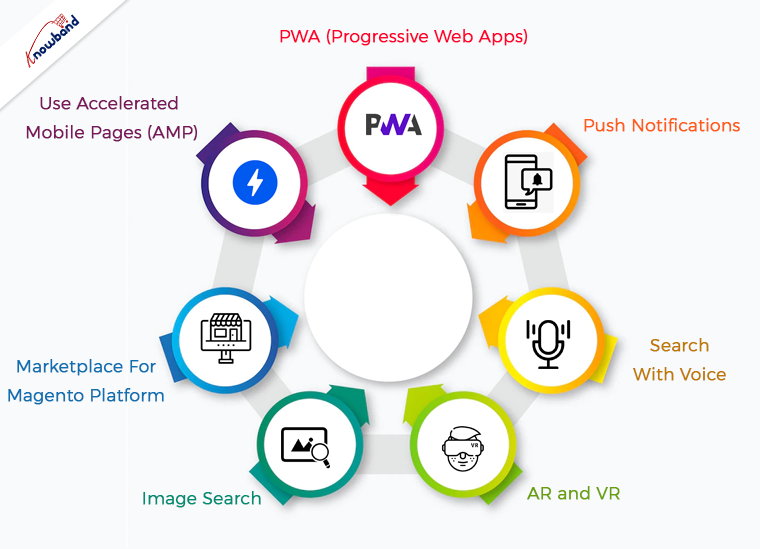
PWA (Progressive Web Apps)

A progressive web application (PWA) is an online application that makes use of cutting-edge web technology. It has design principles to provide a steady, speedy, and interesting user experience.

With an experience similar to an app, PWA integration improves the usability of Magento websites. With full-screen mode, cutting-edge features, and offline mode, Magento PWA loads more quickly and is more interactive. Additionally, PWA features like push notifications and installability can significantly reduce marketing expenses.

Push Notifications

Push alerts can give your Magento business incredible conversion and sales potential. Moreover, push notifications have the potential to improve user engagement, raise brand awareness, and decrease the rate at which users abandon their shopping carts. In comparison to email marketing, push notifications to have a much higher opening rate.

You may let customers know about your deals, sales, and top-selling products with the aid of Magento push notifications. Based on your customers’ preferences, locations, and interests, you may also send them customized push alerts. Your opportunities to increase website traffic and close more transactions will be maximized.

Search With Voice

The eCommerce sector has been undergoing revolutionary change due to voice search technology. The ease with which shoppers can find and purchase goods or services increases with this feature. Further, voice search technology has completely changed the way people shop online.

It is time to incorporate voice search into your Magento e-commerce store if it is not already present. To have one of Google’s highlighted snippets appear on your website, you must voice search-optimize your content. Due to the lengthier nature of voice search inquiries compared to text queries, use a conversational tone and long-tail keywords in your content and product descriptions.

AR and VR

Other cutting-edge methods that shoppers favor while purchasing from an online business include augmented reality and virtual reality. They can quickly test things virtually by picturing them from all angles. Additionally, it aids in their ability to make an informed purchase, which is crucial for establishing a company’s credibility.

Image Search

Visual search is a common way for individuals to quickly look for anything online in the current digital era. The majority of the time, people utilize it to look up places or landmarks. However, online buying and selling are also starting to catch on. Customers can simply find commodities and products that seem similar to each other to buy by using this technology.

Marketplace For Magento Platform

A website that sells goods or services from numerous vendors in return for a commission is known as a multi-vendor marketplace. To track their items, each seller has a separate account. Unique business opportunities may be available in the multi-vendor market. Since you won’t need to invest in inventory, your financial risks will be reduced in the beginning. You can invest your time and money in marketing and business expansion to see benefits faster.

Second, a multi-vendor market enables you to quickly and successfully expand your supply. Furthermore, the vendors who provide goods on your marketplace might be a huge help to you in promoting your business.

Use Accelerated Mobile Pages (AMP)

Websites called AMPs use a very specific HTML framework. This makes it easier for data to be transferred between browsers, which improves the user experience. Or to put it another way, it makes page loading almost instantaneous. 

AMP promotes Faster load times and a lower bounce rate. AMP is based on the idea that mobile users want quicker outcomes. Pages that have been optimized for mobile devices should thus load quickly. Since these AMP pages are faster so these characteristics collectively improve the possibility of clicks.

In The End

In this article, we have been discussing the various trends to Improve the Magento Online store. Apart from this, we assist with custom developments as per the business demands. In case you have any issues or concerns related to our module then kindly let us know the same on support@knowband.com. Moreover, if you want to add any functionality to the module and we will assist you with the same as custom development.