How to Turn Your OpenCart Blog Into a Revenue-Generating Content Strategy

Having a blog is easy. Making it contribute to store growth is where most ecommerce businesses struggle. Article writing without a defined goal may get some visitors, but it won’t result in any sales automatically. The key is to create a content strategy that helps a customer go from having a problem to its solution, and then to the product.

Here is an effective workflow for making the OpenCart Blog Extension by Knowband your sales solution.
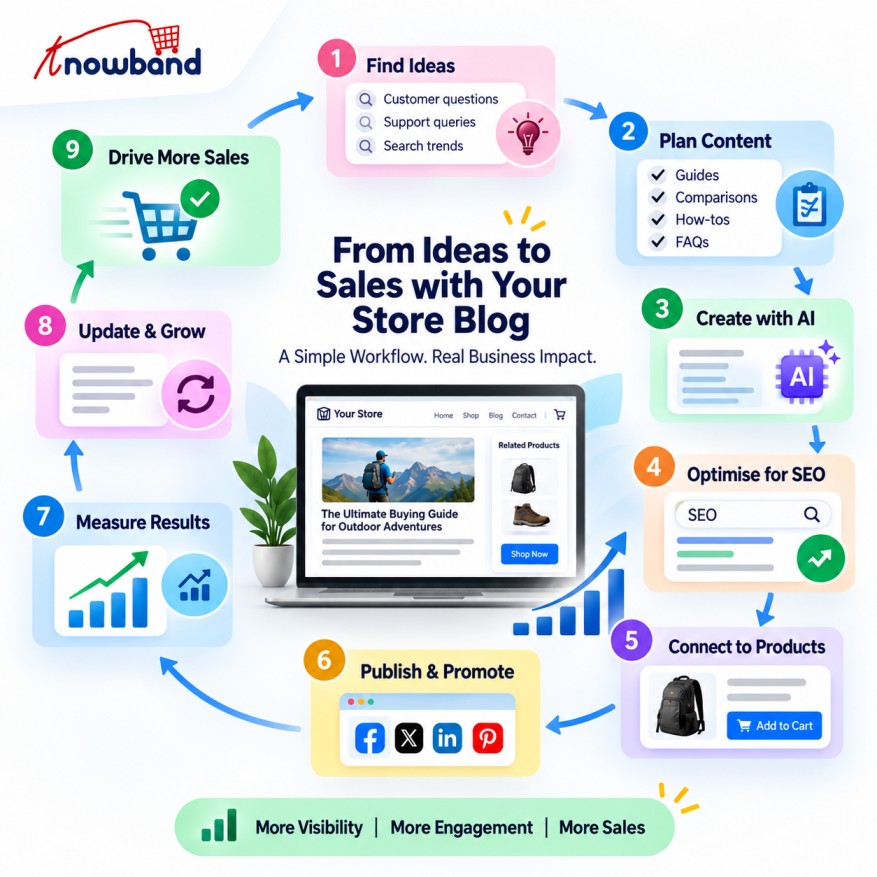
Step 1: Begin With Customers’ Needs

Identify the questions that people have when thinking about purchasing a certain product.

Analyze enquiries, questions, reviews, search queries, and objections, and divide them into the following topics: buying advice, comparison, education, use cases, and troubleshooting.

Implementation: Make a list of content ideas based on the customers’ needs and not based on your guesswork.

Expected impact: You build content around real search intent, giving your store more opportunities to reach potential customers before they are already comparing products.

Step 2: Give Every Article a Specific Job

Do not make every article responsible for “getting traffic.” Think about what you would like the reader to do next.

An awareness article might introduce a problem. A buying guide can help someone compare options. A product-focused article can remove doubts before purchase. A tutorial is used to enhance the experience of an existing customer by providing them with more value from the product.

Implementation: Assign each article a particular function – to attract, to inform, to compare, to convert, to support, or to retain.

Impact expected: Your blog will become a part of the customer journey strategy and not a bunch of random articles.

Step 3: Create Content at Various Purchasing Intent Levels

Once you know the purpose, create content for different levels of purchase intent.

For example:

  • Awareness: “What to Consider Before Choosing…”
  • Research: “How to Choose the Right…”
  • Consideration: “[Option A] vs [Option B]”
  • Decision: “Best [Product Type] for [Use Case]”
  • Post-purchase: “How to Set Up and Use…”

At this point, using an OpenCart Blog Builder can be beneficial for you. It allows you to arrange all kinds of content according to your purposes and publish accordingly.

Impact expected: The customers have several ways to come across your store in the purchasing process, and increase the likelihood of going from informational content to the discovery of a product.

Step 4: Associate Useful Content With Relevant Products

It’s great when a customer reads an article, but it’s much better if there is a way for them to shop for a product that really helps to solve their problem.

Suppose an article explains how to choose between different product types. Once the reader understands what to look for, introduce relevant products that match those requirements.

Do not turn the article into a catalogue. The product should appear because it is useful during the customer’s decision-making process.

Expected impact: Reduce the distance between organic traffic and your catalogue, giving informational visitors a clear route toward products.

Knowband’s OpenCart Blog Extension can support this connection between informational content and product discovery within the store.

Step 5: Create Content Using Customer Objections

Some of the most valuable content ideas might be sitting right there in your inbox.

Whenever you get asked by multiple people if a product will work for an application, how two products compare, or how something works, you need to provide a permanent answer.

Implementation: Use frequently asked questions to create FAQ posts, comparison articles, buying guides, tutorials, or articles related to a certain product.

Expected result: You handle objections before they prevent the purchase, but you also create content that covers topics that matter to your customers.

OpenCart Blog Extension approach to blog management can help merchants bring this content into the same store workflow instead of managing a separate publishing process.

Step 6: Build a Content Path Instead of Isolated Articles

One useful article should lead naturally to another.

A broad buying guide could link to a comparison. The comparison could point to a specific use-case article. That article could then introduce relevant products.

Think of it as:

Search → Article → Related Content → Product → Purchase

Use related posts and internal links where they genuinely help the reader continue researching.

Expected impact: Visitors have more reasons to explore your store, while your content develops stronger connections between related topics and important product pages.

This is one of the areas where the OpenCart Blog Plugin by Knowband can support a more organised content structure.

Step 7: Optimise Before You Publish, Not Months Later

Even a good article still needs to be easily readable for both search engines and customers.

Before publication, consider search intent, title, description, URL, headings, images, internal links, categories, and any product relation.

Do not stuff keywords into every paragraph. Create a clear page first, then add SEO elements that accurately describe its contents.

Expected result: Each piece of content gets more chances to be found and read instead of being SEO optimized after the fact.

Knowband’s OpenCart Blog Builder brings content and SEO management together so merchants can handle these publishing requirements within their OpenCart workflow.

Step 8: Use AI to Produce More Articles Without Losing Focus

AI could speed up content production, yet producing more articles should not be the purpose.

Utilize AI in those areas where it replaces routine work: writing the first draft, developing the outline further, translating content, or working on SEO features. Keep your strategy and the final check with your team.

Expected result: A small marketing team can keep a consistent schedule of publications without transforming its blog into an endless flow of generic articles.

The OpenCart Blog Plugin by Knowband provides assistance in content generation, translation, development, and optimization in the context of the blog workflow.

Step 9: Measure What the Content Actually Does

Do not judge the entire blog by page views.

Look at what happens after someone arrives:

  • Do visitors reach product pages?
  • Which articles assist conversions?
  • Which topics attract relevant traffic?
  • Which posts keep users exploring?
  • Which articles need updating?
  • What are other customer questions left unanswered?

Expected result: You will be able to spend more time on content that brings value to your business and less on low-value articles using the OpenCart Blog Extension.

Turn Your Workflow Into a Repetitive Process

The purpose is not to publish more. It is to create a system that improves with every cycle:

Research customer needs → Plan content → Create → Optimise → Connect to products → Publish → Measure → Update → Repeat

Updated September 30, 2026: The OpenCart Blog Manager helps you organize categories, tags, authors, related posts, and linked products from your store’s admin panel. It also includes SEO fields, multilingual publishing, AI-powered content generation with OpenAI and Google Gemini, and an auto-updated XML sitemap for your blog posts. Read our guide on how to organize OpenCart blog categories, tags, authors, and related posts to see the full introduction and features.

With an OpenCart Blog Extension, this process can become part of your regular ecommerce workflow rather than a separate content project.

The full OpenCart Blog Manager – AI Content & SEO Optimization by Knowband is designed to support this kind of workflow, bringing content management, SEO, product connections, multilingual publishing, imports, and AI-assisted content work into the OpenCart environment.

The important part, however, is not the number of tools available. It is what you do with them.

Ask the right question. Create the right content. Connect it to the right product. Measure the result. Then improve the next piece.

This is how the blog for a store can transform from just posting articles to a useful channel of discovery, consideration, and profit generation.
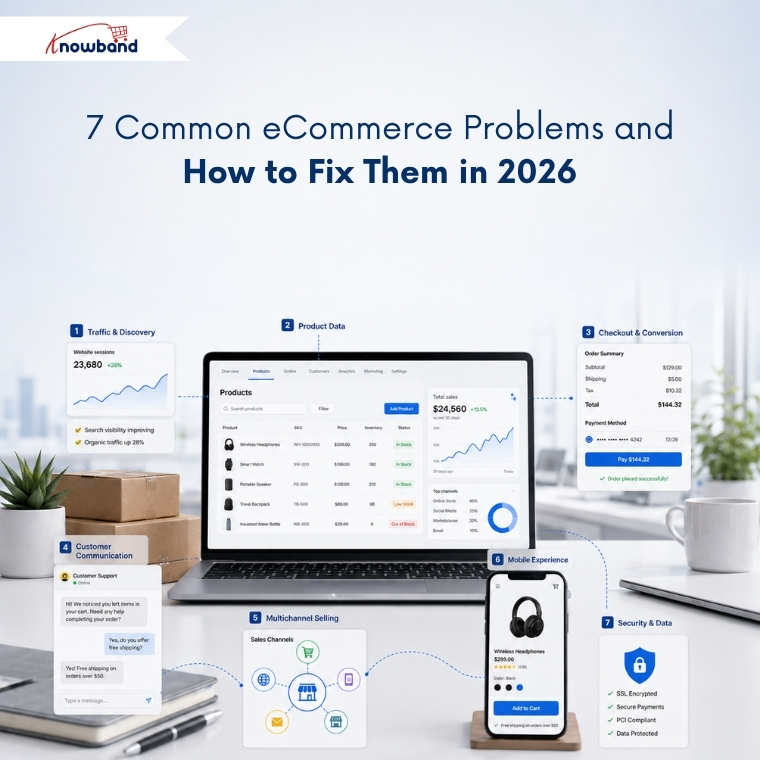
7 Common eCommerce Problems and How to Fix Them in 2026

Running an eCommerce store comes with a wide range of challenges. Poor product data can hurt search visibility, weak discovery can limit the impact of conversion efforts, and slow support can turn interested shoppers into lost customers. These issues are closely connected, so the key is to identify which problem is costing your store the most and address it first. Together, even small gaps across these areas can have a significant impact on revenue.

This guide breaks these challenges into seven categories. Each section explains what the problem is, why it happens, and how to fix it. So, you can use these insights to support business decisions.

1. Traffic and Discovery Problems

What are eCommerce discovery problems?

Discovery problems occur when shoppers who want your product never reach your store. Rankings drop, category pages stop getting indexed, or the product appears in Google but never inside an AI-generated answer.

Sudden Traffic Drop: There could be several reasons for traffic to fall, which include SEO problems, indexing problems, broken links, search rankings, and optimization of pages. It is important that merchants check their site to see any problems related to search engine optimization. OpenCart store merchants can consider getting an OpenCart SEO audit done.

Why discovery fails

Search now runs on two separate tracks, and most stores are only optimised for one. Traditional organic results still reward crawlability, internal linking, and content depth. AI-powered search, however, looks for something different. It depends on structured, machine-readable product facts that a model can quote with confidence.

A product page can therefore rank on page one and remain invisible inside an AI shopping recommendation. The model found no clean price, no reliable availability status, and no extractable specification, so it recommended a competitor it could read instead.

How to fix discovery problems

Start by checking your website’s indexation status in Google Search Console. Identify which URLs Google excluded, and fix the underlying cause rather than resubmitting the sitemap. In many cases, faceted navigation creates thousands of similar URLs that compete with each other. Duplicate category paths pointing to the same product are another common cause of indexing problems.

Next, focus on making your product data easier for search engines and AI systems to understand. Every product needs valid Product schema, a resolvable price, an accurate availability field, and specification data in structured fields rather than buried in description HTML. Running a proper AI crawler and indexing audit shows you what the machines actually retrieve, and adding an llms.txt file that points AI crawlers to your product data closes the remaining gap.

2. Product Data and Catalog Problems

What is poor product data quality?

Poor product data quality means product information is incomplete, inconsistent across channels, or factually wrong. Missing attributes, conflicting specifications, duplicate SKUs, and stale inventory all belong in this category.

Why product data breaks

Product catalogs naturally become outdated over time, often without merchants noticing. A supplier changes a specification without notice, a bulk update runs without validation, or a product variant becomes disconnected from its parent listing. Since these issues rarely trigger immediate errors, they often go unnoticed.

The cost is documented and large. Akeneo research found that 66%of shoppers have abandoned a purchase because product information was missing or inaccurate, and 43% returned a product in the past year because pre-purchase information turned out to be incorrect. Salsify’s 2025 consumer research adds that 54% abandon when product information is inconsistent across the websites they check.

These numbers represent customers who already found your store. They were interested in buying but left because they couldn’t confidently verify the product’s details, compatibility, or suitability.

How to fix catalog data problems

Instead of measuring catalog completeness by product, measure it by individual attributes. For example, a catalog reporting 95% completeness overall can still hold zero dimension data in the categories that generate the most returns.

Always validate before importing rather than after. Bulk transfers that run on saved profiles with a full transfer log make every error traceable to a specific run, which manual CSV work never does. For stores handling frequent bulk updates, reusable import profiles with validation and detailed transfer logs help prevent the same mistakes from happening again.

3. Conversion and Checkout Problems

What is cart abandonment?

Cart abandonment is when a shopper adds a product to the cart and leaves without completing payment. According to Baymard Institute’s meta-analysis of 50 studies, the documented average cart abandonment rate is 70.22%, meaning roughly seven in ten carts never become orders.

Why shoppers abandon checkout

Baymard’s data separates the causes cleanly. Unexpected extra costs revealed late in the flow account for 48% of abandonment, making it the largest single cause by a wide margin. Forced account creation causes 26%, and a long or complicated checkout causes a further 22%.

None of those three is a market condition or a competitor problem. Each one is a design decision the merchant controls, which is why the rate moves when stores address them.

How to reduce cart abandonment

Show the full cost, shipping and tax included, before the shopper reaches payment. Offer guest checkout and move account creation to the post-purchase confirmation, when the customer is satisfied rather than impatient. Compress the flow so progress and order total stay visible in a single view, which is the core argument for a one page checkout for PrestaShop.

Baymard estimates that checkout design improvements alone could deliver an average conversion uplift of 35.26%, equivalent to roughly 260 billion dollars in recoverable orders across the US and EU.

4. Customer Communication and Retention Problems

What are eCommerce communication problems?

Communication problems appear when a store cannot answer a shopper quickly enough to keep the sale, or cannot reach a customer again after they leave. Support backlogs, ignored recovery emails, and repetitive pre-sales questions all belong here.

Why communication breaks down

Support volume grows with catalog size, while support headcount often remains unchanged. The same handful of questions repeat indefinitely: shipping timelines, return windows, sizing, compatibility, and restock dates. A human answers each one, usually several hours after the shopper asked and well after the purchase decision has moved on.

Recovery messaging carries a related problem. Abandoned cart emails still perform reasonably well on open rate, but inbox competition means the reminder often gets read after the intent has cooled.

How to fix communication problems

Automate the repetitive layer first. An AI assistant answering shipping, return, and product queries from live store data removes the questions that never required a person, which frees the team for the ones that do.

For recovery, move to a channel with faster read behaviour. Merchants have been shifting cart recovery from email toward WhatsApp for this reason, because a message read within minutes outperforms one read the following day.

5. Channel Expansion Problems

What are multichannel selling problems?

Multichannel selling problems arise when a store lists on marketplaces or shopping feeds and cannot keep catalog, pricing, and inventory consistent across them. Oversells, rejected feed items, and visible price mismatches follow.

Why channels drift apart

Each channel enforces its own taxonomy, attribute requirements, and image rules. A product that passes validation on your own store fails on Google Shopping for a missing GTIN, or fails on a marketplace because the category mapping is wrong.

Manual listing makes drift inevitable. Once a price gets updated in one place and forgotten in another, any shopper comparing the two learns only that your store is careless.

How to fix channel consistency

Treat your store catalog as the single source of truth and push data outward from it, never sideways between channels. Automated product feed synchronisation then keeps price and stock aligned on a schedule instead of relying on memory.

Treat feed rejections as free diagnostics. When Google refuses an item for a missing attribute, that same gap is usually costing you conversions on your own site too. Merchants weighing a new channel will find the practical considerations before selling on Etsy a useful check before committing.

6. Mobile Experience Problems

What is the mobile conversion gap?

The mobile conversion gap describes the difference between how much traffic arrives on mobile and how much revenue it produces. Mobile carries the clear majority of eCommerce sessions while converting at roughly half the desktop rate.

Why mobile underperforms

Friction a desktop user tolerates becomes a dealbreaker on a phone. Long forms, tap targets built for a mouse pointer, slow largest contentful paint, and limited payment options each cost a measurable share of completions.

Responsive design solved layout without solving interaction. A checkout designed for desktop and scaled down to fit a phone still asks for the same fifteen fields.

How to close the mobile gap

Fix Core Web Vitals on mobile first, since that is where failures concentrate. Reduce checkout fields, enable autofill, and add Apple Pay and Google Pay as payment options.

Reducing checkout steps on OpenCart returns roughly twice the gain on mobile that it does on desktop. Stores with meaningful repeat purchase rates should also review how app-first competitors win returning customers, because a dedicated app removes the friction rather than managing it.

7. Security, Spam, and Data Integrity Problems

What are eCommerce security problems?

eCommerce security problems cover unauthorised access to customer data, payment fraud, and automated abuse such as bot registrations, spam form submissions, and credential stuffing.

Why stores get targeted

Online stores hold precisely what attackers want: payment details, addresses, and credentials that customers reuse elsewhere. Smaller merchants attract attention because they maintain security controls less consistently and monitor them less frequently.

Spam is the more common daily problem. Fake registrations fill the customer table, junk form submissions consume support time, and bot traffic can also distort the analytics that inform key business decisions.

How to reduce exposure

Update the platform and every installed extension on a schedule rather than after something breaks. Enforce HTTPS across the store, restrict admin access by role, and keep off-site backups you have tested restoring at least once. A dedicated security module covers the layers that otherwise get forgotten.

Secure the frontend as well. Stopping bots and fake registrations at the form layer protects both the customer database and the reporting you make decisions from, and well-designed forms reduce abandonment on registration and contact pages at the same time.

Turning Store Data Into Decisions

Every problem above stays invisible until you measure it. Most merchants still export order data into spreadsheets, which means the insight arrives weeks after the loss and after the pattern has already changed.

Query the store directly instead. Getting answers from your store data without writing SQL turns weekly reporting into a two-minute question, and smart store analytics identifies which of these seven categories is costing the most right now.

Track four numbers weekly: abandonment rate split by device, feed rejection count, attribute completeness by category, and support tickets grouped by question type.

Where to Start

Work in order of measurable loss rather than in order of visibility.

For most stores, that means checkout first, catalog data second, and discovery third. The first two help convert visitors you have already acquired, which makes them the cheapest available wins. Discovery brings new visitors in, and filling a leaking bucket rarely ends well.

Knowband builds modules across all seven areas for PrestaShop, OpenCart, Magento, and Shopify, covering checkout optimisation, catalog import and export, marketplace integrations, mobile apps, and customer engagement.


Boost Your ROI: AI Chatbots & Video Carousels in OpenCart Mobile Apps

In today’s fast-moving digital landscape, having a powerful mobile presence is no longer optional,  it is essential. Shoppers increasingly prefer browsing and buying through their smartphones, making it critical for store owners to invest in a robust OpenCart Mobile App. Knowband’s feature-rich OpenCart Mobile App Builder empowers merchants to deliver engaging, conversion-focused shopping experiences without writing a single line of code.

Why Your Business Needs an OpenCart eCommerce Mobile App

Consumer behaviour has fundamentally shifted. Desktop traffic continues to decline as mobile commerce grows year over year. An OpenCart eCommerce Mobile App puts your store directly in your customer’s pocket, enabling faster browsing, easier checkout, and stronger brand loyalty.

Unlike a mobile-responsive website, a dedicated app built with the OpenCart Mobile App Maker offers push notification support, offline browsing capabilities, and app-store visibility,  all of which translate directly into higher repeat purchase rates and reduced cart abandonment.

Introducing Knowband’s OpenCart Android and iOS Mobile App Builder Plugin

The Knowband OpenCart Android and iOS Mobile App Builder Plugin is a complete solution for merchants who want to launch native-quality apps on both major platforms simultaneously. You do not need separate development teams or expensive agency contracts. The plugin handles everything from design to deployment, making it the most practical choice for growing OpenCart businesses.

Key capabilities of the plugin include:

Real-Time Editor: Customize your app’s layout, color scheme, banners, and navigation menus through a visual drag-and-drop interface. Changes reflect instantly, so you can preview exactly what your customers will see before going live.

Multi-Platform Publishing: The OpenCart Android and iOS Mobile App Builder Plugin generates fully compatible builds for both the Google Play Store and Apple App Store, cutting your launch timeline significantly.

Push Notifications: Send targeted promotions, flash sale alerts, and back-in-stock notifications directly to your shoppers’ lock screens, one of the highest-converting marketing tools available to mobile retailers.

Trending Video Widgets: Turn Browsers into Buyers

Short-form video content has redefined how people discover products. The OpenCart Mobile App Creator by Knowband includes a Trending Video Carousel feature from Opencart Video Manager Plugin that brings a social-media-style experience directly into your store app.

Static product images often fail to communicate texture, scale, or real-world usage. Video fills this gap by giving shoppers a near-tactile sense of what they are purchasing. With the video carousel and Floating Widgets, you can:

  • Feature user-generated content and influencer reviews to build social proof
  • Showcase product demonstrations directly on category or home pages
  • Drive impulse purchases by pairing short clips with “Shop Now” call-to-action buttons

For best results, keep video clips between 15 and 30 seconds. This length maintains fast loading speeds while delivering enough context to reduce buyer hesitation.

  • see exactly where customers are getting confused and refine your product descriptions or AI prompts accordingly.

🤖 Also on OpenCart?


Automate Store Conversations with an OpenCart AI Chatbot using Popular AI


Answer customer questions 24/7, reduce cart abandonment, and free up your support team, all with one smart AI Chatbot for OpenCart.

Try the demo for Free Now →

Smart AI Chatbot Integration for 24/7 Customer Support

Modern shoppers expect answers immediately. The OpenCart Mobile App from Knowband supports AI chatbot integration, giving your store the ability to respond to customer queries around the clock, even outside business hours.

A well-configured chatbot handles the most common customer service tasks efficiently:

  • Order Tracking: Customers can check real-time shipping status without calling your support team.
  • FAQ Responses: Common questions about return policies, sizing, and payment methods are resolved instantly.
  • Product Suggestions: The bot can guide shoppers toward relevant items based on their browsing behavior and queries.

The result is a measurable reduction in support ticket volume and a smoother checkout journey that keeps customers moving toward purchase rather than abandoning their carts in frustration.

Actionable Tips for Maximising Your OpenCart Mobile App

To get the most out of the OpenCart Mobile App Builder, follow these best practices:

  1. Map your top support queries and configure your chatbot to handle at least the top 10 most common questions your team receives.
  2. Place the video carousel above the fold on your home page for maximum first-impression impact.
  3. Schedule push notifications strategically, time them to coincide with high-traffic periods such as lunch hours or evenings.

Conclusion

A well-built OpenCart eCommerce Mobile App is one of the most impactful investments a merchant can make in today’s mobile-first marketplace. With the Knowband OpenCart Mobile App Builder, you gain access to enterprise-level features,  trending video carousels, smart chatbot support, push notifications, and dual-platform publishing through a single, user-friendly plugin.

Whether you are launching your first app or upgrading an existing one, the OpenCart Mobile App Maker Plugin from Knowband provide everything you need to deliver a modern, high-converting shopping experience that keeps customers coming back.

Ready to grow your mobile revenue? Explore the Knowband OpenCart Android and iOS Mobile App Builder Plugin today.

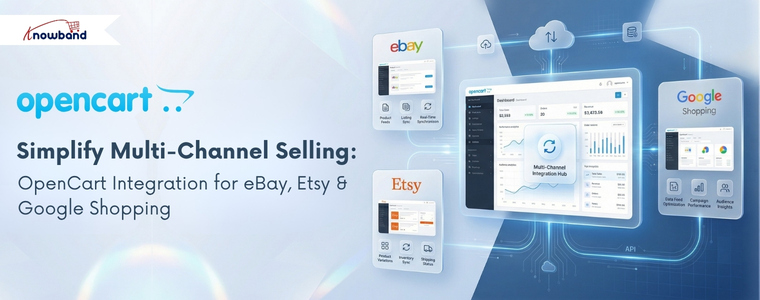
OpenCart Multi-Channel Integration: Sync Google Shopping, Etsy, and eBay from One Store

Introduction: One Store, Three Powerful Sales Channels

Research from Shopify’s 2024 Commerce Report confirms that merchants selling on three or more channels generate significantly more revenue than single-channel sellers. The logic is simple that more visibility means more buyers. But managing separate platforms manually leads to stock errors, missed orders, and wasted hours.

So here is the real question: What if you could manage Google Shopping, Etsy, and eBay all from your OpenCart backend without logging into each platform separately?

That is exactly what the right set of OpenCart integration modules makes possible. Knowband builds each of these connectors specifically for OpenCart merchants who want reliable, low-maintenance multi-channel selling.

Marketplace selling has become an important part of the multichannel ecommerce strategy. According to a 2024 DHL report, 63% of ecommerce businesses sell on at least three online platforms, showing how common it has become for merchants to reach customers through more than one sales channel. In the case of OpenCart, while the opportunity to explore existing marketplaces may help reach a wider discovery of products, it also presents the problem of maintaining consistency in listings, inventory, and orders. This is where selling on the top marketplaces with an OpenCart store can be considered as part of a multichannel selling approach.

OpenCart Google Shopping Integration Module

The OpenCart Google Shopping Integration module connects your product catalog directly to Google Merchant Center. This module auto-generates a Google-compliant XML feed, maps your categories to Google’s taxonomy, and keeps prices and stock levels updated in real time.

Key Highlights

  • Automated feed generation: No manual XML exports needed
  • Real-time price and inventory sync: Supports real-time updates from your store to Google Shopping
  • GTIN, MPN, and brand field support: improves product eligibility and visibility
  • Feed scheduling: submit updates hourly, daily, or weekly automatically

Why Google Shopping  Matters for your Opencart Store

Google Shopping targets buyers who are already searching for your product. A clean, accurate feed from the OpenCart Google Shopping Module puts your listings in front of high-intent shoppers without requiring a large ad budget. Furthermore, free listings alone can drive consistent, qualified traffic back to your store.

OpenCart Etsy Marketplace Extension

The OpenCart Etsy Marketplace Extension bridges your OpenCart catalogue with Etsy’s marketplace, which attracts over 90 million active buyers looking for unique, handmade, and vintage products. It handles Etsy’s specific listing requirements,  custom variations, renewal cycles, and category tags, all managed from OpenCart.

Key Highlights

  • Product variation sync: Maps OpenCart options like size, color, and material to Etsy listing variants
  • Listing renewal management: Provides many synchronisation features like relisting, listing, and many more
  • Tag and category mapping: Pulls relevant keywords from OpenCart to improve Etsy search visibility
  • Order import: Etsy orders flow directly into your OpenCart dashboard

Why Etsy Marketplace Matters for Your Opencart Stores

Etsy’s audience actively searches for products they cannot find on mainstream platforms. If your store carries handmade, customizable, or niche items, this extension puts them in front of exactly the right buyers. Moreover, centralised order management means you never lose track of an Etsy sale again.

OpenCart eBay Marketplace Connector

The OpenCart eBay Marketplace Connector, also referred to as the OpenCart eBay Marketplace Extension,  links your OpenCart store to eBay’s global marketplace, one of the highest-traffic e-commerce platforms worldwide. Furthermore,  automates product listing, bidirectional inventory sync, and order management between both platforms.

Key Highlights

  • Bulk product listing: List your entire OpenCart catalogue to eBay in one action
  • Bidirectional inventory sync: A sale on eBay instantly updates stock in OpenCart
  • Automated order import: Ebay orders appear in your OpenCart backend without manual entry
  • Pricing rules: Apply platform-specific markups to account for eBay fees automatically

Why eBay Matters for Your Store

eBay draws buyers who compare prices across sellers before purchasing. Getting your products listed there increases competitive visibility significantly. Furthermore, the OpenCart eBay Marketplace Extension ensures your stock numbers stay accurate across both platforms, eliminating the risk of overselling.

Why Running All Three Together Makes Sense

Each platform serves a different buyer intent. Google Shopping captures search-driven traffic. Etsy attracts niche and handmade product seekers. eBay pulls in price-conscious, high-volume shoppers. Together, they cover a wide spectrum of the buying journey.

When all three connect to a single OpenCart store, inventory updates once and syncs everywhere. Orders from all channels land in one dashboard. There is no switching between platforms, no spreadsheet reconciliation, and no overselling risk.

Conclusion

Multi-channel selling is no longer optional for growing OpenCart stores; it is the standard. The OpenCart Google Shopping Integration Extension, the OpenCart Etsy Marketplace Extension, and the OpenCart eBay Marketplace Connector each solve a specific visibility problem. Together, they turn your OpenCart store into a fully connected, automated sales hub.

Start with the channel that fits your product type best. Then expand. The infrastructure is already there


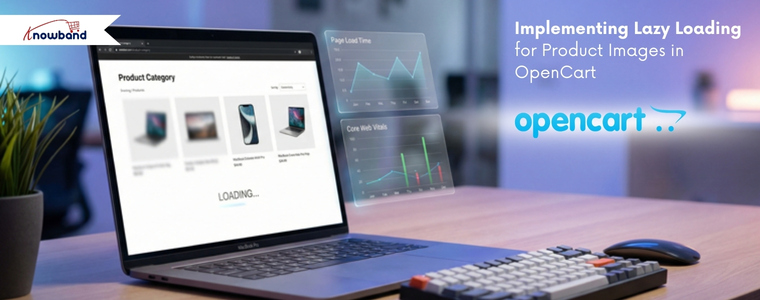
Implementing Lazy Loading for Product Images in OpenCart

In today’s internet-driven world, users expect websites to load instantly. Customers want pages to load quickly when they visit your OpenCart website. Customers may become irritated, and your business may lose revenue if your product pages take too long to load, especially on mobile devices where internet rates may be slower.

Large or numerous graphics are frequently the primary cause of slow page loading. Product photos might be big files, but they are an essential component of any e-commerce website. Lazy loading can help with it.

The Performance Challenge in eCommerce Sites

Moment’s eCommerce spots are veritably visual. A standard order runner can have

  • 20-50 pictures of the product
  • Banners
  • Thumbnails and icons
  • Sections on related products

The browser will need to load each image before the page is completely interactive if all of these are loaded at once. This leads to:

  • First Contentful Paint (FCP) at a slower pace
  • Increased Interactive Time 
  • Poor performance on mobile devices
  • A higher server load
  • Increased rates of bounce

The user experience will be significantly impacted by this, particularly on slower networks.

What Is Lazy Loading?

The technique known as “lazy loading” delays the loading of images (or other content) until they are truly required, which is typically when a user is ready to view them by scrolling into view. Lazy loading waits until the user is ready to view the image before loading it, as opposed to loading all the images at once.

Lazy loading has the following advantages:

  • Bandwidth conservation
  • Better performance on mobile devices
  • Improved SEO and essential web elements
  • Quick loading of the first page

When many of the images may load simultaneously on product pages, lazy loading is especially helpful.

Why Lazy Loading Matters

Imagine looking through an item catalogue. Even if the product images are far below the fold, your browser will try to load them all at once when using traditional loading. Only the images that are in or near the viewable portion of the screen will load initially when using lazy loading. The remaining images will gradually load as the viewer scrolls.

Both your clients and search engines like Google, which like websites that load quickly, will benefit from a quicker and more seamless experience.

Real-World Example: Category Page Without Lazy Loading

Consider this example:

24 products on a category page, Each thumbnail = 150 KB, Total image weight = 3.6 MB

Before even loading banners, CSS, and JavaScript, the browser has to download close to 4 MB of images.

Now consider that the visitor only scrolled halfway through the page. Half the images were never viewed – but downloaded anyway. Therefore, this is wasted bandwidth and 0This is where lazy loading comes in.

Lazy Loading and Core Web Vitals

Web Vitals. The following are directly impacted by large images:

  • Paint with the Largest Content (LCP)
  • Shift in Cumulative Layout (CLS)
  • Next Paint Interaction (INP)

Correctly loading images slowly will enhance performance metrics, particularly on product and category listing pages.

Still, there’s one important thing to keep in mind

 Images above the pack, like the primary product image on a product detail runner, should n’t be lazy loaded.

When to Apply Lazy Loading?

Lazy loading is best suited for:

  • Product listing pages
  • Category pages
  • Blog listing pages
  • Manufacturer pages
  • Upsell sections

It might not be the best fit for:

  • Hero banners above the fold
  • Main product image on the product page
  • Critical branding visuals

How to Implement Lazy Loading in OpenCart

Method 1: Lazy loading in native browsers

Modern browsers use the loading=”lazy” property to provide built-in lazy loading

Example:

<img src=”image.jpg” loading=”lazy” alt=”Product Image”>

OpenCart Steps:

  • Open your theme file:
Version File Path
OpenCart 2.x catalog/view/theme/your_theme/template/product/category.tpl
OpenCart 3.x catalog/view/theme/your_theme/template/product/category.twig
OpenCart 4.x catalog/view/template/product/category.twig
  • Locate the product image <img> tag.
  • Change it as follows:

Before:

<img src="{{ product.thumb }} alt="{{ product.name }}"  width="300"  height="300"

     title="{{ product.name }}">

After:
<img src="{{ product.thumb }}"loading="lazy"  alt="{{ product.name }}"  width="300"  height="300"     title="{{ product.name }}">

That’s all. JavaScript is not necessary. Furthermore, this is the most easy and cleanest way.

Method 2: Using lazysizes (Best for Older Browser Support)

Steps:

  1. Add the lazysizes script:
    <script src="https://cdnjs.cloudflare.com/ajax/libs/lazysizes/5.3.2/lazysizes.min.js" async></script>
  2. Open your theme file based on the OpenCart version mentioned in Method 1 and update the image markup:
  • Before:
    <img src="{{ product.thumb }}" class="lazyload" width="300" height="300" alt="{{ product.name }}">
  • After:
    <img data-src="{{ product.thumb }}" class="lazyload" width="300" height="300" alt="{{ product.name }}">

Method 3: Using Intersection Observer API (Advanced Control)

Modern JavaScript API for better control.

Example:

const images = document.querySelectorAll(“img[data-src]”);

const observer = new IntersectionObserver((entries, observer) => {

  entries.forEach(entry => {

if (entry.isIntersecting) {

   const img = entry.target;

   img.src = img.dataset.src;

      observer.unobserve(img);

}

  });

});


images.forEach(img => observer.observe(img));

This method gives full control over loading behaviour.

Important: AJAX-Based Product Filtering

When products are loaded dynamically via AJAX:

Native loading=”lazy” works automatically.

However, ifyou are using lazysizes, Intersection Observer then You must re-trigger lazy loading after AJAX content loads.

Example:

document.addEventListener('ajaxComplete', function() {

    lazySizes.autoSizer.checkElems();

});

Otherwise, newly injected images may not load correctly.

The Best Methods for Lazy Loading in OpenCart

✔ Avoid loading the images above the fold.

✔ Make sure your images are the right size; avoid using thumbnails that are too big.

✔ Always use PageSpeed Insights to test; optimiseoptimize images to WebP format.

✔ Always test with PageSpeed Insights

✔ After making changes to the template, clear the OpenCart cache.

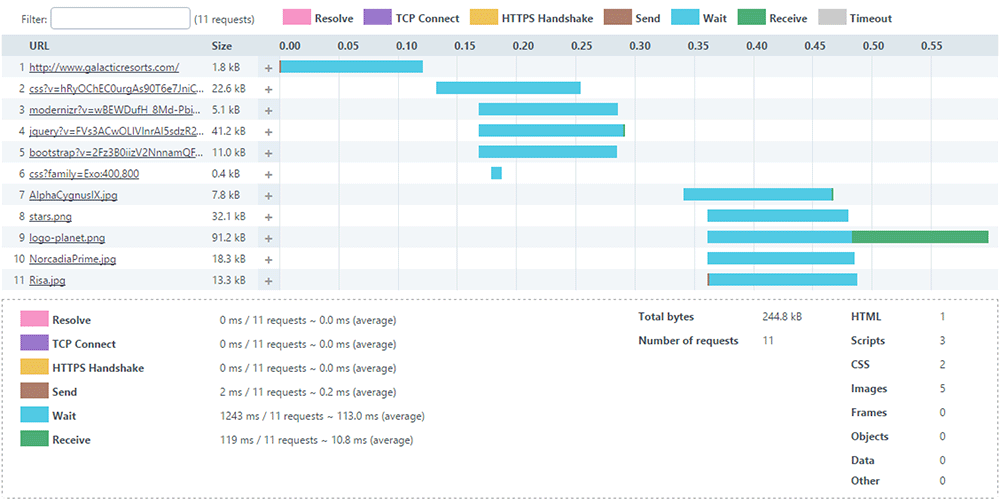
Measuring Performance Before and After Implementation

To evaluate the impact of lazy loading, follow these steps:

Before Implementation

Test your category page and record the following metrics:

  • Page size
  • Page load time
  • Core Web Vitals scores

After Implementation

Run the same tests again and compare the results. You should observe:

  • Reduced initial load time
  • Lower Total Blocking Time (TBT)
  • Improved Lighthouse performance score

The implementation options outlined in this guide, from native HTML attributes to lazysizes and the Intersection Observer API, offer solutions for every level of technical complexity. Whether you are maintaining a small boutique store or managing a high-traffic multi-category catalogue, there is an approach that fits your needs. Start with Method 1 for instant results, and build up to more advanced methods as your requirements grow.

Performance optimisation is not a one-time task as it is an ongoing commitment. Pair lazy loading with image compression, WebP conversion, and proper caching to unlock the full potential of your OpenCart store’s speed.

About Knowband

Knowband is a trusted eCommerce plugin and extension provider with years of experience helping online merchants build faster, smarter, and more feature-rich stores. Whether you run your store on PrestaShop, OpenCart, Shopify, WooCommerce, Magento, or any other major platform, Knowband offers a wide range of ready-to-use plugins and extensions that help you enhance functionality, improve performance, and deliver a better shopping experience, without needing to build from scratch.

Beyond plugins, Knowband also offers comprehensive website development and mobile app development services. Whether you need a fully custom eCommerce storefront built from the ground up, a tailored mobile shopping app for iOS and Android, or a bespoke integration with your existing systems, Knowband’s team of developers has the expertise to bring your vision to life.

If you are looking to optimize further your OpenCart store, or any other eCommerce platform, explore Knowband’s plugin marketplace or get in touch with our team to discuss a custom solution tailored to your business goals.

Contact us at support@knowband.com for custom plugin development, website development, and mobile app development services.

Why PrestaShop and OpenCart Merchants Are Choosing Knowband’s Google Shopping Integration

Getting consistent, purchase-ready traffic to your store is hard. You can spend weeks fine-tuning your social ads or pouring money into influencer campaigns, and still not see the returns you were hoping for. 

For stores built on PrestaShop or OpenCart, tapping into Google Shopping isn’t always easy. Introducing the PrestaShop Google Shopping Module and OpenCart Google Shopping Extension are built specifically to handle that connection, and from what merchants report, they do it well.

Not all website visitors are the same. Someone casually browsing is very different from someone who typed “buy waterproof hiking boots size 11” into Google. That second person is ready to buy, they just need to decide where.

Google Shopping puts your products in front of people like that. They’ve already made up their mind about what they want. Now they’re comparing prices and checking availability. That’s why Google Shopping tends to convert better than most other paid advertising options.

And because your product image, price, and store name show up before anyone even clicks, you’re only attracting people who are genuinely interested. For PrestaShop and OpenCart store owners who want to use their ad budget wisely, this kind of targeted traffic really helps.

🛍️ Also on PrestaShop?


Sync Smarter, Sell Faster: PrestaShop Google Shopping Integration Module by Knowband


Automatically sync your product catalog with Google Merchant Center, track performance with UTM parameters, and reach millions of high-intent shoppers.

Know the Google Shopping Module →

How Knowband’s eCommerce Google Shopping Module Helps E-Merchants

The Knowband PrestaShop Google Shopping Module and the Knowband OpenCart Google Shopping Plugin were both developed to solve the same core problem: listing your product catalogue into Google Merchant Centre cleanly, accurately, and without constant manual work. And that problem is bigger than it sounds.

Feed management, when done manually, is a genuine headache. As the Prices change, Stock runs out, New variants get added it gets very difficult to synchronise all the changes to Google merchant. If your feed doesn’t reflect those changes quickly, you end up with disapproved products from Google, confused shoppers clicking on listings that are out of stock, and in worse cases, policy violations that can affect your entire Merchant Centre account.

 Knowband’s Prestashop Google Shopping Integration Module solution handles all of that automatically, syncing price and inventory in real time, mapping categories correctly, and generating feeds that meet Google’s requirements without you having to manage it by hand.

Key Features of the Opencart Google Shopping Extension

  1. Google Merchant Centre Integration: This Google Shopping Integrations connect your store to Google Merchant Centre through a straightforward setup process. Since no technical knowledge or coding is required, your product data syncs reliably.
  2. Product Feed Generation: You can also generate a Google Shopping product feed in XML or CSV format. Furthermore, you can choose between real-time or scheduled updates, so your listings stay current while reducing manual work.
  3. Category & Attribute Mapping Store admins can also map your store categories to Google Product Categories and match product attributes like GTIN, MPN, brand, availability, and condition. As a result, your products get approved faster and listed more accurately.
  4. Multi-Country & Multi-Language Support You can set up separate feeds for different countries, languages, and currencies. Furthermore, this way, you can reach international audiences and run Google Shopping Ads across multiple markets with ease.

    Start Selling on Etsy from Your Prestashop Store

    Now selling on Etsy is easy with Knowband’s Prestashop Etsy Marketplace Module.


    Try the Demo

  5. Cron-Based Synchronisation Using this Knowband Prestashop Google Shopping Module, schedule automatic feed updates via cron jobs to keep pricing, stock levels, and product details consistently accurate. Furthermore, this helps avoid disapproval caused by outdated information.
  6. Product Filtering Store admins can also choose which products appear in your feed by filtering on category, price range, stock status, or specific product IDs. That way, only the right products get submitted to Google Shopping.

Final Thoughts

Google Shopping isn’t a magic solution, but it’s one of the more reliable growth channels available to eCommerce stores today, especially for merchants on PrestaShop and OpenCart who want to drive direct traffic without being tied to marketplace fees. The Knowband PrestaShop Google Shopping Module and Knowband OpenCart Google Shopping Plugin take care of the technical side of that equation: feed generation, real-time syncing, category mapping, and Merchant Centre compatibility.

From there, it’s about building on that foundation, optimising your product data, testing campaign structures, and paying attention to what the numbers are telling you. Done consistently, it’s the kind of channel that compounds. And for stores that are serious about growing on their own terms, that’s exactly what you want.


OpenCart LLMs TXT Generator Extension- Complete User Guide

The OpenCart LLMs TXT Generator Plugin is a powerful extension designed to generate an llms.txt file for your store. This file contains well-structured information about the store catalogue, including products, categories, and CMS pages, making it easier for AI platforms to understand and access your content.

Today, customers increasingly rely on AI-powered platforms such as ChatGPT, Gemini, DeepSeek, Perplexity, and Claude to search for products and get recommendations. As AI-driven searches continue to grow, having your products recommended by these platforms can significantly improve your store’s visibility and reach.

To address this, Knowband has developed the OpenCart LLMs TXT Generator Plugin, which enables AI platforms to discover, understand, and recommend your products more effectively.

The llms.txt file generated by the Knowband OpenCart LLMs TXT Generator allows AI crawlers and AI answer engines to access store content in an organised and structured format. By placing this file on your server, your store becomes compatible with modern AI search engines and AI product recommendation models such as ChatGPT, DeepSeek, Gemini, Perplexity, and Claude.

Using this AI product recommendation extension for OpenCart improves AI product discovery, supports accurate AI-generated answers, and ensures that your store content is correctly identified and referenced when users search for product- or store-related information on AI-driven platforms.

1.0.0 Key Features of OpenCart LLMs TXT Generator Extension

Support for Advanced AI Model Bots

This OpenCart extension supports access for multiple advanced AI crawler bots used by modern AI answer engines and generative AI search platforms, including:

  • DeepSeekBot
  • GPTBot
  • Anthropic AI
  • PerplexityBot
  • Google-Extended

Supporting these AI bots ensures compatibility with AI product discovery and ChatGPT product recommendations.

AI Crawler Access Control

The Knowband OpenCart LLMs TXT Generator Extension allows administrators to control which AI crawlers can access store content via the llms.txt file.

Customisation of llms.txt File

The OpenCart LLMs TXT Generator Add-on by Knowband allows store admins to add additional content to the llms.txt file.
Customisation options are available for:

  • Store descriptions
  • Product llms.txt entries
  • Category product llms.txt entries
  • CMS page llms.txt entries and more

Access Control for Content Pages

This feature allows admins to choose which content pages—such as product pages, category pages, and CMS pages—should be included in the llms.txt file.

This ensures AI engines generate accurate responses and access only the selected content.

Product Recommendation Compatibility

The OpenCart LLMs TXT Generator Add-on is built to support evolving AI search and AI product recommendation systems. By generating a structured llms.txt file with clear instructions, your store content remains aligned with next-generation AI answer engines like ChatGPT and other recommendation platforms.

Content Filtering

The Knowband OpenCart LLMs TXT File Generator allows store admins to filter and select specific products, categories, and CMS pages for inclusion in the llms.txt file.

This provides complete control over what data is made available for AI product discovery, AI crawler indexing, and generative AI search.

2.0.0 Installation Guide for Knowband Opencart LLMs TXT Generator Addon

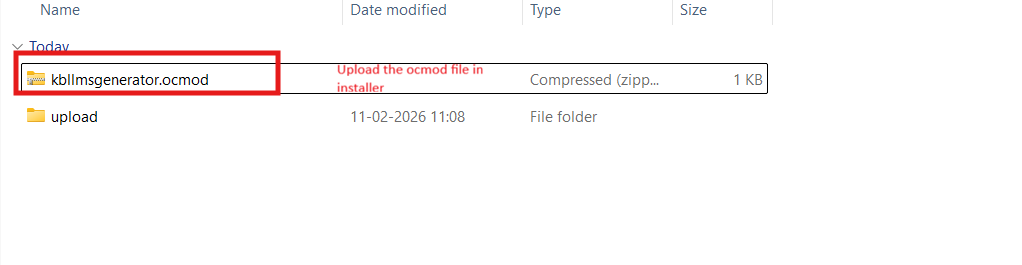
Step 1: Purchase and download the Knowband OpenCart LLMs TXT Generator Extension. After purchase, you will receive the file kbllmstxtgenerator.zip.

Step 2: Unzip the downloaded file. Inside, you will find the admin, catalog, and ocmod folders.

Step 3: Upload the admin and catalog folders to your OpenCart root directory via FTP or cPanel. Then upload the OCMOD file from the ocmod folder through Admin → Extensions → Installer, and refresh modifications.

Step 4: Go to Extensions → Extensions, install the extension, click Edit/Configure, and complete the setup.

3.0.0 Backend/Admin Panel of Opencart Product Recommendation by ChatGPT Extension

3.1 General Settings

  1. Enable/Disable Extension:
    This option in the llms.txt file generator for AI is used to enable or disable the functionality of the Opencart LLMs.txt Generator Extension.
  2. Store Name:
    Store admins enter their store name in this field. This Opencart LLMs.TXT Generator Extension also supports the languages that are added in the store.
  3. Store Description:
    This field is used to add the store description to the llms.txt file generated by the Extension. Furthermore, it helps to describe the store and its catalogue based on the provided content.
  4. Product Batch Size:
    This field in the Opencart LLMs txt File Generator Addon allows you to define how many products are processed per batch during cron execution. By default, 30 products are processed in one batch.
  5. Category Batch Size:
    This field of category batch size allows the cron to process a specified number of categories per batch.
  6. CMS Batch Size:
    This field allows the cron to process CMS pages per batch. By default, 5 CMS pages are processed in one batch during cron execution in the Extension.
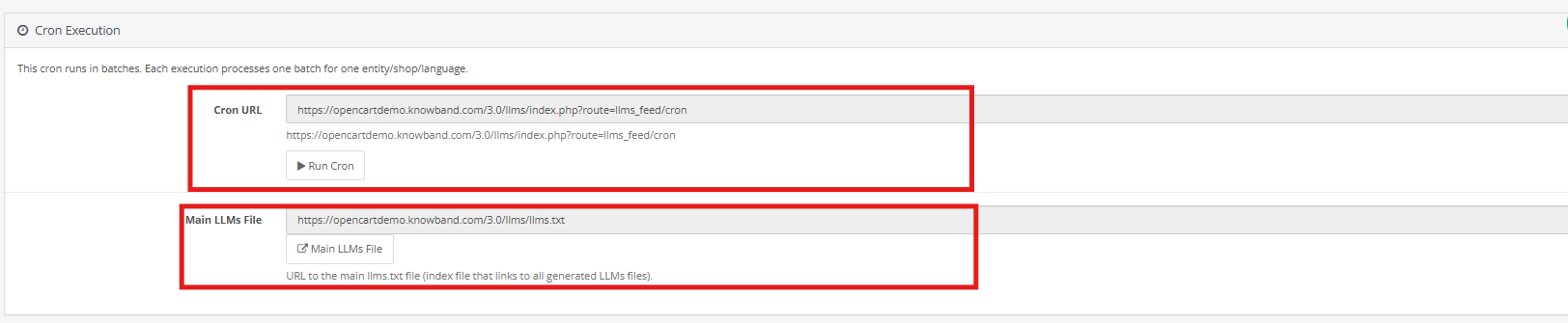
  7. Cron Execution (Batch Processing): This cron job in the Opencart LLMs TXT generator runs in batches. Each execution processes one batch only, for products, categories and CMS pages. After updating settings like general settings, content filtering and customisation of files, running the cron is necessary to reflect any changes.

3.2 Crawlers Setting

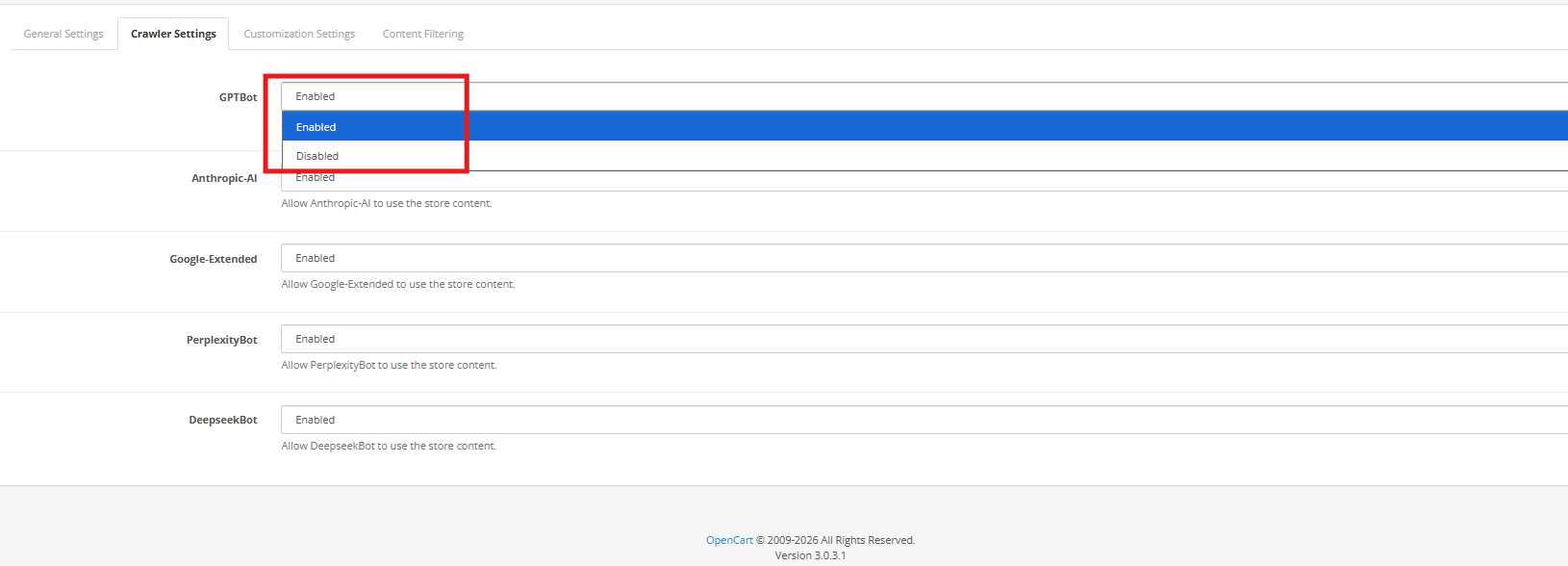
This crawler setting in Opencart LLMS TXT Generator allows the store owners to manage the AI model’s bots like GPTbot, Google Extended Gemini Bot, DeepSeek and many more

GPTBot: AI Crawler of OpenAI ChatGPT, collects the data to train the ChatGPT AI Models. You can allow or disallow this using the 

DeepseekBot: AI crawler bot of deepseek which gathers public web data of the store to train and refine DeepSeek’s large language models

Google-Extended: This Google’s AI-specific crawler (separate from Googlebot) allows the collection of content specifically for training Google’s AI models (like Gemini),

PerplexityBot: This web crawler of perplexity AI is used to fetch up-to-date web content to generate cited answers and summaries

Anthropic-AI: This web crawler of Anthropic is used to collect public web data to train and improve Claude AI models. You can enable or disallow all the AI Crawler bots. 

3.3 Content Filtering

The Content Filtering functionality enables store administrators to decide exactly which store data is included in the generated llms.txt file. This gives you full control over the information shared with AI crawlers and answer engines, ensuring that only meaningful and approved content is exposed while private or irrelevant data remains excluded.

1. Shop Context

The Shop Context setting is designed for OpenCart installations with multiple stores. It allows administrators to select a specific store and generate a dedicated llms.txt file for that shop. Each store can have its own configuration, ensuring accurate and store-specific content generation.

 

2. Product Details

The Product Details filter determines which products appear in the llms.txt file. Store owners may include all products or restrict the selection based on business needs. Options include adding only active products, featured items, or manually selected products, while excluding others from being shared.

3. Category Details

The Category Details filter helps manage category-level content. Administrators can choose which categories should be included, allowing inactive or unnecessary categories to be excluded. This keeps the file well-structured and focused on relevant store data.

4. CMS Pages

The CMS Pages filtering option allows you to control which CMS pages are included in the CMS llms.txt file. This is useful for preventing internal, draft, or temporary pages from being shared, while still making essential pages such as policies and informational content available to AI platforms.


3.4 Customization

The Customization features of the OpenCart LLMs.txt Generator allow store owners to add additional context to the generated llms.txt files. These options help enhance product, category, and CMS information with helpful notes, improving how AI crawlers interpret your store content.


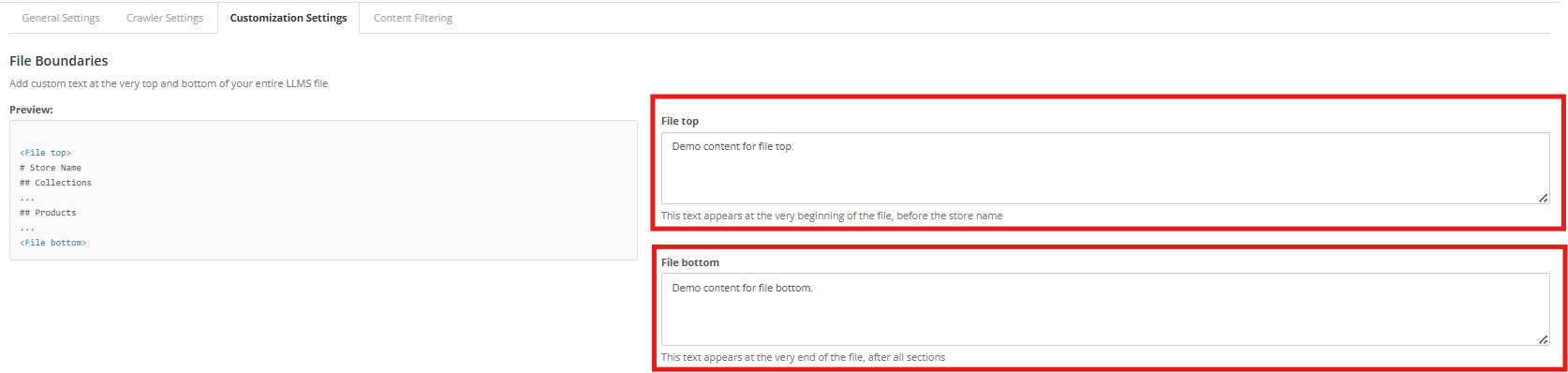
1. File Boundaries Customisation

The File Boundaries option allows you to insert custom text at the beginning and end of the llms.txt file. This can be used to add general instructions, notes, or explanations without altering the core store data, helping crawlers understand the file structure more clearly.

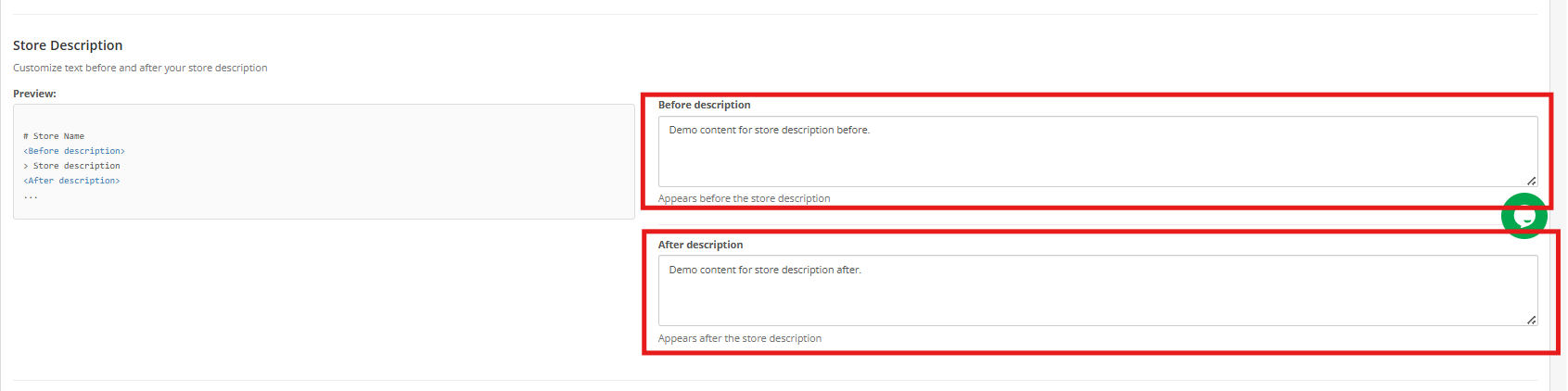
2. Store Description

The Store Description customisation lets you add content before and after the store description section in the llms.txt file. This helps define your store’s purpose, key offerings, or any special instructions, making it easier for AI-driven platforms to generate accurate responses related to your business.

3. Category Section Customisation

With Category Section Customisation, store owners can add explanatory text before and after the categories section. This is useful for clarifying category organization, naming patterns, or relationships, allowing crawlers to interpret category data more accurately.

4. Product Section Customisation

The Product Section Customisation feature allows you to include additional notes before and after the product details section. These notes can provide general product-related guidelines or context without modifying the actual product information, improving AI understanding and recommendations.


5. CMS Pages Section Customisation

The CMS Pages Section Customisation option enables administrators to add contextual notes around the CMS pages section. Since CMS pages often contain key information such as policies, FAQs, and shipping details, this added context helps AI systems better interpret non-product content.


Pro Tip:
Maintain strong SEO practices across your product, category, and CMS pages to improve visibility on AI-powered search platforms. As AI technology advances, your store should evolve with it—use this extension to ensure AI models can accurately understand and recommend your business.


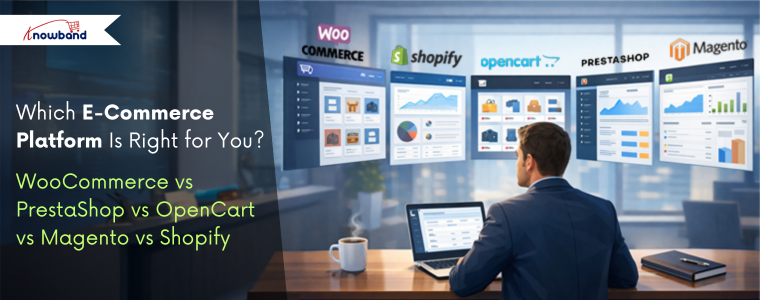
WooCommerce vs PrestaShop vs OpenCart vs Magento vs Shopify

Choosing the right platform is one of the most important decisions when you are starting an online store. With so many options available, it can become tiring to decide which platform best fits your business needs.  If you are looking best platform to start an online store, then you are at right place. Each platform offers different benefits and flaws in terms of usability, scalability, cost, and features. We at Knowband already manage these stores as we provide the service for these platforms. This will help you in choosing the right platform for your store.

This article provides a practical comparison of five popular e-commerce platforms, WooCommerce, PrestaShop, OpenCart, Magento, and Shopify, based on key factors such as ease of use, performance, customisation, scalability, and overall cost. You will also learn the e-commerce platform pros and cons. 

Additionally, understanding these helps your business select open source ecommerce platforms that aligns with your business goals.

Key Factors to Consider When Choosing an E-Commerce Platform

Before comparing platforms, as a store owner, you need to understand the core factors that will play a crucial role.:

  • Ease of Use: If you are technical or non-technical, you first need it to be simple to set up and manage products, your entire catalogue and orders.
  • Customisation & Flexibility: Platform should have the ability to modify design and functionality according to your business needs.
  • Performance & Speed: Additionally, there is a major factor that is how well the platform handles traffic and large catalogues
  • Scalability: Also, scalability is the factor your platform can grow with the business
  • Cost: Cost is one of the most important factors as it should be affordable not too expensive.

WooCommerce: Ideal for WordPress-Based Stores

WooCommerce is one of the most used e-commerce platforms and works as a plugin for WordPress. Furthermore, its popularity makes it unique due to its simplicity and flexibility, especially for businesses already familiar with WordPress.

Key Feature  of the WooCommerce

  • Easy to use, especially for WordPress users
  • Massive plugins 
  • Strong SEO capabilities
  • Highly recommended for content-driven stores and blogs

Limitations of WooCommerce

  • Performance can be reduced with large catalogues without optimization
  • Requires paid plugins for advanced features like wishlist 
  • Heavily dependent on hosting quality

Knowband recommends it as the best e-commerce platform for small businesses, medium-sized businesses, bloggers, and entrepreneurs looking for an easy way into online selling.

PrestaShop: Feature-Rich and International-Friendly

PrestaShop is an open-source platform designed specifically for e-commerce. This is the best e-commerce platform for startups. Moreover, it is particularly popular in Europe and offers strong built-in functionality. Furthermore, unlike wordpress it offers the basic functionalities, wishlist, abandoned cart, designs and many more.

Key Highlights of Prestashop

  • Support for multiple currencies and languages
  • Support many advanced taxes and shipping options
  • Strong back-office dashboard
  • Handles large catalogues efficiently

Limitations of the Prestashop

  • Requires moderate technical knowledge
  • Paid modules can increase costs
  • Smaller extension marketplace than WooCommerce

We recommend it to international sellers and businesses that need advanced e-commerce features without heavy reliance on plugins.

Prestashop Plugins

Explore all the plugins that will make your prestashop store more professional


Install Now

OpenCart: Lightweight and Performance-Focused

OpenCart is known for its simplicity and speed.  Additionally, it provides essential e-commerce features without unnecessary complexity. This OpenCart platform also supports built-in tools for coupons, discounts, and special prices like prestashop

Strengths of the Opencart

  • Lightweight and fast
  • Simple admin interface
  • Built-in multi-store functionality
  • Low hosting requirements

Drawback of the Opencart Platform

  • Smaller extension ecosystem
  • Limited advanced features
  • Smaller community compared to competitors

Knowband recommends it to small businesses with straightforward needs and limited budgets that prioritize performance.

Opencart Extension

Give the advanced features to your Opencart store Using Popular Extensions


Install Now

Magento: Enterprise-Level Power

Magento is what the big players use when they need a serious, robust, enterprise-grade solution. Here, Big player refers to the major enterprises and retailers that have a large volume of products through their stores. This Magento Platform is best ecommerce platform for large businesses.

Key Highlights of Magento:

  • Magento scales to handle millions of products and transactions
  • Inventory and customer management tools 
  • Customisation is easy in Magento
  • Built to handle large product catalogues 

The Downsides of Magento are:

  • Learning Magento is a bit difficult for store owners
  • Professional developers are required
  • Hosting and keeping it running will cost you high money

Magento Plugins

Let Knowband Manage Your Magento Plugins, while you only work on selling.


Contact Us Now

Shopify: Everything is handled by them

Shopify takes a totally different approach than other platforms. They handles everything for you unlike others. It’s fully hosted, which means they deal with the technical things while you focus on selling

Key Features of the Shopify

  • You can easily have a store there
  • Shopify handles the hosting, security, and performance. The store owner only focuses on selling.
  • Customer support is highly active
  • A variety of plugins on the app store when you need extra features
  • Perfect for dropshipping or selling across multiple channels (social media, in-person, etc.)

The Downsides:

  • Monthly fees that add up over time
  • Transaction fees on certain plans (unless you use Shopify Payments)
  • Less control over the backend compared to platforms you host yourself

Shopify Custom Development

Let Knowband handle your Shopify store seamlessly, so you can concentrate on scaling your store and brand.
Contact Us Now

Pricing Plans of all the Platforms: WooCommerce, Prestashop, Opencart, Magento and Shopify

Platform Initial Cost Hosting Cost Theme & Extension Cost Development & Maintenance Overall Cost Suitability
WooCommerce Free (WordPress plugin) $5–$30/month (shared to managed hosting) Free to $200+ (plugins & themes) Low to medium, increases with customization Best for small to medium businesses
PrestaShop Free (open-source) $10–$40/month $50–$500 (modules & themes) Medium, often requires developer support Suitable for growing businesses
OpenCart Free (open-source) $5–$25/month $20–$300 (extensions & themes) Low to medium, limited for complex needs Ideal for small businesses
Magento Open Source Free (software only) $50–$200+/month (cloud or dedicated hosting) $100–$1,000+ (extensions & themes) High due to complexity Best for large or fast-growing stores
Magento Commerce (Adobe) Paid license Included or enterprise-level hosting Often custom-built Very high (enterprise development) Enterprise-level businesses
Shopify Monthly subscription Included $0–$350 (themes) + paid apps Low, fully managed platform Best for beginners & fast launches


The conclusion is that there’s no magic “best platform” that works for everyone. It really comes down to what you need for your specific situation.

WooCommerce is fine when you want flexibility, and you’re already comfortable with WordPress. PrestaShop has built-in features that international sellers actually need. OpenCart keeps things simple and fast. Magento gives enterprise-level businesses the scalability they require. And Shopify just makes everything easy if you want a managed solution.

Your decision should come down factors about cost, your technical skill and your business size. Moreover, you can also switch platforms eventually as your business evolves. 

About Knowband

Knowband is a sub-company of Velocity Software Solutions Pvt. Ltd., a leading technology company specialising in e-commerce development and digital solutions. Knowband provides a wide range of ready-to-use plugins, extensions, and custom development services for popular eCommerce platforms like prestashop, WooCommerce, Opencart, Shopify and Magento.

With a strong focus on innovation and performance, Knowband helps online businesses enhance functionality, improve user experience, and increase conversions.

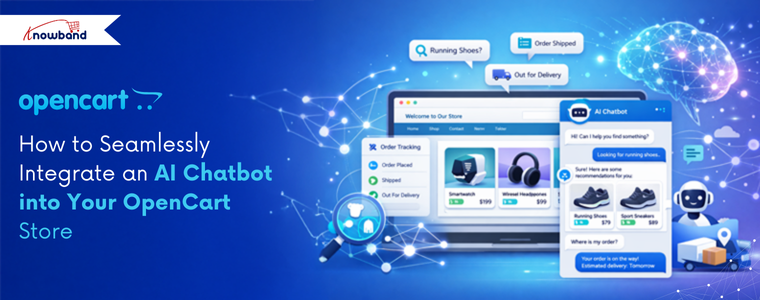
How to Seamlessly Integrate an AI Chatbot into Your OpenCart Store with Knowband

Introducing the perfect AI chatbot for your OpenCart store. Nowadays, you have observed that many stores have AI chatbots that answer customer queries and recommend products. Like that, Knowband has released its OpenCart AI chatbot after developing the PrestaShop AI chatbot.

Important Update for PrestaShop and OpenCart AI Chatbot Users

Knowband is excited to announce the release of the latest versions of its OpenCart AI Chatbot Extension and PrestaShop Live AI Chatbot Addon, which are now live and available on the OpenCart Marketplace and Prestashop Addon Marketplaces. This major update in both the AI Chatbot Module brings a wide range of enhancements designed to improve chatbot management by store owners, customisation of the UI of the chatbot interface, security, and implementation of new AI Models like DeepSeek, Gemini and many more with their engines and overall customer interaction.

The updated Live AI Chatbot for OpenCart now includes a detailed Chat Logs feature for store owners, allowing them to analyse conversations and customer queries, and gain valuable patterns to help in product recommendations and many more. Furthermore, this AI Chatbot for Prestashop also includes features such as chatbot availability Scheduling and many more.

Try the demo today: https://opencartdemo.knowband.com/3.0/aichatbot/admin/

This chatbot enables users to integrate the AI Live Chatbot on the frontend on all pages. This AI chatbot comes with built-in API features and is integrated with the Qdrant database. This perfect chatbot not only works with exact product names, but it also understands the customer’s words and their meaning. Based on that, it recommends products that help in conversion.

So let’s explore the highlighted key features and key benefits of the OpenCart AI Chatbot Module.

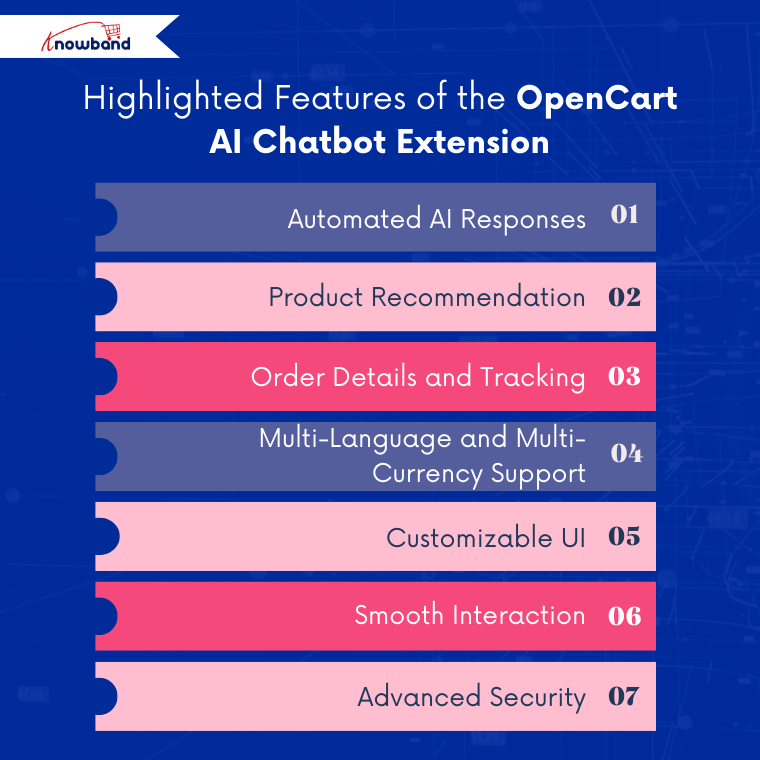
Highlighted Features of the Knowband OpenCart AI Chatbot Extension

1. Automated AI Responses

This professional AI chatbot responds to customers based on their queries. Furthermore, it delivers product information, order information, and tracking based on the real data of the store. The chatbot instantly answers customer queries, from product availability and pricing to order status. This real-time AI Assistant is designed using OpenAI ChatGPT. Moreover, this AI chatbot supports multiple ChatGPT models such as GPT-5, GPT-4 Turbo, Mini, and GPT-3.5.

2. Product Recommendation

Integration with vector search is the main key feature of this OpenCart AI chatbot. This allows the AI chatbot to recommend products based on the keywords and meaning of the customer’s query.

3. Order Details and Tracking

The AI chatbot helps customers check order information, shipping information, order status, and more. Customers get the information when they add sentences like “What’s my order status?” or “When will I receive the order?”

4. Multi-Language and Multi-Currency Support

The AI chatbot works perfectly with stores that have multiple languages. This AI chatbot can automatically detect the store’s language and currency and answer in that language, providing responses for international customers.

5. Customizable UI

This AI chatbot allows admins to customise the overall UI according to their brand’s theme. You can change the chat window colour, button colour, and text blocks of both the chatbot and customers.

6. Smooth Interaction

This Knowband AI chatbot smoothly interacts with all customer queries. Even if customers ask queries that are not related to the store, the chatbot answers that it cannot respond to them.

7. Advanced Security

This AI chatbot is integrated with guardrails to ensure that the chatbot does not respond to queries that can be a threat to your store.

Prestashop AI Chatbot Addon

Create and launch a perfect AI Chatbot for your Prestashop store.


Try the Demo

Why You Should Use an AI Chatbot for Your Opencart Store

Professionalism: An AI chatbot integrated into your OpenCart store enhances your brand’s professionalism and credibility. Furthermore, this AI Chatbot helps customers easily search for products, find information, and navigate the store smoothly, creating a more polished and trustworthy shopping experience.

24/7 Instant Customer Support: This best AI chatbot extension acts as 24-7 customer support for your opencart store, as it helps in reducing the cost of labour.

Faster Response Times & Reduced Waits: The customer does not have to wait for too long for replies; this AI chatbot replies in seconds, accurately to all the queries of customers.

Higher Conversion Rates: This AI chatbot recommends the product based on the meaning of the words that the visitor used when he or she comes to the store. This, in turns helps in conversion rates

Personalised Shopping Experience: The AI chatbot helps the customers with order tracking, delivery status, updates, and post-purchase queries. This improves transparency, builds customer trust, and ensures a smooth experience.

Conclusion

In conclusion, this OpenCart AI Chatbot Extension is much more than a simple chatbot. With features such as seamless integration with the store’s data and smart automation, it becomes a must-have solution for improving customer engagement and support.

Moreover, it also works as a live chat system for your OpenCart store, remaining available 24/7 to assist customers throughout their shopping journey.

Knowband is continuously working on enhancements and plans to introduce new features such as chatbot availability, scheduling and chat log options. Store owners can also customise this module according to their business requirements. Our team of experts is always available to help with customisation and ongoing support.

Support: support@knowband.com

Checkout our PR on AI chatbots for e-commerce stores

https://www.prlog.org/13121743-knowband-launches-ai-chatbot-for-prestashop-and-opencart-stores.html

Opencart AI Chatbot Extension – Complete User Guide

1.0.0 Introduction

Introducing the OpenCart AI Chatbot Module by Knowband, which is designed to meet these expectations by providing a smart, professional, AI virtual chatbot for your opencart store.

By using advanced OpenAI technology, this ai chatbot gives natural, human-like responses in real time. Furthermore, it helps customers search for products, check prices and stock, understand store policies, and track orders, without human intervention.

With easy setup and powerful features, this AI assistant by Knowband improves customer satisfaction, reduces support workload, and boosts conversions. 

2.0.0 Key Features of OpenCart AI Chatbot Using ChatGPT

1. Real-Time Intelligent Responses Firstly, the AI Chatbot instantly answers customer queries related to product prices, stock availability, categories, and comparisons by fetching live store data.

2. Multi-Language & Multi-Currency Support The chatbot automatically detects the store’s languages and currencies and responds accordingly, making it perfect for international Opencart stores.

3. Powered by ChatGPT Technology Using the latest OpenAI GPT models, the opencart chat extension provides accurate, context-aware, and like-human responses.  Moreover, admins can choose different AI models like GPT 5, GPT 4o & GPT 4o mini based on performance needs.

4. Vector Search Integration Vector search integration with Qdrant allows the chat plugin for opencart to perform semantic searches based on keywords and their meaning. Moreover, this enables intelligent product recommendations, providing customers with results that match the true intent of their queries.

5. Smart Product Search Furthermore, customers can search products, browse categories, and compare items directly within the chatbot interface.

6. Automatic Order Information Retrieval Logged-in customers can retrieve order details such as order ID, products, prices, and order status directly using opencart live chatbot Extension.

7. Real-Time Order Status & Tracking Customers can easily track their orders and shipment status by entering their order ID in the live chatbot plugin for opencart.

8. Fully Customizable Chat Interface Interestingly, store owners can customise chatbot colours, chat window design, icons, buttons, and text styles to match their brand theme using Opencart Live chat Plugin.

3.0.0 Installation Guide for OpenCart AI Chatbot Extension

Step 1: After purchasing the extension, download the ZIP file from your Knowband account. Step2: Unzip the folder and copy the files to the upload folder and move the admin and catalog files.

  Step 3: Log in to the OpenCart Admin Panel and navigate to Extensions → Installer. Upload the downloaded ocmod file.

Step 4: Go to Extensions –> Modifications and click “Refresh”. Then navigate to Extensions -> Extensions -> Modules and install the opencart online chatbot Extension.

Step 5: Click on Edit to access the configuration page.

4. 0.0 Admin Interface Overview

The OpenCart Chatbot Using OpenAI is designed to be simple and user-friendly. The admin panel includes sections for General Settings, AI Configuration, and UI Customisation.

4.1.0 General Configuration of Opencart AI Chatbot Extension

Enable Chatbot: Store owners can enable or disable the module as per their need.

OpenAI API Key Enter your OpenAI API key to create a connection between the chatbot and OpenAI. This key is mandatory for the functioning of the Opencart AI Chatbot.

For security reasons, the API key should be kept confidential and must not be shared with anyone.

AI Model Selection Choose the AI model that will be used to generate opencart AI chatbot ChatGPT extension responses based on your store’s requirements:

  • GPT-4o: Suitable for handling complex queries, providing accurate responses, and maintaining better context during longer conversations.
  • GPT-4o Mini : Designed for faster response times and reduced API usage, ideal for basic customer interactions.
  • GPT-5: Offers enhanced processing capabilities and improved response quality for advanced use cases.

Temperature This setting controls the randomness of opencart chatbot software responses. Moreover, lower values generate more predictable and factual replies, while higher values allow more variation in responses. It is recommended to use a moderate value for customer support scenarios.

Max Results You can define the maximum number of product results displayed when customers asks product related queries. This feature on opencart live chatbot extension turns limiting results, helps maintain clarity and prevents overloading the chat interface.

Conversation History In this feature, Opencart modern chat assistant remembers the last conversation history and answers according to that.

Debug Mode: Enable this option to generate system logs that assist in diagnosing issues related to chatbot behavior, API connectivity, or data retrieval.

Enable Vector Search You can activate semantic search functionality, enabling the Opencart AI Chatbot Using OpenAI to better understand user intent and return more relevant responses beyond keyword-based matching. Qdrant URL Enter the endpoint URL of the Qdrant vector database server used to store and retrieve vector data for semantic search operations. We have covered the steps in section 7.0.0.

Qdrant API Key Provide the API key required to authenticate access to the Qdrant server. Furthermore, this ensures secure communication between the chatbot and the vector database.

4.2.0 Chatbot UI Customisation of  Knowband Opencart AI Chatbot Plugin

The module allows complete customisation of the chatbot interface, helping store owners match the chatbot’s appearance with their store’s branding and design. Chatbot Logo Upload First, this option allows you to upload a custom logo for the OpenCart ChatGPT AI Chatbot. The logo represents your brand inside the chat window and helps maintain visual consistency across your store. Supported file formats include JPG, PNG, GIF, and WEBP.

Chat Background Color Next, using this setting, you can define the background color of the chat area where conversations appear. This helps improve readability and ensures the chat interface aligns with your store’s overall design.

System Message Color Additionally, this option enables you to customize the background color of messages sent by the OpenCart Live AI ChatBot Extension. A distinct system message color helps customers easily differentiate between chatbot responses and their own messages.

User Message Color In addition, this setting in the OpenCart AI Chatbot Software Plugin allows you to change the background color of customer messages in the chat window. As a result, conversations become clearer and easier to follow.

Chat Popup Background Color Moreover, this option lets you customize the background color of the entire chat popup window. This ensures that the AI Chatbot for OpenCart blends smoothly with your store’s theme and layout.

Chat Button Color Furthermore, this setting controls the color of the OpenCart AI Chatbot Extension launch button and action buttons. A visually appealing and contrasting button color can improve visibility and encourage customers to start a conversation.

Chat Text Color Likewise, this option allows you to set the text color for both chatbot responses and user messages. Choosing a clear and readable text color enhances accessibility and user comfort.

In summary, these customisation options ensure that the Best AI Assistant for OpenCart integrates seamlessly with your store design while delivering a modern, visually appealing, and user-friendly chatbot experience.

Language Selection (English, French) This setting allows you to select the language in which the chatbot interface will be displayed. The chatbot can be configured separately for each available language, such as English and French, ensuring localized communication for different customer groups.   Chatbot Title Enter the title that will be displayed at the top of the OpenCart ChatGPT-powered Chatbot popup window. This title helps users identify the chatbot’s purpose, such as AI Product Assistant, and can be customized for each language.

Welcome Message Lastly, set the initial message shown to customers when the OpenCart Chatbot Using OpenAI (ChatGPT) LLM opens. This message is used to greet users and guide them on how to interact with the chatbot, such as asking about products, orders, or store policies.

5.0.0 Frontend View of Opencart AI Chatbot Extension

On the frontend, the chatbot appears as an interactive chat widget that assists customers in real time.

Frontend Capabilities of Opencart AI Chatbot Plugin Includes:

Product Search and Browsing Customers can search for products and browse categories directly through the chatbot. Additionally, this AI chatbot conversation retrieves relevant products based on customer input and displays matching results in real time, making product discovery faster and easier.

Keyword- and Meaning-Based Queries The ChatGPT AI chatbot supports both keyword-based and semantic (meaning-based) queries. Furthermore, with Qdrant integration enabled, the chatbot understands the intent behind customer questions and returns more accurate and relevant results, even when exact keywords are not used.

Product Details In addition, customers can request detailed product information such as price, stock availability, and product descriptions without navigating away from the current page, using AI chatbot assistance.

Order Details and Order History For logged-in users, the chatbot provides access to complete order information, including previous orders, purchased products, prices, and current order status, directly within the AI chatbot interface.

Shipment Tracking and Order Status Moreover, the ChatGPT chatbot allows customers to check shipment details and track the current status of their orders by simply providing the required order information.

General Store Queries Lastly, the Live AI ChatBot responds to common store-related questions such as store policies, delivery information, payment methods, and other general inquiries, ensuring continuous customer support.

6.0.0 How to Generate OpenAI API Key

To enable the functioning of the AI Chatbot Software by Knowband, you need an OpenAI API key. Follow these steps: Step 1: Log in to your OpenAI account Use your registered email and password to access the OpenAI platform.   Step 2: Navigate to Profile → View API Keys This section lists all your existing API keys. Step 3: Click “Create New Secret Key” Generate a new API key specifically for your chatbot integration. Step 4: Copy the API Key and store it securely The key provides access to your OpenAI account, so it should not be shared publicly.

Step 5: Paste the key into the module Now, in your OpenCart admin panel, open the AI chatbot module settings and enter the key in the API Key field under General Configuration → OpenAI API Key.

7.0.0 How to Generate Qdrant API Key and Endpoint URL for Opencart AI Chatbot

If you are using vector search with Qdrant for semantic queries in Knowband’s Opencart Best AI Assistant, follow these steps:

Step 1: Sign in to your Qdrant account Access your Qdrant cloud or self-hosted instance.

Step 2: Create a new API Key Navigate to the clusters, create a cluster, and generate keys for your chatbot integration.

Step 3: Copy the API Key and Endpoint URL The Endpoint URL points to your Qdrant server, and the API Key authorises access to the vector database. Step 4: Enter the details in the module In your OpenCart admin panel, go to General Configuration → Qdrant URL and paste the endpoint URL. Then enter the API Key in the Qdrant API Key field. Note: Moreover, using Qdrant vector search allows the chatbot to perform semantic searches, providing context-aware and accurate product recommendations based on customer queries.

9. 0.0 Summary

The OpenCart AI Chatbot Extension by OpenAI ChatGPT enhances customer support by offering instant, intelligent, and personalised assistance. Furthermore, it automates repetitive tasks, improves engagement, and helps store owners deliver faster and smarter customer experiences 24/7. Hence, this AI chatbot helps OpenCart merchants stay competitive while providing a modern, reliable, and efficient shopping experience.

Admin Demo Link: https://opencartdemo.knowband.com/3.0/aichatbot/admin

Frontend Demo Link: https://opencartdemo.knowband.com/3.0/aichatbot/

10.0.0 Tutorials

This section contains step-by-step tutorials to help you install, configure, and use the module features effectively.