OpenCart Wish List Module that drives sales and engagement

Not every time you purchase products by directly adding them to the cart and checking out immediately. You often save some products for final review and add them to your wish list. The term ‘wish list’ sounds fascinating. In eCommerce, users can add all the products they are liking and willing to buy sooner or later to their wish list. Users won’t have to add to their cart until they’re ready to check out.

There is a high cart abandonment rate for most e-commerce brands, but few know how to reduce it. Abandoned cart reminder email strategies were addressed in a previous blog post that surely works. In this article, you will learn how a wish list can improve conversions in your OpenCart store. You can also find out about the most popular products and categories of the store that you can use in making marketing strategies and inventory management.

What is a wish list?

The wish-list feature enables e-commerce clients to build a list of goods that they are not yet ready to purchase, but that they plan to buy for themselves or receive as a gift in the future. Wish lists provide shoppers with a convenient way to arrange the items they want, making it unnecessary for quick reminders to use the shopping cart.

Not only do well-built wish lists lower the rate of cart abandonment (because of shoppers), they help boost the site’s customer experience by making it easier for customers to purchase from you and inspiring others to do the same.

Why do you need a wish-list or save for later option in your eCommerce store?

Besides the obvious advantage of enhancing the shopping experience of the consumer, Wishlist has the potential to provide online retailers with a much broader, strategic value. A Wishlist provides an incentive for clients to save products “for later” if at that moment they do not commit to a purchase and find them easily once they return to your shop.

  1. You will give your prospects a chance to save the items they will later show interest in.
  2. They help you keep track of what your customers want.
  3. They help you predict stock levels properly and manage inventory.
  4. You can use the wishlist data to have targeted marketing
  5. Easily assess the efficacy of your overall marketing activities by monitoring which goods end up on the wishlists of your customers.

Every Thing about OpenCart Wish List Module
1.     Attractive front-end representation

The wish list display should be attractive and clean. The look and feel of the front-end of the OpenCart Advance Wish List Module are neat and clean. It has a direct call to action button for adding products to the cart. You can edit want the button color, font, and other details according to the theme.

2.     Allows customer to maintain a private wish list:

The OpenCart Wish List Module acts as a handy way to remember the items that made it to the list, which is particularly important for major future events, such as weddings, new babies, housewarmings, etc. when assembling gift lists or drawing shopping lists. Mobile shoppers find this feature especially appealing because on a smaller screen it saves a lot of “browsing” time.

3.     Top Wish-listed Product and Categories

From this point of view, you might be tempted to suggest that you do not need a wishlist because you already know which of your best-selling items are. The advanced OpenCart wishlist addon helps the store vendor to evaluate the product that is most requested or most common. The category/product review reports can be presented by the OpenCart store admin in the form of a graph.

4.     Wish list module does Customer Analysis

The favorite product list addon of OpenCart helps the eCommerce merchant to evaluate the customer lists with the shortlisted product quantities and other details.

5.     Order Analysis Report

An Order listing tab is offered by the OpenCart wishlist extension. It allows the store manager to analyze the ordered products that were on the wishlist of the customers.

Benefits of OpenCart Wish List Module:

To see what items consumers save for later and what items they buy, you will analyze the data, which will help you find the underlying problems that hamper your sales: do customers need more data? Are they abandoning carts due to product price? Will discounts and deals work for them?

Conclusion: It improves the overall customer experience and for the merchant, it provides them with the data like the products that are most popular and frequently added to the cart. Some products are most added but least purchased. In that case, you can see where it is going wrong? Here the product analysis report will help.

Recommended Reads:

Best Practices for Back-In-Stock Alert Emails

Online shoppers get disappointed when the product they are looking to purchase is out-of-stock. This is majorly seen during the launch of a smartphone when it gets out of stock even before the user has added it to his cart.

Then they just wait, wait, and wait unless there is another option. And there is a sense of excitement when that product is back in stock.

I can relate to this very well. I wanted to purchase a smartphone. When I looked for my desired smartphone on Amazon, it was unavailable, went out of stock from the smartphone brand’s website as well and wasn’t available anywhere else. So, I subscribed to get notified about it as soon as it returns to the store.

A few days later, I got the notification that the product is available to buy. Without wasting any further time, I quickly opened the email, clicked on the buy now option and purchased the phone.

This is where the role of back-in-stock alert emails becomes crucial. A single back in stock email can bring you huge revenue. A case study done by Marketing Sherpa revealed that back-in-stock alert emails have around a 22.45% conversion rate.

If you do not take the onus of informing your visitors when the product becomes available again, they will likely search a competitive product on other online shopping websites.

What is Back-in-stock Email?

A back-in-stock email is an email that is sent to those users who have subscribed to receive updates regarding an out-of-stock product. When the product is back-in-stock, the shoppers are informed via email about its availability so that they can purchase it as soon as possible or before it goes out of stock again.

Many of the users can miss out on the purchase if they aren’t notified and this eventually leads to some lost revenue.

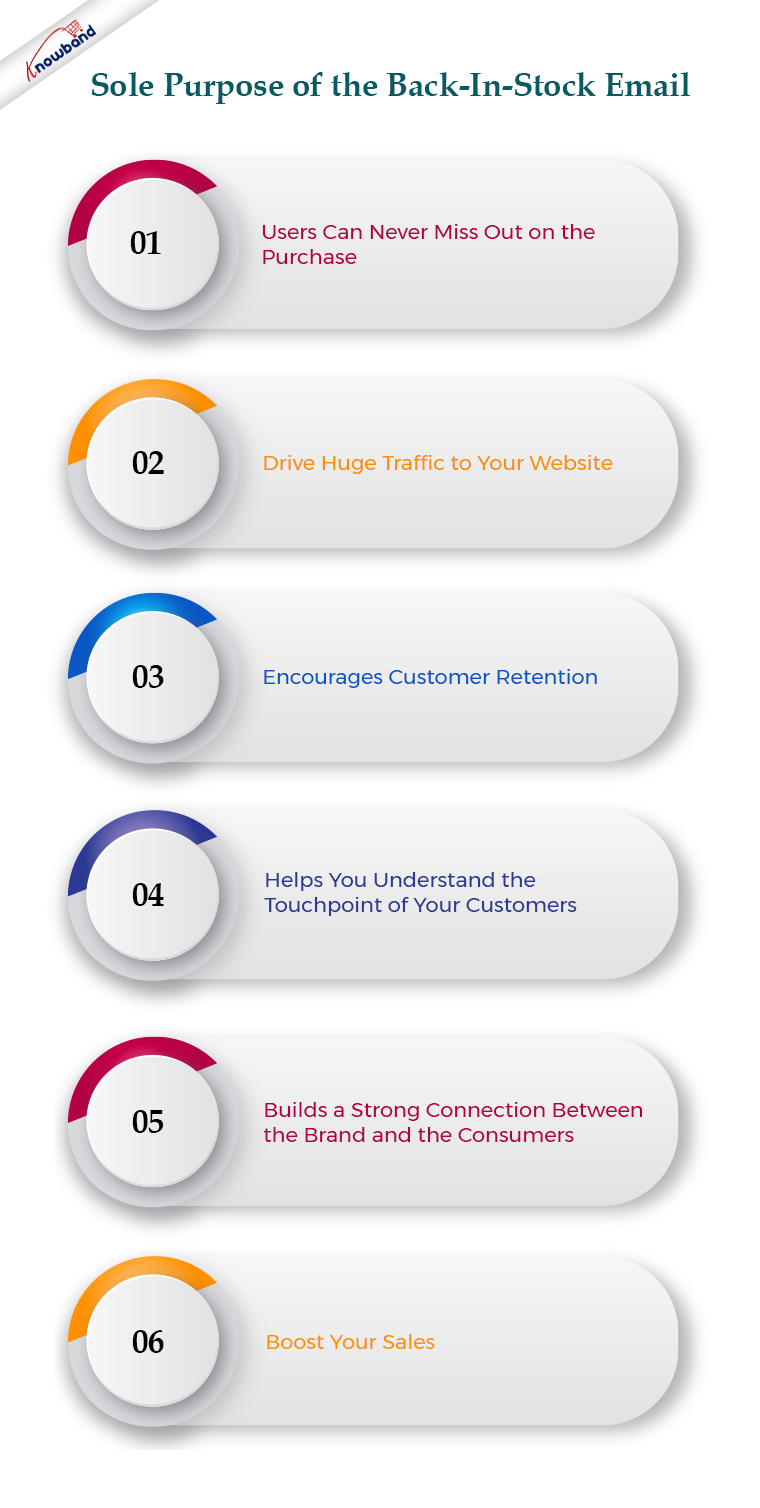
The sole purpose of the back-in-stock email is to boost your sales. Besides, it helps you drive huge traffic to your website, encourages customer retention, helps you understand the touchpoint of your customers, and builds a strong connection between the brand and the consumers.

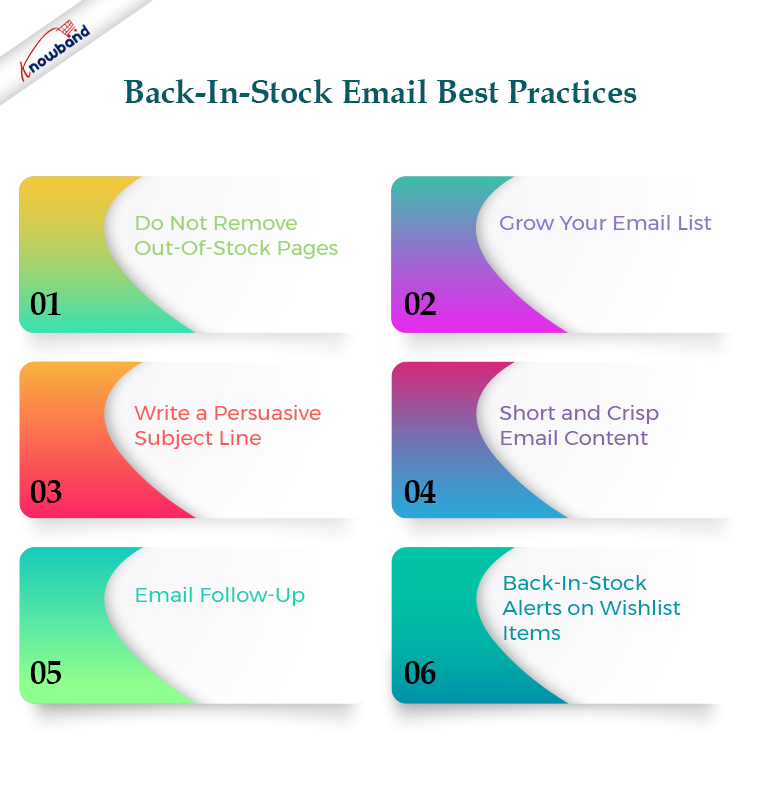
Back-In-Stock Email Best Practices

We will start from scratch. For a back-in-stock alert email, keep the following points in mind.

1. Do Not Remove Out-Of-Stock Pages

It is never a wise idea to hide the out-of-stock product pages from your website. How will consumers even know that the product is just out-of-stock? If they browse your website, search for and product, and find a 404 page, they will simply think that the product was never available in your store. Moreover, it will leave a negative user experience.

The concept of back-in-stock email would not even work if out-of-stock product pages are not visible.

So, simply include an out-of-stock tag on the product and place a “notify me” call to action, clicking on which users will be asked to specify the email address on which they want to get notified about the product availability once it is back in stock.

You can also take the help of Exit Popup, so when a user tries to exit your website after seeing that the product is out of stock, the popup appears asking them to get an alert over their email address once the product is back in stock.

2. Grow Your Email List

Many of your users might not have subscribed to your newsletters or promotional emails. So when someone clicks on the “notify me” option, having a newsletter checkbox along with the email address field can help you grow your email list further.

This will not only be beneficial to sending back-in-stock alerts but you can target those users in other email campaigns as well.

3. Write a Persuasive Subject Line

Users will be excited to know that the product they desired to purchase is back in stock. Increase the excitement by writing a compelling subject line.

Since the subject line has to be in limited words to make it visible, it must start with “Back in Stock,” followed by the product name. This will immediately make it clear to the visitor what the email is about.

After that, you can use the call to action like “Grab it ASAP”, “Limited Stock Available”, and “Hurry, selling fast”. These sorts of tags are highly effective in creating urgency.

4. Short and Crisp Email Content

Shoppers would want to grab the product as soon as it is available. Do not let them waste their time in reading the email content. Keep only the necessary information in the body.

What should you include in the email content?

Use the product image for sure. Visuals tend to make the purchase decision even stronger. Apart from this, write a short and persuasive text. Use large and bold font to highlight the main point. Use an alluring CTA like “Shop Now” or “Buy Now”. Also, it should be clearly visible.

5. Email Follow-Up

It is likely to happen that your subscribers miss out on your back-in-stock email due to some reason. Therefore, it is recommended to take a follow-up after a while if the product hasn’t gone out of stock.

This will push customers to purchase the product once they realize that they missed the opportunity to get the product in the previous email.

You can also inform the back-in-stock alert subscribers even when the product quantity is low or when the consumers have added the product to the cart but forgot to purchase, just to make them purchase the product before it goes out of stock again. This helps to reduce cart abandonment as well.

6. Back-In-Stock Alerts on Wishlist Items

Many online shoppers add the product to their Wishlist so that they do not have to search again for that product when they return to the store next time. Wishlist items also indicate that customers have the intent to purchase it.

So, if a Wishlist item goes out of stock, make sure to remind customers when it is back in stock. Tell them that the product they wished to buy is now available for purchase.

Back-In-Stock Notification Module by Knowband

If you are looking for a module that could help you set the back-in-stock alert for out-of-products, you can try out our Back-in-stock notification module.

This module adds a “notify me” tab on your out-of-stock product pages. Hence, users can enter their email addresses and get notified as soon as the product is back in store.

In fact with this module, you can set a low-stock alert as well which means if the available product quantity reaches the specified number, a low stock notification will be sent to the subscribers, triggering impulse buying. The module is available for the PrestaShop and Magento platforms.

PrestaShop Back in Stock Notification module

OpenCart Back in Stock Notification module

You can also check out the Web Push Notifications module which also provides similar functionality. In fact, the users do not even need to specify their email addresses. If a product is out-of-stock, the user can simply subscribe for web push notifications.

This module is available for PrestaShop, and Magento 2.

Final Thoughts

Back-in-stock alert emails are important to drive shoppers back to your store and encourage them to shop. They are far more impactful than any other type of email since customers have opted for it themselves and they have a strong desire to purchase that product.

I hope this article helped you understand the concept of back-in-stock alerts. If the product will take time to come back in stock, then you can recommend some related and similar products to the customers. Who knows if they change their mind from that product to buying the suggested one!