

How to Create an SEO-Friendly Blog in PrestaShop: A Practical Guide to Content, SEO & AI Search
Learn how to create an SEO-friendly blog in PrestaShop with content strategy, SEO optimization, internal links, AI search, and product discovery.
A blog should do more than bring visitors to your store. Content built around customer questions can move readers from search discovery toward relevant products.
A PrestaShop Blog Module provides the infrastructure for that process inside the store. The commercial result depends on how the content is planned and connected.
Build a PrestaShop Blog Module Strategy Around Products
Start with the products or categories you want to grow.
Prioritize products that require comparison or research before purchase. Then list the questions customers ask. A skincare store, for example, could create a guide about choosing products for a specific concern and connect it to suitable products.
This gives each article a commercial context without making it promotional.
For merchants looking to implement this approach directly within their store, a blog module for PrestaShop can provide the publishing environment needed to connect content with the catalogue.
Match Every Article to a Real Search Intent
Match the article to the customer’s intent: informational, comparison-based, or purchase-focused.
Use a simple map:
- Problem: What challenge is the customer looking to address?
- Search: What might they type into Google?
- Content: What answer would genuinely help?
- Product: Which products solve the problem?
- Next step: Where should the reader go after learning?
PrestaShop’s own SEO guidance recommends broader terms around categories and more specific long-tail expressions around products, supporting a funnel-based approach to ecommerce search.
A blog management workflow can support this process by letting merchants associate products with posts and display linked posts on product pages. The PrestaShop Blog Module by Knowbadn also provides related-product connections and linked blog posts on product pages.
Turn an Article Into a Product Discovery Journey
The article should not end when the reader gets an answer.
For example, a coffee grinder guide can explain grind size, brewing methods, and capacity before presenting relevant grinders.
The journey becomes search query → useful answer → relevant product → product page → purchase consideration.
Keep the product connection relevant. Recommend products because they solve the problem discussed. Answer the main question early, use descriptive headings, and cover the subquestions buyers are likely to have. This guide to AI search provides additional context on how ecommerce content can be structured for AI-driven discovery.
Build Content Clusters Around Commercial Categories
One article rarely answers every question around a category. Build a cluster.
For a home fitness store, a category could support:
- How to choose resistance bands for beginners
- Resistance bands vs free weights
- How to build a home workout routine
- Common mistakes when using resistance bands
- Which resistance band strength should you choose?
These topics target different questions around the same category.
This is where a PrestaShop AI Content Addon can reduce production friction. Knowband’s PrestaShop Blog Module assists with post content, excerpts, tags, metadata, ALT text, and translations within the post workflow.
Use AI to accelerate execution, not to decide what customers need. The Module should remain a supporting part of that workflow, not the strategy itself. Review outputs for accuracy, originality, product relevance, and brand voice before publishing.
Make SEO Part of Publishing
A useful article can still underperform if its search presentation and structure are neglected.
Before publishing, check:
- Does the title match the searcher’s question?
- Is the URL clear and relevant?
- Do H2 and H3 headings explain the structure?
- Are metadata and image ALT text useful?
- Are relevant articles and product pages internally linked?
- Sitemap: Is the page included in the sitemap and accessible to search engine crawlers?
A PrestaShop SEO Blog Addon can support this process with controls for blog URLs, metadata, sitemap inclusion, RSS feeds, and content organization. The manual documents URL patterns, meta fields, sitemap controls, RSS settings, and related content options.
Then connect SEO metrics with commercial behaviour. Search impressions and clicks show discovery, while product clicks, cart activity, and conversions reveal commercial impact.
Prepare Content for AI Search Without Writing for Machines
AI-driven search changes how shoppers may discover information, but the underlying principle remains useful content.
Answer the main question early, use descriptive headings, and cover the subquestions buyers are likely to have.
Google continues to emphasize helpful, people-first content, while current ecommerce content strategies increasingly map articles to different stages of the customer journey.
For a PrestaShop Blog Module, the practical goal is simple: make the page easy for people to understand and easy for search systems to interpret.
Use AI to Scale Execution, Not Strategy
Content teams often lose time on repetitive production work. Once the topic, search intent, product relationship, and editorial angle are decided, AI can accelerate execution.
Knowband’s PrestaShop AI Content Addon can assist with post content, excerpts, metadata, tags, image ALT text, and translations through configured AI providers.
Knowband also gives merchants a way to keep that work closer to the store administration. Publishing becomes easier to manage across categories or languages. The merchant still decides which products, questions, and actions matter.
Measure Revenue Paths, Not Just Blog Traffic
Traffic is an early indicator, not the final objective.
Monitor each content cluster for:
- Organic visits
- Search impressions and clicks
- Clicks from articles to products
- Product-page engagement
- Add-to-cart activity
- Assisted conversions
- Revenue associated with content-assisted journeys
If an article gets traffic but little product engagement, revisit the intent match or internal journey. Repeat topics that consistently introduce shoppers to products.
Knowband’s PrestaShop Blog Manager can fit into this workflow by keeping posts, product relationships, SEO settings, publishing, and content organization within the PrestaShop administration environment.
A Practical Workflow for a Revenue-Focused PrestaShop Blog
Use this sequence for every new content opportunity with your PrestaShop Blog Module:
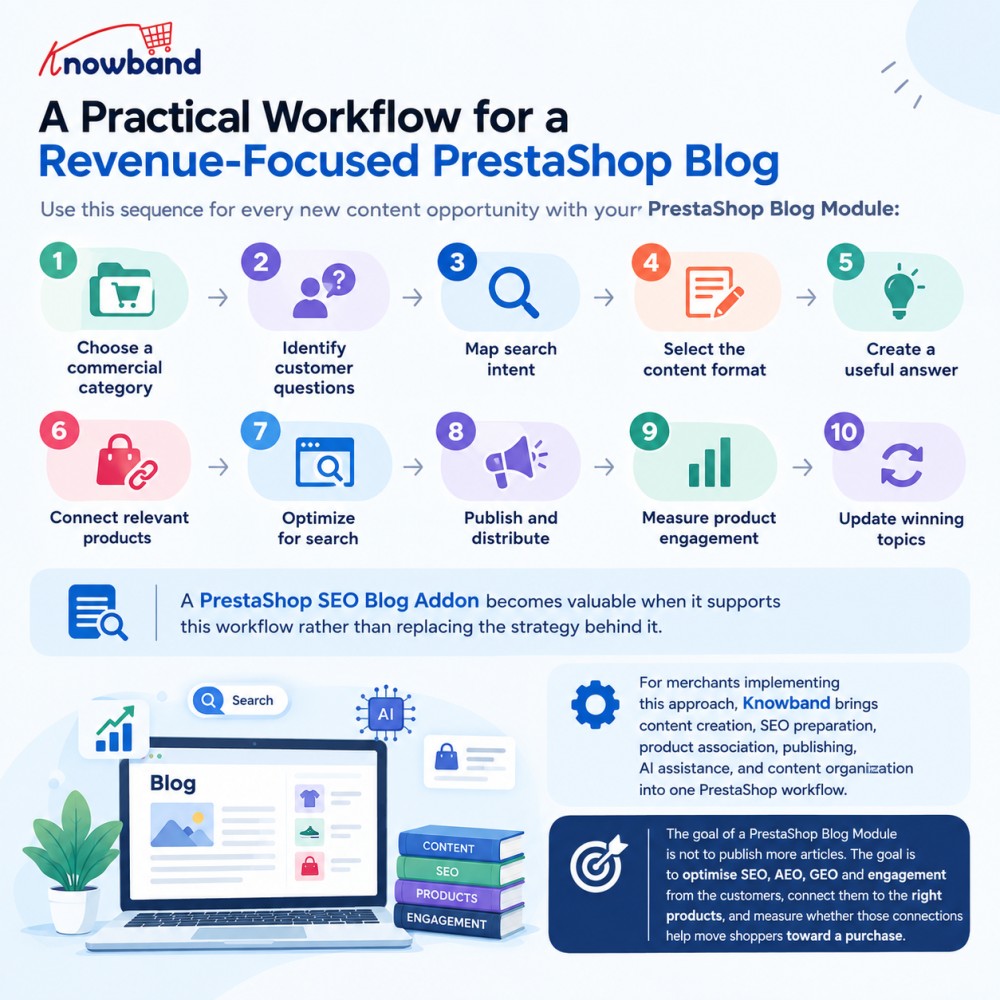
A PrestaShop SEO Blog Addon becomes valuable when it supports this workflow rather than replacing the strategy behind it.
For merchants implementing this approach, Knowband brings content creation, SEO preparation, product association, publishing, AI assistance, and content organization into one PrestaShop workflow.
Explore PrestaShop Blog Manager also available on Prestashop Addons to see how this content-to-commerce workflow can be implemented in a PrestaShop store.
Explore this tutorial to learn how to add blogs to your PrestaShop website without any coding knowledge.
- Best PrestaShop SEO Module: 10 Must-Have Features to Improve Rankings
- Three Recovery Emails Recover 37% More Carts Than One: Building the Right PrestaShop Abandoned Cart Sequence
- PrestaShop 9.2 Ask AI vs AI Admin Assistant: Which Is Better for Store Management?
- Integrating a Custom Payment Gateway in PrestaShop: Technical Requirements, API Flow, and Real-World OPC Challenges
- Knowband Launches AI-Powered PrestaShop Blog Manager to Simplify Content, SEO, and Engagement