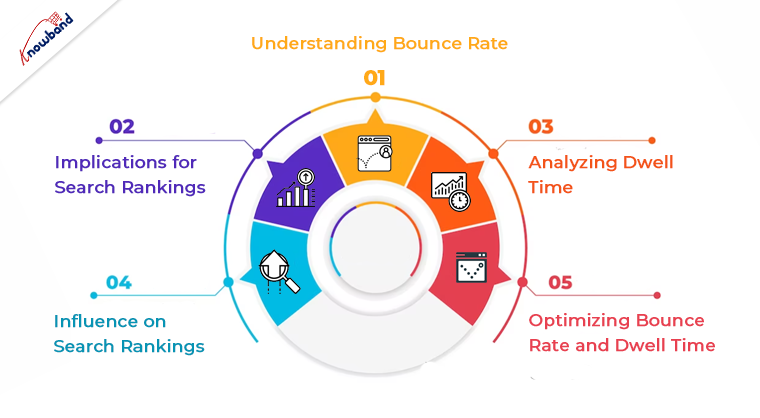
In the world of search engine optimization (SEO), understanding user behavior metrics is essential for achieving higher search rankings. Among these metrics, bounce rate and dwell time play a significant role in Google’s algorithm. This blog post explores the importance of bounce rate and dwell time, and how they influence search rankings.
Understanding Bounce Rate:
Bounce rate refers to the percentage of users who visit a webpage and leave without engaging with it or navigating to other pages on the same website. A high bounce rate indicates that users find the content or user experience unsatisfactory, while a low bounce rate suggests engagement and relevance.
Implications for Search Rankings:
Google considers a high bounce rate as a negative signal, suggesting that the webpage does not meet users’ expectations. Consequently, websites with high bounce rates may experience a drop in search rankings. Conversely, a low bounce rate indicates that users find the content valuable, potentially leading to improved rankings.
Analyzing Dwell Time:
Dwell time measures how long users spend on a webpage after clicking through from the search results. Although not a publicly acknowledged ranking factor, dwell time is believed to impact search rankings.
Influence on Search Rankings:
Longer dwell times suggest that users find the content useful and engaging. Google recognizes this as a positive user signal and may reward websites with longer dwell times with improved rankings. Conversely, shorter dwell times indicate lower user satisfaction and may result in ranking penalties
Optimizing Bounce Rate and Dwell Time:
Reducing bounce rate and increasing dwell time is crucial for improving search rankings. Consider the following strategies:
High-Quality Content:
Creating valuable, informative, and engaging content that meets users’ search intent can reduce bounce rates and increase dwell time.
Enhanced Website Usability:
Improving website loading speed, navigation, and mobile responsiveness encourages users to explore further, reducing bounce rates and increasing dwell time.
Enhanced User Experience:
Optimizing the webpage’s layout, design, and readability can increase user engagement and dwell time.
Strategic Internal Linking:
Implementing relevant internal links within the content can direct users to related pages, encouraging them to stay longer and explore further.
Conclusion:
Understanding the role of user behavior metrics such as bounce rate and dwell time is crucial for optimizing websites and improving search rankings. By focusing on reducing bounce rates and increasing dwell times, website owners can enhance user engagement and provide a better overall experience. These metrics are important signals to Google’s algorithm, indicating relevance, usefulness, and satisfaction. To succeed in SEO, invest in creating high-quality content, improving website usability, and optimizing the user experience.
In case of any doubts or queries, do not hesitate to contact support@knowband.com. Our team of experts can provide further guidance and assistance in understanding and leveraging user behavior metrics to boost your website’s performance. Stay proactive and seek expert advice to stay ahead in the ever-evolving world of SEO.
The only goal of any business is to bring new customers and increase sales with the old ones but some visitors do not make it to the endpoint and leave without buying. In eCommerce, it is called the bounce rate. You might be getting enough clicks but no conversions and many website elements can be responsible for bounce rate.
Imagine a person wants to climb a mountain and planned an 11km long trek but he can’t go because the trek dates aren’t matching his holiday dates and he canceled the plan. The same can happen when a customer visits your website and does not find the product they want to buy.
Simply quoting, if a customer visits your website with an intention but he does not complete the action is termed as bounce rate. Let me give you another example, your website sells cosmetics and the customer requires a product that is organic and chemical-free but you fail to provide such a product because of poor categorization. He will immediately leave the site and may not come back.
If you don’t want your customers to bounce back, you need to provide engaging content, strong and powerful search bar.
Why does the user bounce?
A rising bounce rate is an obvious indication that there are off-putting elements or underlying problems that you need to fix on your web. A bounce is caused by a variety of causes and circumstances.
Although there may be several explanations for the elevated e-commerce bounce rates, a list of the common ones is below:
Page didn’t meet expectations: Visitors didn’t find the data or the product in the appropriate manner that they were looking for.
Long loading time: It takes more time for the page to load.
Poor UI and content management: If the user interface of the website is bad and the content isn’t well managed.
Poor navigation and UX: The landing page’s UI is complicated and difficult to understand by the end-user.
The lack of ‘Call to Action’: For customers, poor navigation will increase the bounce rate.
How to reduce bounce rate?
Firstly, you need to optimize the reason behind the bounce rate on your website, and once you do that you can take necessary actions. Sometimes, the bounce rate can cause you so much revenue which is dangerous for your business. Here are some pro tips that can help you reduce the bounce rate on your website:
1. Do not use unwanted Pop-ups
Unless it is necessary, do not use pop-ups on the entry page. Try pushing it on the exit page or after the user completes the action. A cause of the bounce rate can be a pop-up window that annoys the visitor. If necessary, you can add a gamified element to the entry page for an email subscription or any discount offer. Spin and win
2. Translate your site for global users
A multilingual website demonstrates the potential for increased sales. Any language that you add to your website has the potential to increase your sales dramatically. In addition to targeting the local market, it would also draw Internet users from other countries by creating a multilingual website. A multilingual website can reduce the bounce rate for international traffic from 80% to 40%.
3. Improve Page Loading speed
Getting fast page load time can also improve the crawl rate of your website. The quicker it is possible to load pages, the more Google will index pages at one time. High page speed may also increase the crawl requirement of your website. Many users bounce because of high page loading time. Hence, it is pivotal to reduce page loading time.
4. Invest in UI and make it attractive and engaging
To improve the bounce rate the better UI and engaging content can be helpful. A successful design inculcates trust and makes it intuitive to navigate. People don’t spend a lot of time on places that they don’t like or find hard to navigate. Make it simple by getting a nice template to start with for your visitors. There’s a great list of pretty customizable themes available on the web for various platforms.
5. Optimize the landing page and product page
The process of optimizing elements on a website to improve conversions is Landing Page Optimization. Optimization of the landing page is a subset of optimization of conversion rate and involves using methods such as A/B testing to enhance the conversion targets of a given landing page. This will improve the bounce rate several times than any other method.
The next possible strategy to improve the bounce rate is by optimizing the product page. You can include social proofs like review and ratings, clear call to action buttons, product videos, and high-quality images to the product page.
6. Reduce checkout friction
Checkout friction is the major cause of cart abandonment and a higher bounce rate. It is important to remove frictions from your checkout page to decrease shopping cart abandonment, generate sales, newsletter subscribers, and to improve conversions. Adding multiple payment methods, shipping choices, make unnecessary fields optional, and offering social login and guest checkout can help.
You can use the One Page Checkout Module to overcome these issues. Read this to reduce the checkout page friction which can help you in reducing bounce rate.
7. Make your website mobile responsive
Mobile visitors have far less patience than desktop visitors. To provide mobile users with a better user experience, ensure that your website has a responsive design. Also, the user base of smartphone users is more than desktop users.
8. Add Personalisation Element
By presenting the data, personalization can help to enhance conversions. To support a specific product, following a centered strategy that is personalized to their behavior and liking would certainly help them in a successful transaction. The conversion and bounce rate are inversely proportional. If the conversion increases it will automatically diminish the bounce rate.
Final Words:
eCommerce Conversion: One of the easiest ways of improving your bounce rate is to boost your conversions. Someone who converts is automatic will not bounce. This guide will teach you how to use A / B testing to get more conversions on your website and other methods.
Minimize the bounce rate of a website: A very in-depth look at the bounce rate, including ways of using Google Analytics to correct a high bounce rate.
Reduce Cart abandonment: This is again a healthier way to reduce the bounce rate and these pro tips will help you reduce abandoned carts on your web store.
For, eCommerce related projects, contact our team at support@knowband.com or drop a reply here in the comment section.
First, we should know about the term “bounce rate”
In easy words we can say, bounce rate is the ratio between the number of visitors comes on our site and the number of visitors leaves our site from the landing page without navigating to another page.
When visitors or customers land on our website from any other external link for example advertisement, search result, shared link, etc but if they do not visit internal links of the site. This will increase the bounce rate as the server of Google Analytics will not be triggered due to no engagement.
So this will lower our ranking in Search Engine Results which is definitely a great loss for the growth of our website.
When the bounce rate matter
We should keep in mind that if the objective of our website is to share information then bounce does not matter for us. Let us take an example if our webpage gives any text-based information and if visitors came and read the articles and leave our sites. Here the job is done as the visitor got the information.
But the bounce rate really matters if we are looking forward to getting more and more active visitors engaged on our sites.
The major reason for the bounce rate
The website is taking more time to load.
Bad user interface and content management.
The UI of the landing page is complex which not easily understandable for every type of user.
Visitors didn’t get the information in the smart way which they looked for.
Internal links of our website are not clearly highlighted for the visitors.
Unwanted popup on the landing pages.
How to measure the bounce rate
Google provides many useful services for our website. To measure the bounce rate we can use Google Analytics which tracks and monitor the traffics coming on our websites. It calculates the total behavior on our website. So it is a great tool to measure the bounce rate of our website.
To use these tools we just need a Google account and link our website with Google Analytics. Note: If you need any help to use this tool please write the query in the comment box given at the bottom of the page.
According to Google
The bounce rate is a single-page session divided by all the sessions or the percentage of all sessions on your site in which users viewed only a single page and triggered only a single request to the Analytics server.
How To Minimize The Bounce Rate Of Our Website?
A Good Landing Page
A landing page is the first page where our visitors enter in our website by clicking on the links of search engine results. The first impression is the last impressions so landing page must have a clear and user-friendly interface.
The landing page plays an important role in the good conversions rate. A good landing page should an attractive offer and able to explain why it is valuable for money in concise terms. There should be an “About” section on the landing page and also navigation links should be clearly visible.
The landing page of Knowband is a good example of the landing page.
Reduce Page Load Time
As a user, we can know how irritating to browse the slow pages. Visitors simply press the back button if a page takes more than 5 seconds to load. Unwanted third party scripts on our website also increase the page load time. If we are showing an unoptimized image it also takes more time to load.
Tips:According to Google, a good score for page speed is 85 or above. We can know about the speed of our pages using the Google Analytics tool.
Remove Unwanted Pop-Ups
Unwanted pop-ups and ads on the pages are also responsible to increase the bounce rate.
AB Testing
AB Testing is a useful experiment where two or more designs of the same page will show randomly to the visitors. By seeing the report of the AB Testing we can analyze which design had performed better and given more conversion.
CTA: Call To Action
CTA is just like a hidden trap or baits on our landing page. Newsletter subscription, download button, internal links are some good examples of CTA. These things should be clearly visible on our pages.
Thanks for reading this blog. Hope all five mentioned tips will help you to reduce the bounce rate of your website. You can consider these points according to your business need.