
Artificial intelligence (AI) is transforming industries worldwide, and its impact on e-commerce is nothing short of revolutionary. From personalized shopping experiences to intelligent inventory management, AI is helping online businesses grow faster, work smarter, and serve customers better.
At Knowband, we’re always focused on delivering cutting-edge e-commerce solutions, and artificial intelligence plays a vital role in shaping the future of e-commerce. In this blog post, we’ll discuss 10 effective and practical applications of AI that are actively changing the face of e-commerce.
Whether you are a store owner, marketer, or developer, these innovations demonstrate how AI can increase efficiency, improve customer satisfaction, and drive sales.
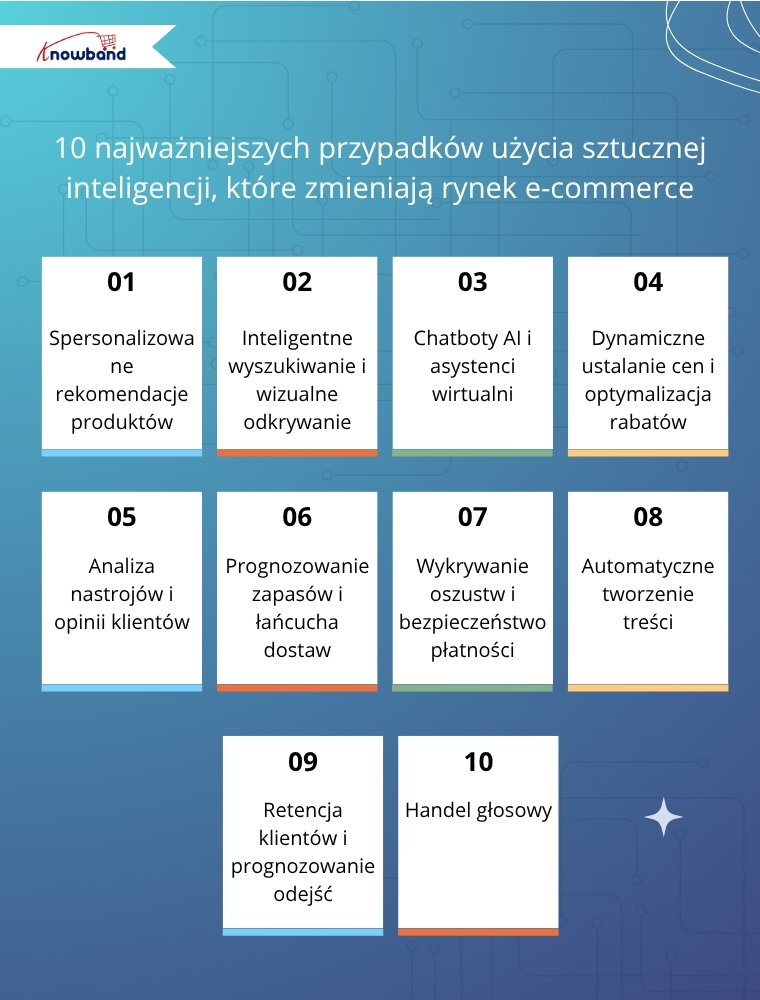
1. Personalized product recommendations
One of the most common applications of artificial intelligence in e-commerce is product recommendations. By analyzing a customer’s browsing history, previous purchases, and behavior in real time, AI systems can predict which products a customer is most likely to purchase.
Platforms like Amazon use advanced algorithms to tailor recommendations, increasing average order value and improving customer satisfaction. Furthermore, these personalized experiences are key to generating sales and building long-term customer loyalty.
2. Smart Search and Visual Discovery
Artificial intelligence is streamlining product searches, offering users a more seamless experience. Furthermore, traditional keyword-based searches are being replaced by AI-powered searches that understand natural language and intent.
Even more impressive is the search option, which allows customers to add their product to find similar photos. Clothing and furniture retailers, for example, use image recognition tools to allow customers to shop based on a photo—a feature that streamlines searches and increases conversion rates.
3. AI Chatbots and Virtual Assistants
AI-powered chatbots have become essential for e-commerce stores. They can handle product inquiries, track orders, process returns, and even provide personalized recommendations—all without human intervention.
What sets AI chatbots apart from traditional scripted bots is their ability to learn from interactions and improve over time. Furthermore, they provide immediate, 24/7 support, shorten response times, and relieve human agents of the burden of solving more complex problems.
4. Dynamic pricing and discount optimization
Artificial intelligence enables real-time pricing strategies based on demand, competitor prices, inventory levels, and customer behavior. Furthermore, machine learning algorithms enable e-commerce companies to automatically adjust prices to remain competitive and maximize profits.
Moreover, such dynamic pricing is already being used by large retailers to increase sales, especially during promotions, peak seasons or flash sales.
5. Analysis of customer sentiment and opinions
Gaining insight into customer perceptions of products or brands is crucial. Artificial intelligence uses natural language processing to analyze reviews, social media conversations, and opinions, helping to determine overall sentiment.
However, this analysis helps companies identify strengths and weaknesses, improve products and adapt marketing strategies.
6. Inventory and Supply Chain Forecasting
Artificial intelligence plays a key role in optimizing inventory management and streamlining logistics operations. By analyzing sales history, seasonal fluctuations, and current market trends, predictive analytics allows for precise estimation of future product demand. This helps avoid overstocking or out-of-stocks, lowering warehousing costs, and improving delivery efficiency.
Some platforms use AI to automatically order products or optimize warehouse layouts, ensuring a smoother supply chain.
7. Fraud detection and payment security
Online fraud is a growing problem, but artificial intelligence is helping to combat it effectively. AI models detect suspicious behavior, such as unusual login locations, fast transactions, and inconsistent payment details.
By learning from patterns, these systems become more effective over time at identifying fraudulent activity and reducing chargebacks. This not only protects customers but also helps maintain trust in the platform.
8. Automatic content creation
Creating product descriptions and marketing content for a large catalog can be time-consuming and tedious. Thanks to advances in artificial intelligence, tools like ChatGPT, Gemini, Claude, and DeepSeek now help generate SEO-friendly product descriptions, meta tags, email campaigns, and even blog posts. This significantly reduces workload, ensures consistency, and allows content teams to focus on strategy and creativity rather than repetitive tasks.
Knowband offers an advanced AI-powered content generation and translation plugin for major e-commerce platforms including PrestaShop, OpenCart, WooCommerce, and Magento 2.
Moreover, Knowband PrestaShop AI Content Generator and Translator Module allows store owners to easily generate product descriptions, meta titles, meta descriptions and translate content into all available store languages – increasing global reach and efficiency.
We also offer customization services to tailor AI content generation capabilities to your e-commerce needs.


Integrate your Prestashop store with powerful AI engines like ChatGPT, Claude, Gemini, and DeepSeek
No coding skills required
9. Customer retention and churn prediction
AI can analyze user behavior to predict which customers are most likely to drop off or abandon a brand. By identifying at-risk customers, companies can send them timely offers, reminders, or personalized incentives to re-engage them.
A proactive approach increases customer retention and improves customer lifetime value (LTV).
10. Voice Commerce
With the rise of voice assistants like Alexa, Google Assistant, and Siri, voice commerce is becoming a popular shopping channel. Customers can now use voice commands to search for products, add them to their carts, and complete purchases.
Thanks to artificial intelligence, assistants can understand users’ intentions, recommend appropriate products, and conduct transactions, making shopping more convenient and accessible.
Final remarks
Artificial intelligence isn’t just improving e-commerce; it’s also transforming the way the industry operates. From smarter customer experiences to back-office efficiency, AI-powered technologies are helping businesses stay competitive in the rapidly evolving digital marketplace.
Whether you run a small online store or manage a large retail chain, incorporating AI tools into your e-commerce strategy can translate into significant improvements in customer satisfaction, sales, and operational efficiency.
Are you looking for AI-based solutions that will increase the efficiency of your eCommerce store?
Our team offers tailored AI integrations, custom modules, and seamless migration between platforms like PrestaShop, Shopify, Opencart, Magento 2, and WooCommerce. Transform your store into a smarter, more efficient, and future-proof business.
[osadź]https://www.youtube.com/embed/ZKbstBUAj0A[/osadź]

